On this page
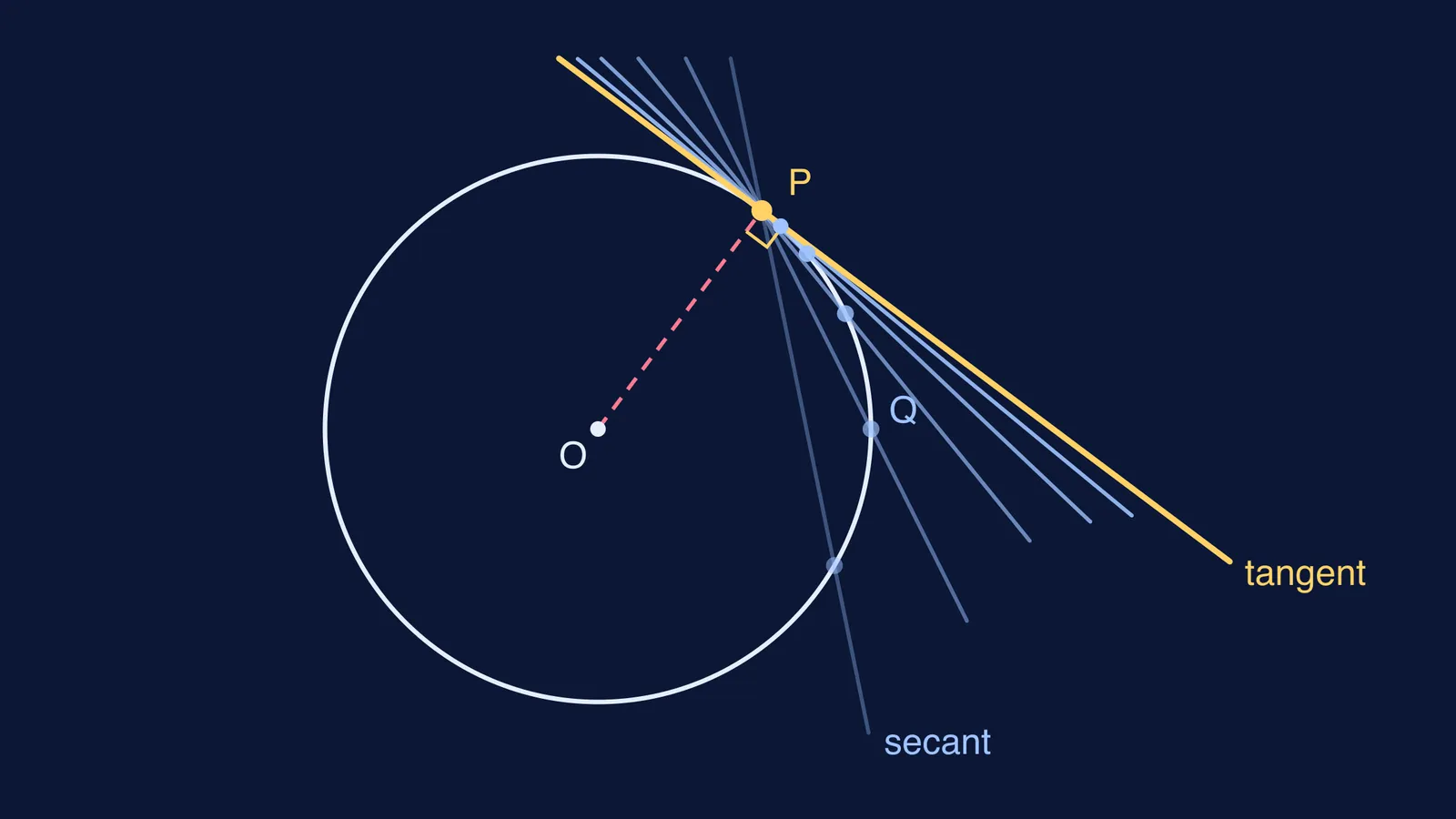
Lay a ruler across a circle. Usually its edge crosses the circle twice; tilt it and at one position it only grazes the circle. The grazing line is the tangent, the crossing lines are secants, and the step from one to the other is the idea calculus is built on.
What is the difference between a tangent and a secant of a circle?
A secant is a line that meets a circle at exactly two points, and the segment between those two points is a chord (Wikipedia, Secant line). The word comes from the Latin secare, "to cut", which is an easy way to remember it: a secant cuts through the circle.
A tangent is a line that touches a circle at exactly one point and never enters the circle's interior (Wikipedia, Tangent lines to circles). That point is the point of contact.
The tangent has a property no secant has: it is perpendicular to the radius drawn to the point of contact. Euclid proved this as Proposition 18 of Book III of the Elements (Euclid III.18, David Joyce's edition).
Secant: two common points, cuts off a chord.
Tangent: one common point, perpendicular to the radius there.
From a point outside the circle you can draw two tangents, from a point on the circle exactly one, and from a point inside none (Wikipedia, Tangent lines to circles).
How many points can a line share with a circle?
Only three answers are possible: none, one or two (Wikipedia, Secant line), because substituting a line into a circle's equation gives a quadratic. The quickest test compares the radius r with the perpendicular distance d from the centre to the line:
If d < r, the line is a secant and meets the circle twice.
If d = r, the line is a tangent and meets it once.
If d > r, the line misses the circle.
The tangent case follows from Euclid: the radius to the point of contact is the perpendicular from the centre, so d = r. To practise the d = r test, work through the condition for a line to be tangent to a circle. For a secant, the length of the chord cut off by a line comes out as 2√(r² − d²).
How does a secant turn into a tangent?
Take the circle x² + y² = 25 (centre O at the origin, radius 5) and the point P(3, 4) on it. Pick any other point Q(x, y) on the circle and draw the secant PQ. Its slope is (y − 4)/(x − 3).
Now use the circle's equation. Because x² + y² = 25 and 3² + 4² = 25, subtracting gives (x − 3)(x + 3) + (y − 4)(y + 4) = 0. So the slope of PQ is also −(x + 3)/(y + 4).
Slide Q towards P:
Q = (5, 0): slope −2
Q = (4, 3): slope −1
Q with x = 3.5: slope about −0.859
Q with x = 3.1: slope about −0.770
Q with x = 3.01: slope about −0.752
Q with x = 3.001: slope about −0.7502
The rewritten slope has no zero in its denominator at P, so you can now put x = 3 and y = 4 straight in: −6/8 = −3/4. That limit is the slope of the tangent at P, and the tangent is y − 4 = −(3/4)(x − 3), or 3x + 4y = 25.
Two checks: radius OP has slope 4/3, and (4/3) × (−3/4) = −1, so the tangent is perpendicular to it; and the distance from O to the line is 25/5 = 5 = r.
Why does the secant-to-tangent idea matter beyond circles?
The same move works on other curves: as the two points of a secant on a curve move together, the secant approaches a tangent line (MathWorld, Secant Line). OpenStax's Calculus Volume 1 writes the slope of the secant through (a, f(a)) and (x, f(x)) as (f(x) − f(a))/(x − a); as x nears a, these secants approach the tangent (OpenStax, A preview of calculus). The limit of that secant slope is the derivative; our interactive post on the derivative as the slope of a tangent lets you zoom in and see it happen.
A quick check before you write "tangent"
Have you shown exactly one common point (zero discriminant, or d = r)?
Is your line perpendicular to the radius at that point?
If you took a limit, did you remove the 0/0 before substituting?
If a step keeps tripping you up, the Fermi Problem Library has worked problems with a step-by-step solver that explains the reasoning rather than printing an answer. If the gap is in the idea itself, circles or limits, the Fermi Concept Library gives every mathematics concept its own lesson and its place in the map.
Try it yourself: repeat the example with P(4, 3); you should get 4x + 3y = 25.