On this page
Parabola tangent questions keep coming back to one line: y = mx + a/m. Once you know where it comes from, you can find a tangent of any slope, its point of contact and the tangents from an outside point.
What is the slope form of a tangent to y² = 4ax?
A parabola is the set of points that are the same distance from a fixed point (the focus) and a fixed line (the directrix), as Wolfram MathWorld's entry on the parabola defines it. For y² = 4ax the focus is (a, 0) and the directrix is x = −a.
Substitute a line of slope m, y = mx + c, into y² = 4ax:
(mx + c)² = 4ax
m²x² + (2mc − 4a)x + c² = 0
A tangent meets the curve at exactly one point, so this quadratic must have a repeated root. Set the discriminant to zero: (2mc − 4a)² − 4m²c² = 0, which simplifies to 16a² − 16amc = 0, so c = a/m.
The slope form of the tangent to y² = 4ax is y = mx + a/m, valid for every slope m ≠ 0.
Where does the tangent touch the parabola?
The repeated root of the quadratic is x = (4a − 2mc)/(2m²). Put c = a/m and this becomes x = a/m². Then y = m(a/m²) + a/m = 2a/m.
The tangent y = mx + a/m touches y² = 4ax at the point (a/m², 2a/m).
Check it: (2a/m)² = 4a²/m² = 4a(a/m²). It is also the parametric point (at², 2at) with t = 1/m.
How do you find the tangents from an external point?
Say the point is P(h, k). You want the tangents y = mx + a/m that pass through P:
Substitute P into the slope form: k = mh + a/m.
Multiply by m to get a quadratic in m: hm² − km + a = 0.
Solve it. Each root is the slope of one tangent through P.
For each slope, write the tangent y = mx + a/m and the contact point (a/m², 2a/m), then check both by substitution.
The discriminant of step 2, k² − 4ah, tells you what to expect:
k² − 4ah > 0: P is outside the parabola and there are two tangents.
k² − 4ah = 0: P is on the parabola and there is one tangent.
k² − 4ah < 0: P is inside, on the side of the focus, and no tangent passes through it.
One edge case: if h = 0, the m² term vanishes and one of the tangents is the vertical line x = 0, which the slope form cannot give.
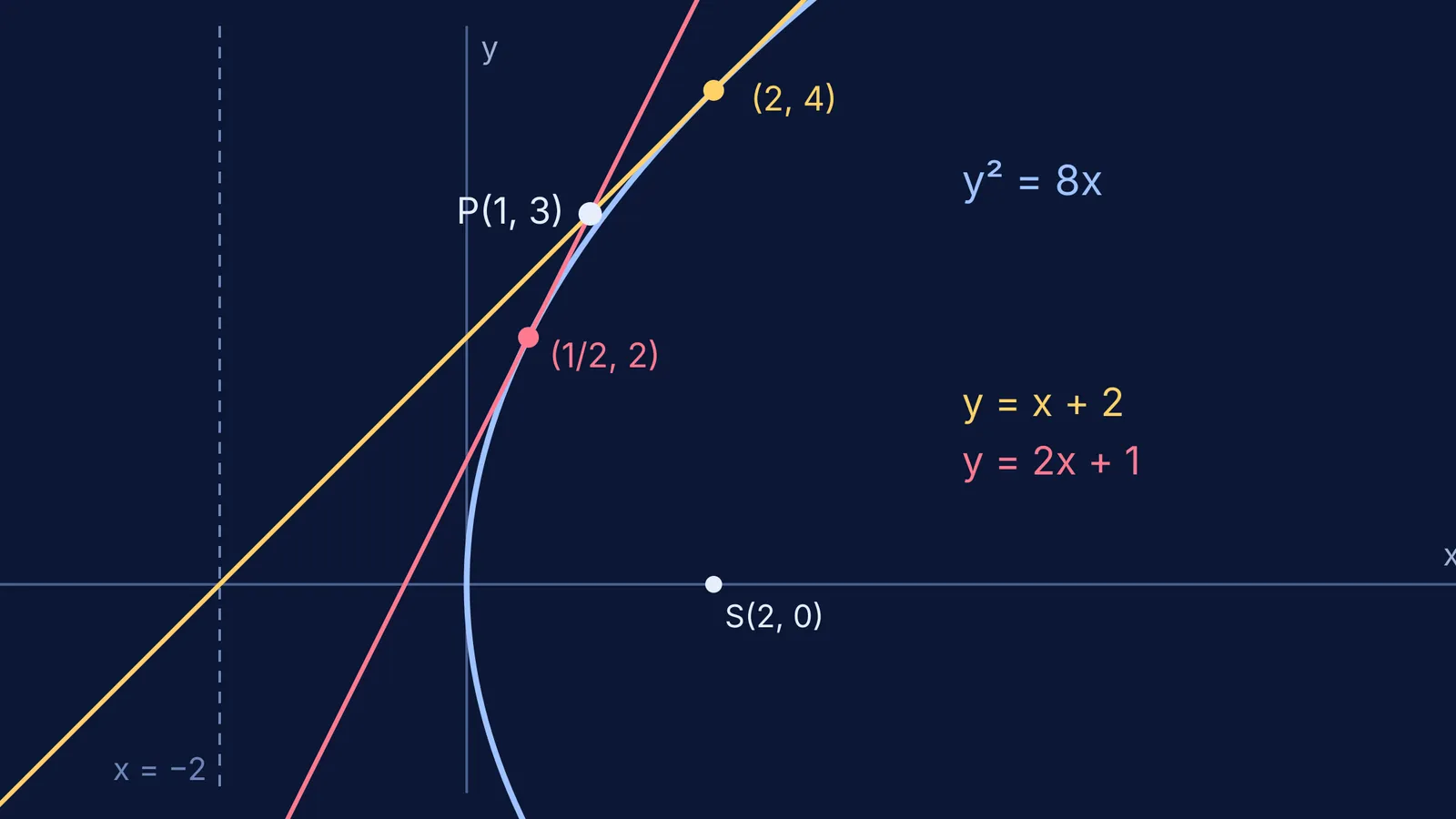
Worked example: y² = 8x and the point P(1, 3). Here a = 2. Since k² = 9 > 4ah = 8, P is outside: expect two tangents.
Substitute: 3 = m(1) + 2/m.
Multiply by m: m² − 3m + 2 = 0.
Factorise: (m − 1)(m − 2) = 0, so m = 1 or m = 2.
For m = 1 the tangent is y = x + 2, touching at (2/1, 4/1) = (2, 4). For m = 2 the tangent is y = 2x + 1, touching at (2/4, 4/2) = (1/2, 2).
Check: both lines pass through P (1 + 2 = 3 and 2 + 1 = 3), both contact points lie on the curve (16 = 8 × 2 and 4 = 8 × 1/2), and the slopes add to k/h = 3 and multiply to a/h = 2. The diagram above plots this exact example.
Why do perpendicular tangents meet on the directrix?
The quadratic hm² − km + a = 0 gives the product of the two slopes as a/h. If the tangents from P are perpendicular, that product is −1, so a/h = −1 and h = −a. Whatever k is, P sits on x = −a, the directrix: a two-line proof instead of a fact to memorise.
Which mistakes cost marks on parabola tangents?
Run this checklist before you move on:
Wrong parabola. For x² = 4ay the same method gives y = mx − am², not a/m.
Sign of a. For y² = −4ax, the tangent is y = mx − a/m.
Shifted vertex. For (y − k)² = 4a(x − h), use y − k = m(x − h) + a/m.
The inside case. If k² < 4ah, no real tangent exists; that is the answer, not an arithmetic slip.
No substitution check. Plugging the contact point back into the curve catches most errors.
If a step still feels like a leap, the Fermi Problem Library has worked problems with a step-by-step solver that explains the reasoning rather than printing an answer. If the gap is in discriminants or the parabola itself, the Fermi Concept Library gives each concept in mathematics its own lesson.
Try the method now on y² = 12x and the point (−3, 2), and check that the two slopes multiply to −1.