On this page
You meet both set-ups in your first organic chemistry practicals, and on paper they look almost the same: a round-bottomed flask, a heat source, a water-cooled condenser. The difference comes down to one question. Does the condensed vapour go back into the flask, or out of it?
What is the difference between reflux and distillation?
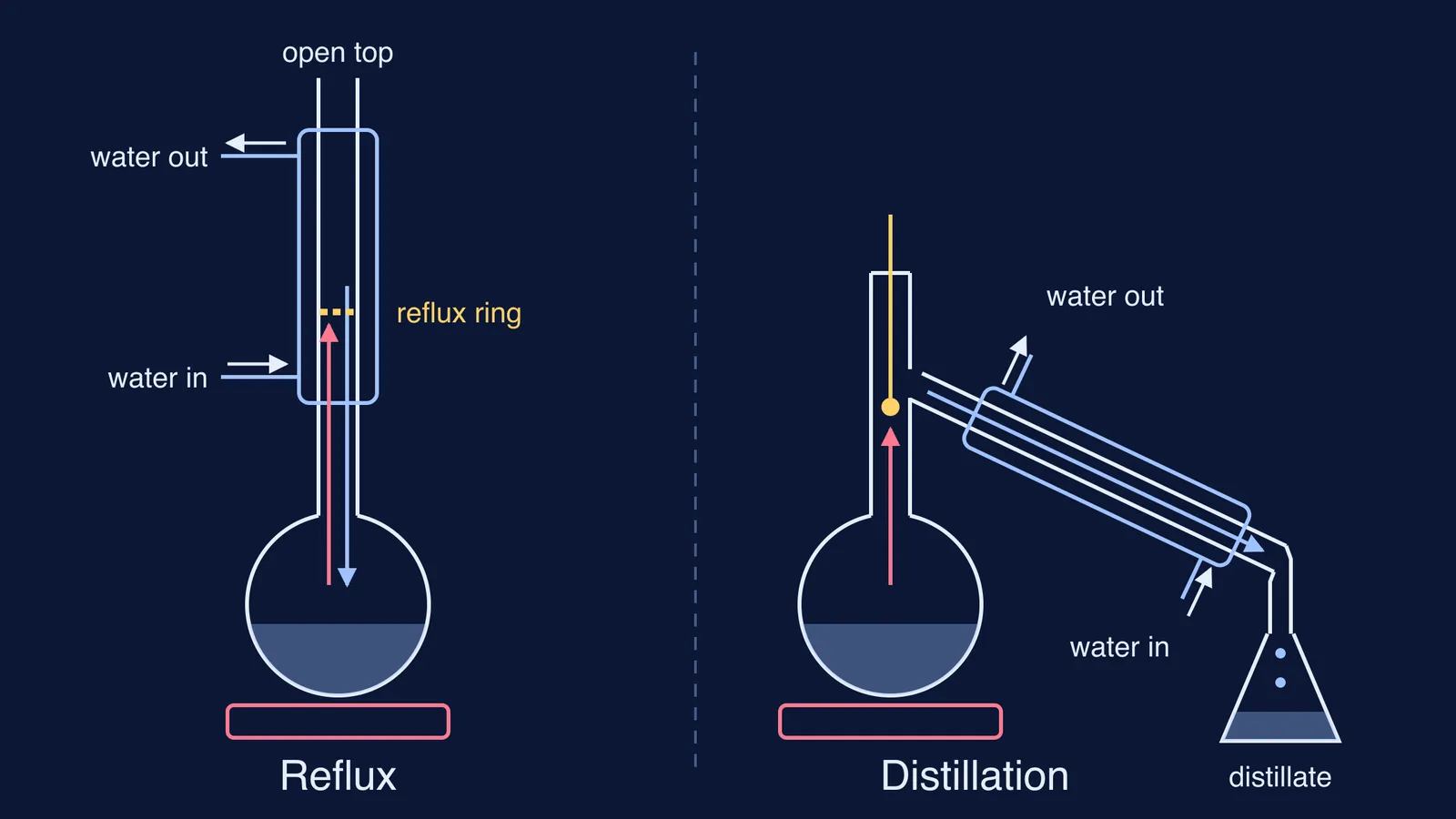
A reflux setup lets a liquid boil and condense, with the condensed liquid returning to the original flask, according to the reflux chapter of Lisa Nichols' Organic Chemistry Lab Techniques/01:_General_Techniques/1.04:_Heating_and_Cooling_Methods/1.4K:_Reflux). The same textbook calls reflux analogous to distillation, with the main difference being the vertical placement of the condenser.
In a simple distillation, the condenser slopes down and away from the flask, so the condensed liquid (the distillate) drips into a separate receiving flask at a recommended rate of about 1 drop per second (Nichols, simple distillation procedure/05:_Distillation/5.02:_Simple_Distillation/5.2C:_Step-by-Step_Procedures)).
So the short version is:
Reflux: condenser vertical, vapour comes back, nothing leaves the flask. Purpose: heat a reaction.
Distillation: condenser sloping, vapour moves on, liquid collects elsewhere. Purpose: separate or purify.
Why do chemists heat a reaction under reflux?
Many organic reactions are slow. Chemguide's page on ester hydrolysis notes that the reaction with pure water is so slow it is never used; instead the ester is heated under reflux with dilute acid or alkali.
In an open vessel the solvent would boil away; under reflux the condenser returns it, so no solvent is lost and the liquid stays at the boiling point of the solvent during active reflux (Nichols, reflux/01:_General_Techniques/1.04:_Heating_and_Cooling_Methods/1.4K:_Reflux)). That gives you a steady, known temperature for as long as the reaction needs. The University of Alberta organic lab tutorial puts it plainly: reflux allows a mixture to be heated constantly without monitoring and without loss of material.
Three set-up rules worth memorising:
Heat until a reflux ring of condensing vapour sits roughly one-third of the way up the condenser (Nichols, reflux/01:_General_Techniques/1.04:_Heating_and_Cooling_Methods/1.4K:_Reflux)).
Fill the flask no more than half full (same source).
Never stopper the top of the condenser. The Alberta tutorial warns that heating a closed system could create a potential bomb.
In both set-ups, cooling water enters the condenser at the bottom and leaves at the top; our explainer on why condenser water enters from the bottom shows why.
When should you use distillation instead?
Use distillation when you want to take something out of the flask: a liquid away from a dissolved solid, one liquid away from another, or a product away from the reaction mixture. Nichols gives a rule of thumb: simple distillation works when the components differ in boiling point by more than 100 °C, and with a smaller gap it fails to purify the mixture completely, so fractional distillation is used (Nichols, overview of distillation/05:_Distillation/5.01:_Overview_of_Distillation)).
The thermometer bulb sits just below the side arm so it is fully immersed in the vapour, the flask should be one-third to one-half full, and you should never distil to dryness, because side reactions can occur as components become concentrated (Nichols, step-by-step procedures/05:_Distillation/5.02:_Simple_Distillation/5.2C:_Step-by-Step_Procedures)). If the thermometer position confuses you, read where to place the thermometer bulb in distillation. Boiling stones or a stir bar stop bumping in both set-ups; why boiling chips are added before heating explains how they work.
Worked example: one experiment that uses both
Ester hydrolysis needs reflux and distillation, in that order, as described on Chemguide:
Heat the ester under reflux with dilute sodium hydroxide solution; the condenser stops the mixture boiling away while it reacts.
Distil off the alcohol that forms.
To get the carboxylic acid rather than its sodium salt, add an excess of a strong acid such as dilute hydrochloric acid to what is left, then distil off the carboxylic acid.
Step 1 makes the products (reflux); steps 2 and 3 take them out (distillation).
How do you answer reflux vs distillation questions in a viva?
Use this four-point checklist when asked which technique is involved:
Purpose: react (reflux) or separate and purify (distillation)?
Condenser: vertical above the flask, or sloping towards a receiver?
Condensate: back to the same flask, or into a new one?
Safety point: reflux stays open at the top; distillation never runs to dryness.
A good answer names the purpose first, then the condenser, then one safety point. For example: "We refluxed to keep the mixture at the solvent's boiling point for a long time without losing solvent. The condenser is vertical and open at the top, so the vapour condenses and runs back into the flask."
If terms such as boiling point, vapour pressure or condensation still feel shaky, the Fermi Concept Library has a lesson for every concept in chemistry, each with its place in the map. For practice, the Fermi Problem Library has worked problems with a step-by-step solver that explains the reasoning rather than printing an answer.
Next time you set up the glassware, follow the drops before you switch on the heat.