

On this page
In a chemistry practical, an examiner may point at a condenser's two hoses and ask which one goes to the tap. The answer is the lower arm, for two reasons, one bigger than the other.
Why does condenser water enter from the bottom?
A Liebig condenser is a glass tube inside a wider glass jacket. Vapour from the flask runs down the inner tube, and cooling water flows through the jacket around it. Lisa Nichols' lab manual on LibreTexts/05%3A_Distillation/5.02%3A_Simple_Distillation/5.2C%3A_Step-by-Step_Procedures) says the tap hose goes to the lower arm, forcing water to travel against gravity, and that by forcing the water uphill it will completely fill the condenser.
The water has to rise to the top arm before it can leave, so every centimetre of the inner tube ends up wrapped in water. The University of Alberta's organic lab tutorial puts it the same way: water entering from the bottom keeps the condenser completely filled with cold water, which gives maximum cooling and maximum recovery of your purified liquid.
What happens if you connect the water at the top?
Water fed into the top arm just runs down to the lower arm and out. It never has to fill the jacket. A Meredith College procedure on LibreTexts shows this in a diagram: water flowing in at the upper part leaves an air bubble, and the jacket is not full. Nichols' manual calls the result inefficient cooling of the gas travelling through the inner tube.
Air carries heat away far worse than water, so the stretch of tube next to the air pocket cools much less. Vapour can slip through uncondensed, and you collect less liquid.
Why does the coldest water meet the vapour on its way out?
With water going up and vapour coming down, the two streams flow in opposite directions. Engineers call this counter flow; when both fluids move the same way it is parallel flow, as set out in this heat exchanger chapter by Beyenir and Boskovic/01:_Sim_Labs/1.05:_Heat_Exchangers). In counter flow, fresh cold water arrives at the bottom end, where the last of the vapour and the newly condensed liquid are about to leave. That end gets the biggest temperature difference, so leftover vapour gets its strongest cooling just before the exit. Labster's condenser notes add that the hottest vapour never meets the coldest water, which avoids thermal shock to the glass.
One caveat. While a vapour is condensing, it stays at its boiling point. The Engineering Toolbox notes that when one fluid changes phase, its temperature can be taken as constant and its temperature profile does not depend on the direction of flow. So the full jacket is the bigger reason. Counter flow mainly decides where the coldest water sits.
Condensing vapour gives up a lot of heat, which is why the jacket needs steady water flow; see why latent heat of vaporisation is larger than fusion. Your kidneys also rely on fluids flowing in opposite directions, as in Werner Kuhn's countercurrent multiplier.
A worked example: distilling ethanol
Ethanol boils at 78.24 °C, according to PubChem; round it to 78 °C. Suppose the tap water comes in at 25 °C and leaves at 35 °C (sample numbers for practice).
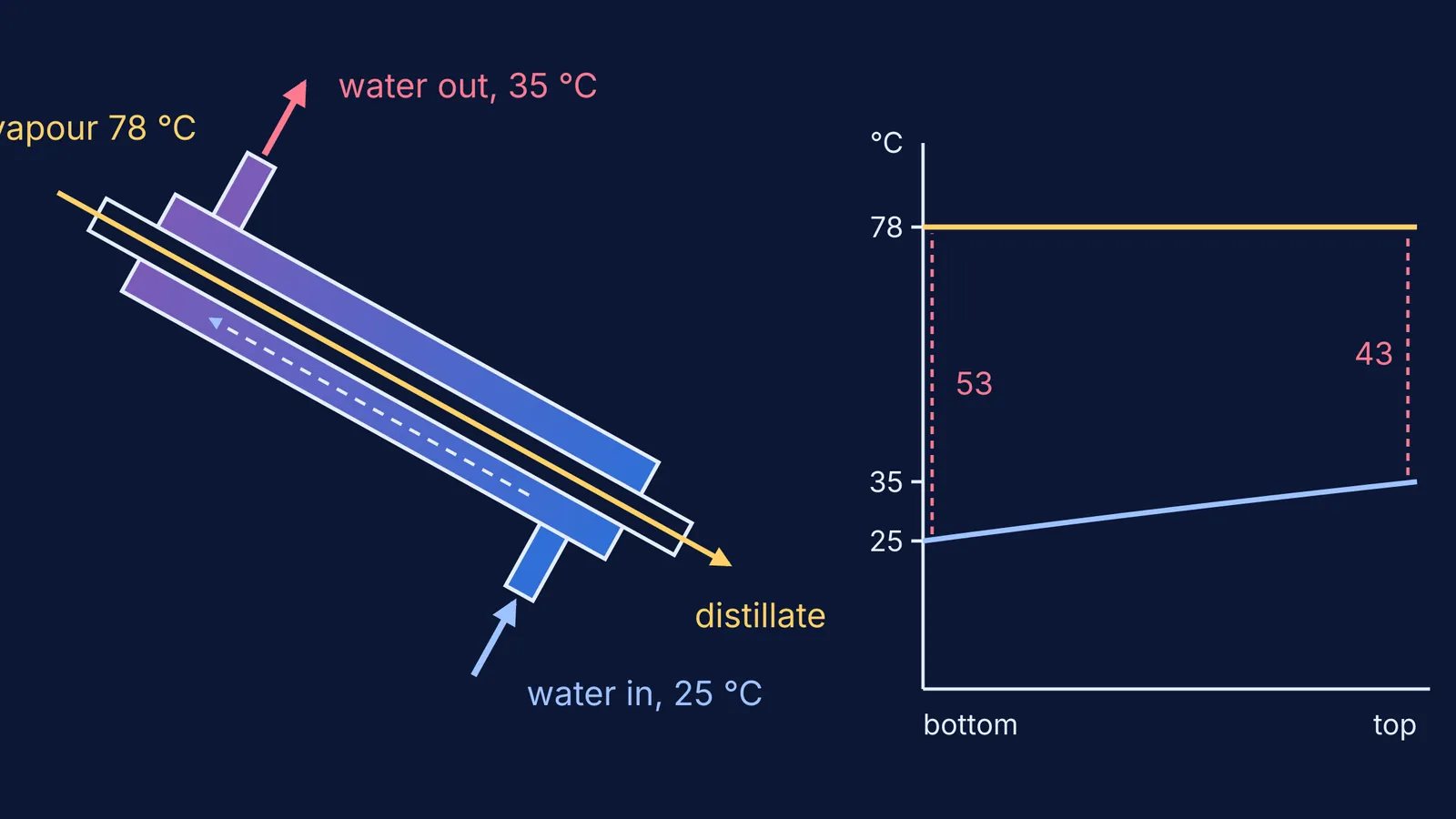
Water in at the bottom: where the vapour enters at the top, the gap is 78 − 35 = 43 °C. At the exit end it is 78 − 25 = 53 °C.
Water in at the top, with the jacket somehow full: the gaps swap, 53 °C at the top and 43 °C at the exit.
The log mean temperature difference, LMTD = (ΔT₁ − ΔT₂) / ln(ΔT₁/ΔT₂), from the Beyenir and Boskovic chapter/01:_Sim_Labs/1.05:_Heat_Exchangers), gives (53 − 43) / ln(53/43) = 10 / 0.209, about 47.8 °C, in both cases. Same average. What changes is where the 53 °C gap sits: at the exit, where it catches stray vapour and sends the distillate out cooler. A real top-fed jacket also has its air pocket, so it does worse still. Questions like this are good practice in the Fermi Problem Library, where a step-by-step solver explains the reasoning rather than printing an answer.
What should you check before you switch on the heat?
Lower arm to the tap, upper arm to the sink.
Push each hose more than one centimetre onto its arm, or water pressure may pop it off (Nichols, LibreTexts/05%3A_Distillation/5.02%3A_Simple_Distillation/5.2C%3A_Step-by-Step_Procedures)).
Open the tap to more than a trickle, but not so hard that the hose flops around.
Look at the jacket: it should be full of water, with no air bubble trapped in it.
Tape the drain hose in the sink if it barely reaches.
The same set-up turns up in the principle of steam distillation. If heat flow and temperature difference still feel shaky, the Fermi Concept Library gives every concept in physics and chemistry its own lesson and its place in the map.


