

On this page
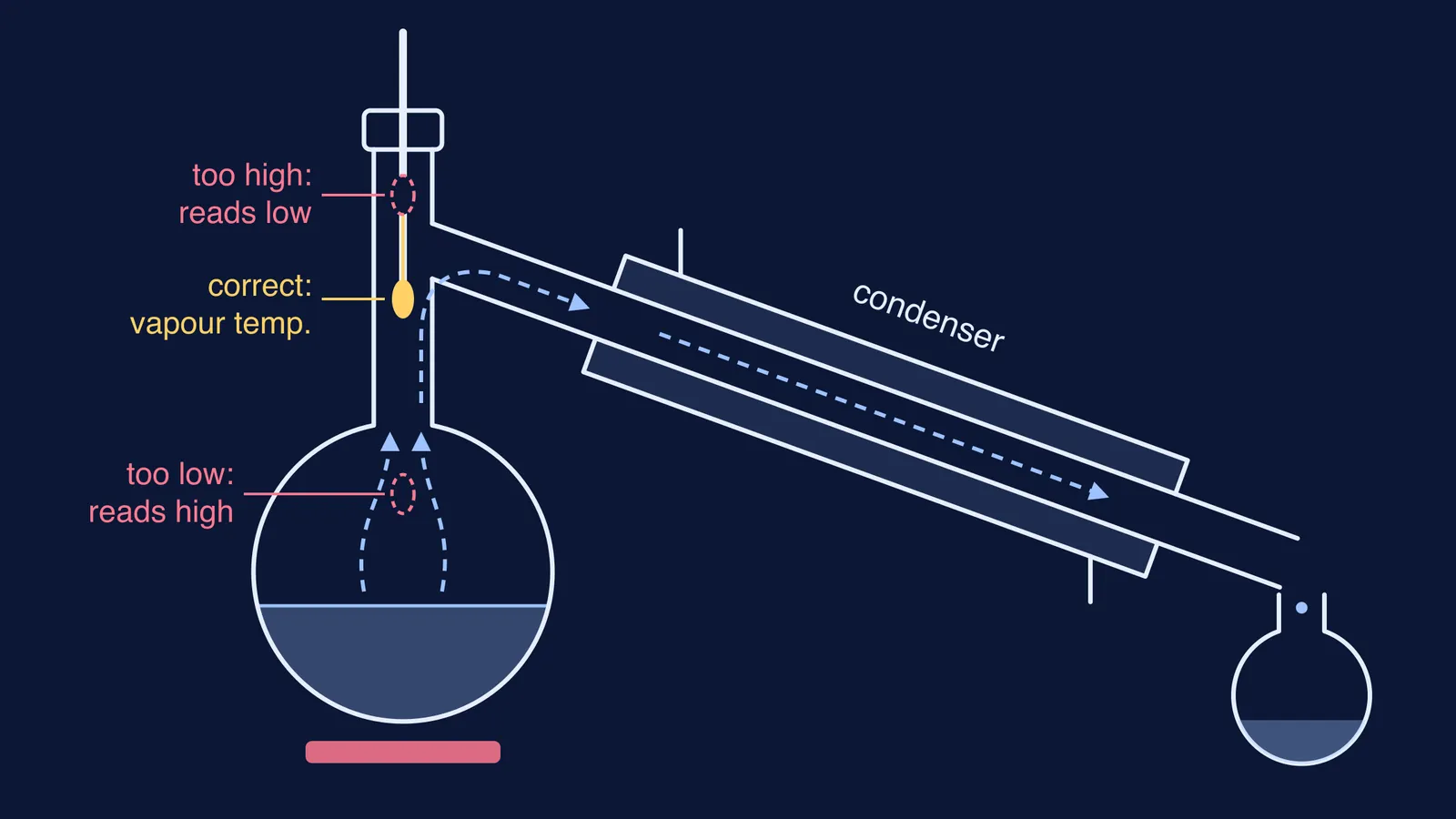
In a distillation diagram the thermometer does not dip into the flask. It hangs in the still head, with its bulb at the bottom of the side arm that leads to the condenser. Once you know what it is measuring, a question that moves the bulb is an easy mark.
Where exactly does the thermometer bulb go in distillation?
The lab-techniques textbook by Lisa Nichols of Butte College, hosted on LibreTexts, gives the rule in one line: position the thermometer bulb just below the arm of the three-way adapter, where vapours turn toward the condenser/07:_Technique_Summaries/7.21:_Simple_Distillation). The "three-way adapter" is the still head: the glass piece on top of the flask with one opening for the thermometer and one side arm to the condenser.
Picture the side arm as a doorway: the bulb sits just under its bottom edge, inside the stream of vapour about to leave the flask. The same textbook's step-by-step procedure/05%3A_Distillation/5.02%3A_Simple_Distillation/5.2C%3A_Step-by-Step_Procedures) adds that the bulb must be fully immersed in vapour to register an accurate temperature.
Why measure the vapour and not the boiling liquid?
The point of the reading is to know what is distilling over. The University of Colorado Boulder's organic chemistry lab pages explain that the vapours above a boiling liquid are in equilibrium with it, so they are at the same temperature as the boiling liquid.
The same CU Boulder page notes that a thermometer in the boiling mixture would likely read higher than the vapour, because the liquid can be superheated or contaminated with other substances. The vapour at the side arm is what will condense into your receiver, so its temperature tells you which substance you are collecting.
What happens if the bulb is too high or too low?
CU Boulder's page on thermometer placement gives both errors:
Too high (above the side arm): the bulb is out of the path of the vapour, so it reads lower than the true temperature.
Too low (down near the flask): the bulb is too close to the boiling liquid, so it reads higher than the true vapour temperature.
Just below the side arm: the bulb is bathed in the vapour that is turning toward the condenser, so it reads the boiling point of the distilling liquid.
A useful way to remember it: high reads low, low reads high, and only the doorway reads right.
Worked example: what the thermometer shows during a real distillation
Suppose you distil a mixture of acetone and water with the bulb in the right place. PubChem lists the boiling point of acetone as about 56 °C and of water as about 100 °C at normal atmospheric pressure. The Nichols procedure/05%3A_Distillation/5.02%3A_Simple_Distillation/5.2C%3A_Step-by-Step_Procedures) describes what you should then see, in an idealised run:
The liquid may start boiling while the thermometer still shows room temperature, because the bulb is some distance above the liquid.
A ring of condensing vapour climbs the neck and reaches the bulb. Now the reading starts to rise.
The reading levels off near acetone's boiling point while acetone distils. Record the temperature once it has plateaued; the procedure suggests a collection rate of about 1 drop per second.
When most of the acetone has gone, the reading drops noticeably. That drop is your signal to change the receiver.
If you keep heating, the reading climbs again toward water's boiling point as the next component distils.
Now move the bulb down into the flask in your head. It would read above the vapour temperature, and you could no longer trust the plateau and the drop to tell you when acetone stops coming over.
Real mixtures do not always split this cleanly; our explainer on minimum and maximum boiling azeotropes shows why. For a related set-up, see the principle of steam distillation.
A quick set-up check before you switch on the heat
Use this in a practical exam or when you are asked to spot mistakes in a diagram:
Is the bulb level with, or just below, the bottom of the side arm? Not in the liquid, not above the arm.
Is the flask only one-third to one-half full, as the Nichols procedure/05%3A_Distillation/5.02%3A_Simple_Distillation/5.2C%3A_Step-by-Step_Procedures) advises?
Are there boiling stones or a stir bar in the flask?
Will you stop before the flask is dry? The summary/07:_Technique_Summaries/7.21:_Simple_Distillation) is blunt: never distil to dryness.
Reading the scale is a separate skill; see our guide to reading a measuring cylinder and thermometer correctly.
If the link between vapour pressure, boiling and equilibrium feels shaky, the Fermi Concept Library gives each chemistry concept its own lesson. For practice questions, the Fermi Problem Library has worked problems with a step-by-step solver that explains the reasoning rather than printing an answer.


