On this page
If a war or a failed harvest wiped out a crop's seeds, where would farmers find them again? In seed banks: the most famous sits inside a frozen Norwegian mountain, and India has its own in Ladakh.
What is the Svalbard Global Seed Vault?
The Svalbard Global Seed Vault is a backup store for crop seeds, owned by Norway and carved horizontally into Plateau Mountain on Svalbard (NordGen Seed Vault FAQ). It opened in 2008, and the seed vault itself is more than 100 metres inside the mountain (Crop Trust). The vault can store 4.5 million seed samples, and as of 2026 it holds more than 1.4 million samples from 134 institutions (Crop Trust).
Samples are kept at −18 °C, the same conditions as the depositing gene banks' own collections (NordGen). Permafrost and thick rock would keep the seeds frozen even without power (Crop Trust).
It is a spare copy, not a shop. Under its "black box" system, depositors keep ownership of their seed boxes, and only the depositor can withdraw one (Crop Trust). The crop research centre ICARDA made the first-ever withdrawal in 2015 (same source).
Why are seeds dried and frozen?
A seed is a living plant waiting to grow, and like anything alive it ages. Water wakes it up, which is why a seed swells once it soaks up water (how imbibition makes seeds swell). A seed bank keeps seeds dry and cold so they stay asleep.
Seeds that survive drying are called "orthodox", and most are preserved better dried and cold; seeds that cannot survive drying, called "recalcitrant", are hard to store (Nadarajan and colleagues, Plants, 2023).
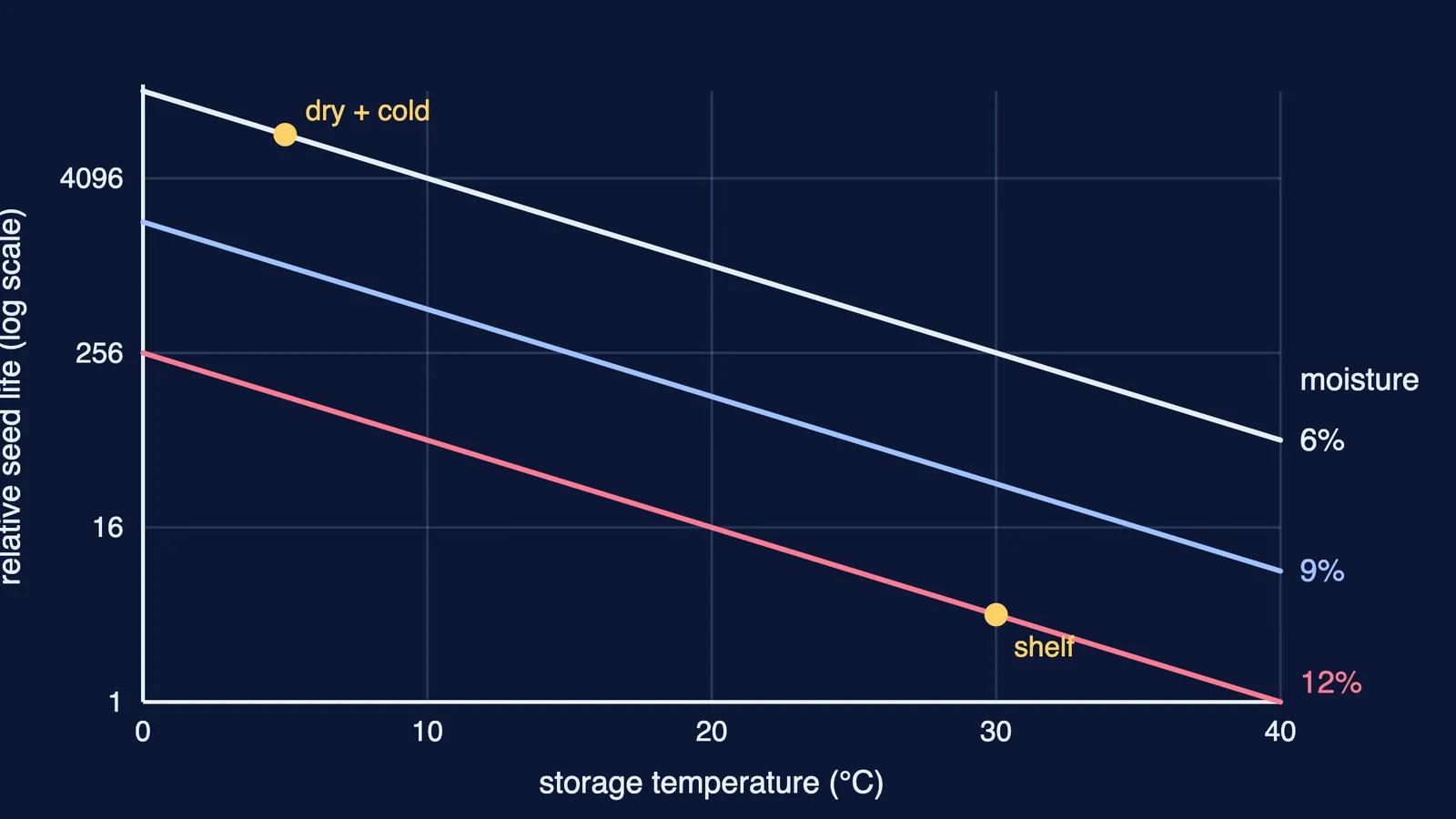
A classic guide is Harrington's "Thumb Rules": seed life span halves for each 5 °C rise in storage temperature and for each 1% rise in seed moisture, and the two effects are independent and add up (Nadarajan and colleagues, 2023). Harrington also warned that the temperature rule does not apply below 0 °C or above 50 °C (same source).
A worked example: the seed packet on your shelf. Say a seed packet sits on a shelf at 30 °C with 12% moisture.
Dry the seeds from 12% to 6% moisture: six 1% steps, so life doubles six times, 2 × 2 × 2 × 2 × 2 × 2 = 64 times longer.
Cool them from 30 °C to 5 °C, as in a fridge: five 5 °C steps, so 32 times longer.
The effects add, so the multipliers multiply: 64 × 32 = 2,048 times the shelf life.
Treat this as a rough guide: real seed lots vary by species and starting quality. The diagram at the top plots the same rules.
If powers of two and log scales feel slippery, the Fermi Concept Library covers every concept in physics, chemistry, biology, mathematics and computing.
How long do frozen seeds last?
It depends on the species. NordGen says well-dried, vacuum-packed seeds of the most long-lived species stored at −18 °C can stay viable for centuries (NordGen).
Nature has run longer experiments. An ancient date palm seed from Masada, radiocarbon-dated to the first century CE, germinated and grew into a normal seedling; the researchers suggest the Dead Sea climate may have helped it last (Sallon and colleagues, Science, 2008).
In Siberia, researchers regenerated whole fertile plants of Silene stenophylla from fruit tissue 31,800 ± 300 years old, buried 38 metres deep in never-thawed permafrost at −7 °C (Yashina and colleagues, PNAS, 2012). They used tissue culture, not sowing, so this shows how well frozen plant tissue survives, not that frozen seeds sprout after 30,000 years. Permafrost preserves animal remains too, as the hunt for woolly mammoth DNA shows.
No one can wait centuries to check, so gene banks run regular germination tests and work out when to send fresh seed to Svalbard (NordGen). India's National Genebank counts 27,724 regenerated accessions in its base collection (ICAR-NBPGR genebank status).
What is India's seed vault at Chang La?
India's answer is the National Permafrost Repository at Chang-La in Leh, Ladakh, set up by DRDO (ICAR). In 2011 ICAR signed an agreement with DRDO to conserve plant genetic resources there, including "safety duplicates" of unique accessions, at −4 to −20 °C with 10–20% moisture (ICAR). At the time, ICAR said that apart from India, only Norway had a permafrost storage facility (same source).
Chang La is the backup. The main collection is the National Genebank of ICAR-NBPGR in New Delhi, whose base collection, kept at −18 °C, held 476,895 accessions as on 31 October 2026 (ICAR-NBPGR).
Why keep copies at all? Plant variety keeps shrinking for the reasons biologists call the evil quartet of biodiversity loss, and a variety lost from every store is lost for good.
Try it yourself: a one-week seed test
Gene banks check stored seed with a germination test. Try a small one:
Put 20 moong seeds from an old packet and 20 from a fresh one on damp tissue in two labelled boxes.
Keep the tissue damp; after a week, count the sprouts.
Germination percentage = sprouted seeds ÷ 20 × 100.
If the old packet scores lower, you have measured seed ageing. If multi-step calculations like the worked example trip you up, the Fermi Problem Library has worked problems with a step-by-step solver that explains the reasoning.
Next time a seed packet says "store in a cool, dry place", you will know the arithmetic behind it.