

On this page
Soak a handful of dry chana overnight and by morning they are fat, heavy and often split out of their skins. Nothing alive has to pump that water in. The swelling is called imbibition, and it is the same thing that makes a wooden door stick in the monsoon and, in the old stories, cracks rock.
What is imbibition in seeds?
Imbibition is the absorption of a liquid by a solid colloid, which increases in volume as it takes the liquid up (Imbibition, Wikipedia). The swelling solid is called the imbibant. In a seed, the imbibants are the starch grains, the stored proteins and the cellulose of the cell walls.
The same source lists two conditions: the solid must attract the liquid, and there must be a water potential gradient between the dry solid and the water. A dry seed has both. Its large molecules are hydrophilic and packed with surface, so water molecules stick to those surfaces, slide between the chains and push them apart.
Our explainer on how osmosis and diffusion differ sets out the membrane side.
Why do seeds swell when soaked in water?
Water uptake by a dry seed happens in three phases: a rapid rise in water during imbibition, a lag phase with little uptake, then a second rise as the root pushes out (Plant Propagation, University of Florida, Kentucky and Texas A&M). Phase I is the swelling you see in the bowl of chana; a swollen seed has not necessarily germinated. Our guide to seed dormancy and germination covers what happens after the swelling.
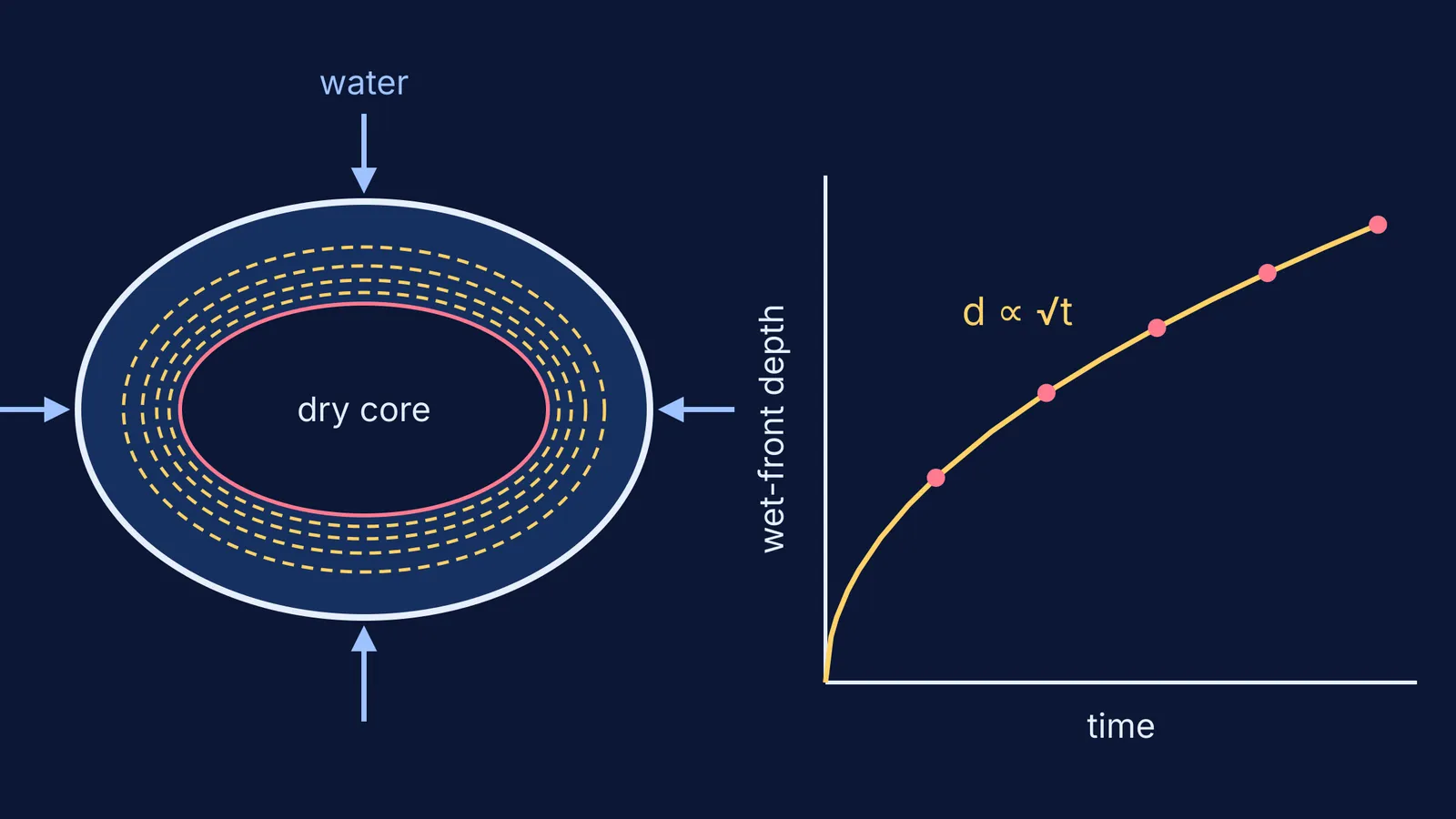
A 2018 study in Physical Review E used tomographic imaging to follow water into soy seeds and found that it spreads inward more and more slowly, with the early wet front following the Lucas-Washburn law, where distance grows with the square root of time (Louf et al., Physical Review E, 2018). Artificial seeds behaved the same way in that study, and the authors concluded that capillary effects contribute to water uptake in soy seeds. To go twice as deep, the front needs four times as long, so water moves in fast at first and then slows.
How can swelling wood crack a rock?
King's College London's project on Roman stoneworking describes wooden wedges that are soaked with water so that they split the stone as they expand (Art of Making in Antiquity, King's College London). Wikipedia's imbibition entry says early Egyptians used soaked dry wood the same way to cleave stone blocks (Imbibition, Wikipedia).
The physics is the seed story with nowhere to go. A dry wedge is driven tight into a crack. When its cell walls take up water, they try to swell, but the rock walls hold them in. All that blocked swelling turns into pressure on the rock, called imbibition pressure, and a crack that is already under stress can open further.
Why does a wooden door get stuck in the monsoon?
Wood is hygroscopic: it takes up moisture from the air when it is humid and gives it back when it is dry (Swedish Wood). The water binds in the cell walls, and the wood changes size as long as its moisture stays below the fibre saturation point, which averages about 30% (NRC Canada, Building Digest 244). The same digest notes that wood shrinks and swells about twice as much along the growth rings as across them, and only 0.1 to 0.2% in total along the grain.
Here is a worked example you can check. Swedish Wood gives an average movement of about 0.26% across the grain (radially and tangentially) for pine and spruce for every percentage point change in moisture content.
Take a pine board 200 mm wide across the grain.
Suppose a dry winter leaves it at 10% moisture and a humid monsoon month raises it to 16% (example figures). That is a change of 6 points.
Swelling = 200 mm x 6 x 0.0026 = about 3.1 mm.
If the gap between the door and the frame was 2 to 3 mm, the door now rubs or jams.
The door barely grows in height, because wood hardly moves along the grain.
How do you write an imbibition answer in an exam?
Cover these five points:
The imbibant, named as a hydrophilic colloid (starch, protein, cellulose).
The two conditions: affinity for water and a water potential gradient.
The result: more volume and imbibition pressure.
One example: swelling seeds, a stuck door or split rock.
The difference from osmosis: no membrane needed.
To see the curve at home, weigh 20 dry chana, soak them, and weigh them again (patted dry) every hour for six hours. Plot mass against time and look for a steep rise that flattens. Then compare it with our potato osmosis experiment.
If water potential or colloids are the gap, the Fermi Concept Library has a lesson on every concept in physics, chemistry, biology, mathematics and computing. Start with water potential, then come back to the door sum.


