On this page
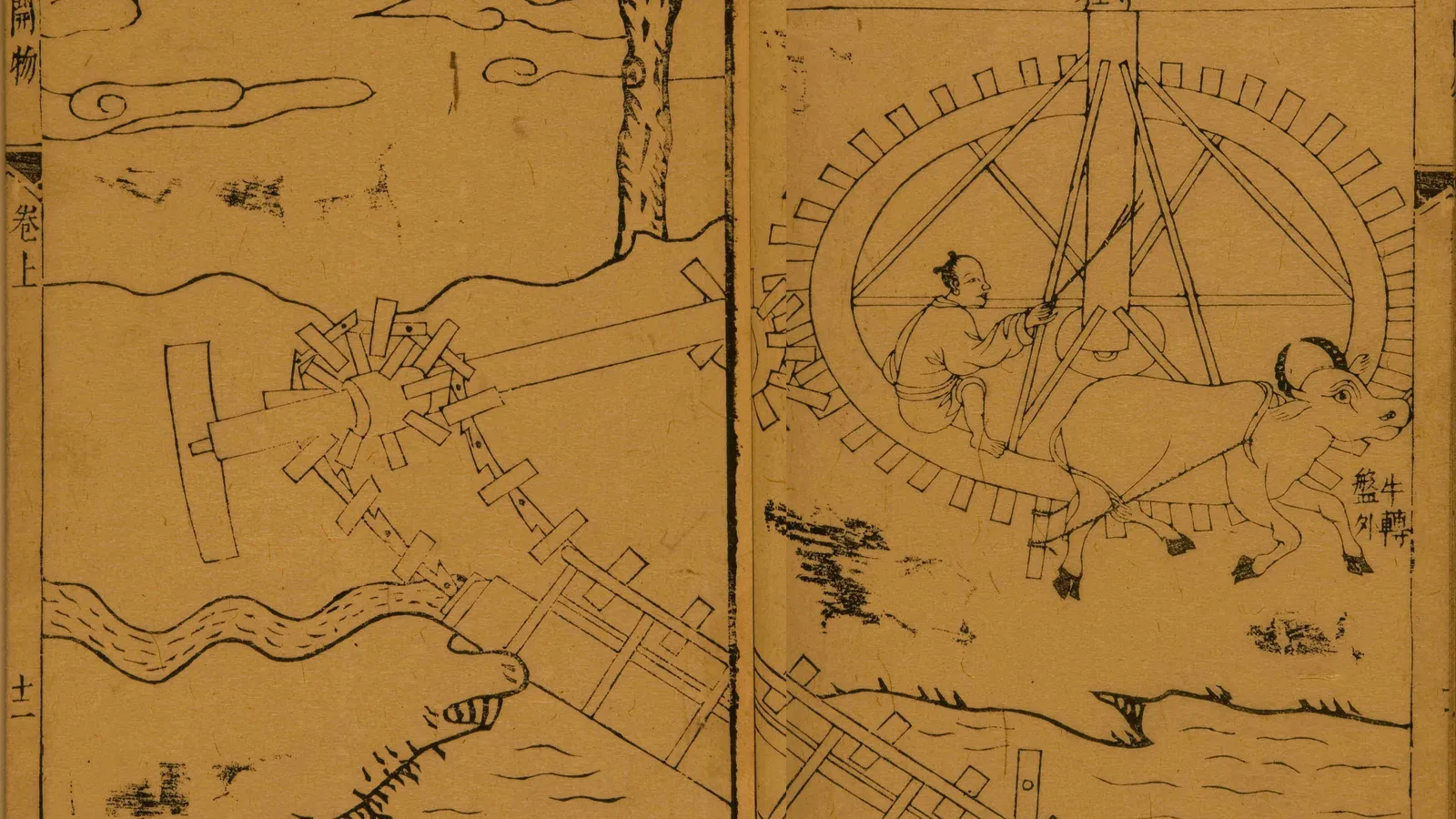
In 1637 Song Yingxing, a minor local official in southern China, published a book about crafts and trades rather than classics. The University of Chicago Press summary of historian Dagmar Schäfer's study of Song says the Tiangong kaiwu documents “the extraction and processing of raw materials and the manufacture of goods essential to everyday life, from yeast and wine to paper and ink to boats, carts, and firearms.”
What is the Tiangong Kaiwu?
The Tiangong Kaiwu, usually translated as The Exploitation of the Works of Nature, is an illustrated encyclopedia of Chinese technology in three volumes and eighteen chapters, according to the University of Sydney Library. Song passed the provincial examination in 1615, failed the higher metropolitan examination five times, the last in 1631, and then held minor posts (Wikipedia: Song Yingxing).
His preface (Project Gutenberg, original Chinese) is frank. He puts grain first and gold and jade last on purpose. He says he was too poor to buy rare works to check against, so he wrote down what he had seen and heard, and that the book has nothing to do with passing exams or winning office.
The book became scarce in China under the Qing dynasty, but copies survived in Japan, and an English translation by E-tu Zen Sun and Shiou-chuan Sun appeared in 1966 (Wikipedia: Tiangong Kaiwu).
How did Song Yingxing describe salt making?
The salt chapter in the Project Gutenberg text opens by sorting salt into six kinds: from the sea, lakes, wells, earth, cliffs and sand or rock. Song says sea brine supplied eight parts in ten of China's salt.
On high coastal ground, salt farmers spread an inch of straw ash before a dry day; overnight, dew drew salt up into it. If midday was clear, they swept up ash and salt together, washed the brine out and boiled it down in wide iron pans. Rain for ten days on end, Song notes, meant a “salt famine”. It is the idea in our piece on how salt is made from sea water in salt pans: drive off water until sodium chloride crystallises.
Far from the sea, in Sichuan, workers drilled brine wells only a few inches across, taking a month to half a year per well. In western Sichuan, sealed bamboo pipes ran from “fire wells” to the pans, and the brine boiled with no flame in sight; Song calls it a great wonder.
How was paper made in the Tiangong Kaiwu?
The papermaking chapter (Project Gutenberg) sets out bamboo paper in steps:
Soak young bamboo in a pond for more than 100 days, then beat off the green skin.
Coat the fibre with lime and boil it for eight days and eight nights.
Pour hot wood-ash lye through it for more than ten days, until it rots soft.
Pound it to a paste and stir it into a vat of water.
Dip a fine bamboo screen: a light shake makes thin paper, a heavy shake thick.
Press the stack like a wine press and dry the sheets on a heated brick wall.
For where the craft began, read about Cai Lun and the making of paper in Han China.
What does the 1637 book say about casting metal?
The casting chapter (Project Gutenberg) lists the metal for the court bell of his time: 47,000 jin of copper, 4,000 jin of tin, 50 liang of gold and 120 liang of silver, for a bell weighing 20,000 jin. The largest bells were cast by the lost-wax method: a core of rammed lime and earth was coated inches thick with beef tallow and beeswax in the ratio 8 to 2, carved, covered in a paste of fine earth and charcoal, then heated so the tallow and wax ran out. Song's rule: every jin of tallow-and-wax space takes ten jin of copper.
Is Song's ten-to-one casting rule right?
The metal fills exactly the space the tallow and wax left, so the volumes are equal and the mass ratio equals the density ratio.
Copper's density is 8.96 g/cm³ (Royal Society of Chemistry).
Beeswax's relative density at 15 °C is 0.958 to 0.970 g/cm³ (FAO).
Taking beeswax for the whole mix: 8.96 ÷ 0.96 ≈ 9.3.
So a jin of wax space holds about 9.3 jin of copper, and Song's ten is close. This is a rough check: the mix was mostly tallow, and bell metal is not pure copper. Treat ten as a working rule, not a law; Song does not explain the number.
If ρ = m/V still feels like a formula rather than a picture, the Fermi Concept Library gives every concept in physics and chemistry its own lesson, so you can revisit density first.
How can you read an old technology book like a scientist?
Name the inputs and outputs: bamboo to paper, brine to salt.
For each step, ask what change happens: evaporation, crystallisation, softening in alkali, melting.
Test one number against data you trust, as we did with the wax rule.
Note what the author admits not knowing. Song says he could not tell what Korean white paper was made from.
For another Ming scholar who wrote practical knowledge into Chinese, read how Xu Guangqi translated Euclid's Elements into Chinese.