

On this page
You probably write on paper every day without asking what it is or where it came from. The usual answer in textbooks is a name and a date: Cai Lun, 105 CE. That answer is partly right. This post looks at what the original Chinese record says, what archaeologists have found since, the simple science of how paper forms, and what the story teaches about inventions in general.
What does the Han history say about Cai Lun?
Cai Lun's biography is in the Book of the Later Han (Hou Hanshu), chapter 78, among the lives of palace eunuchs. You can read the original Chinese text on Wikisource. Translated into plain English, it says:
Cai Lun, courtesy name Jingzhong, came from Guiyang. He entered palace service at the end of the Yongping era and rose to be a senior attendant to the emperor.
He was later made director of the imperial workshops. In 97 CE he supervised the making of swords and instruments, and the text says they were so well made that they became a model for later generations.
Since ancient times, writing had mostly been done on bamboo strips bound together, and the sheets made of silk were called zhi, the word now used for paper. Silk was costly and bamboo was heavy, and neither was convenient.
Cai Lun had the idea of using tree bark, hemp ends, old rags and fishing nets to make paper. In 105 CE he presented it to the emperor, who praised his skill. From then on it was used everywhere, and people called it "Marquis Cai's paper".
The same chapter records that he was made a marquis in 114 CE, and that years later, when a new emperor ordered him to face the judges over an old court intrigue, he took poison.
Was Cai Lun the first person to make paper?
No. The Britannica article on paper states that the oldest known fragment of paper is a map found in 1986 in a tomb at Fangmatan, Gansu Province, dated to the second century BCE, more than two centuries before Cai Lun. It also says that the first records detailing a formal papermaking process appeared in China around 105 CE.
The entry on Cai Lun in Springer's Contextual Dictionary of Chinese Cultural Knowledge fits this picture: it says he reviewed people's existing experience of papermaking and developed a more advanced technology. In other words, he took a craft that existed, made it cheaper and more reliable with waste materials, and got it adopted.
How does paper actually form?
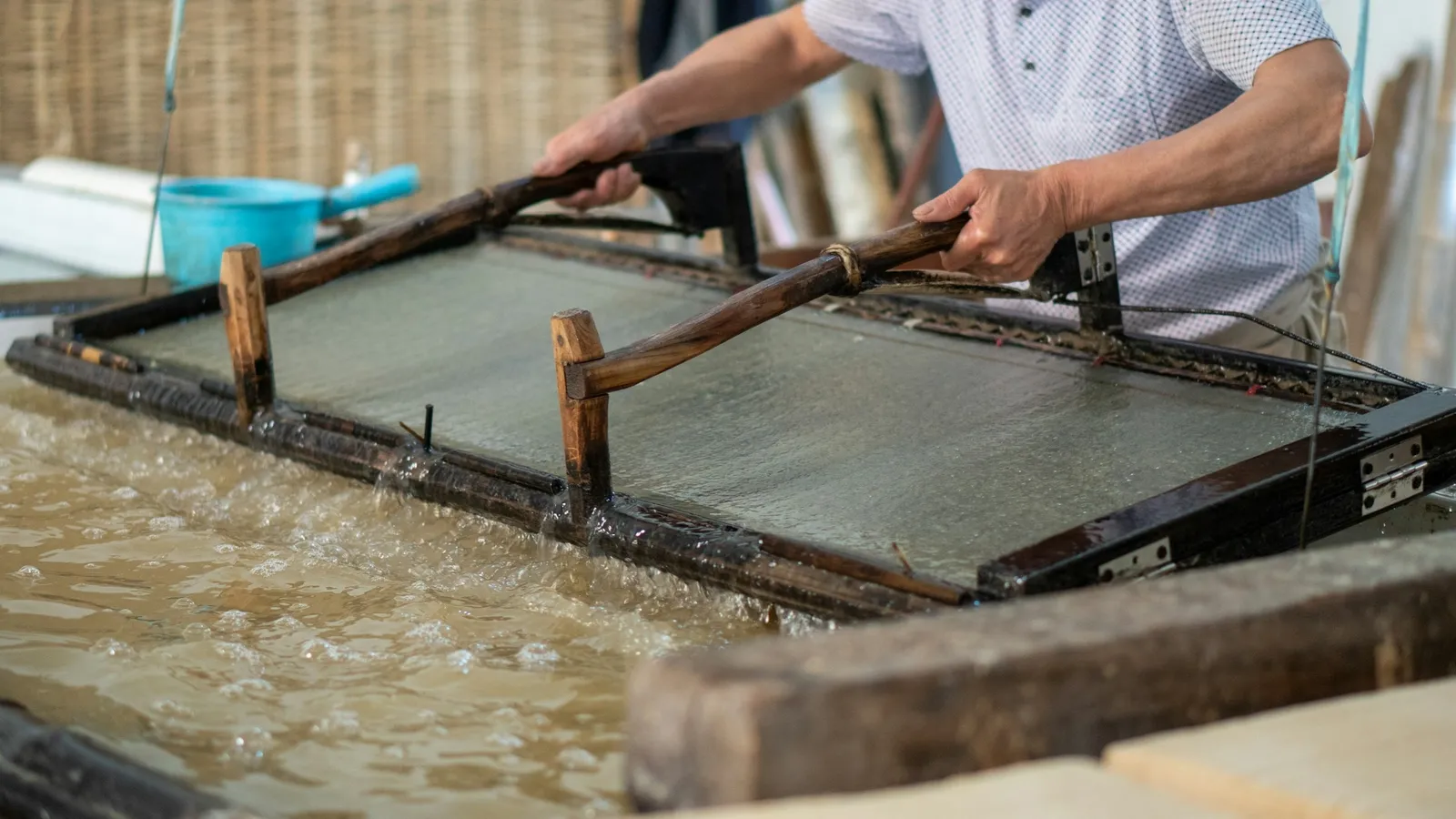
Britannica's papermaking article describes paper as a matted sheet of fibres, usually cellulose, formed from a water suspension on a screen. The basic steps have not changed since ancient times:
Beat the fibres in water until they separate and soak.
Filter the mixture on a woven screen so a mat of fibres forms.
Press the wet sheet to squeeze out most of the water.
Dry it so the rest of the water evaporates.
Britannica describes Cai Lun's sheet as made from mulberry and other bast fibres with fishnets, old rags and hemp waste. Every item on that list is a source of long plant fibres, and rags and old nets were cheap because they were already worn out. That is the chemistry-and-materials insight: what matters is the fibre, not what the object used to be.
What mistakes do people make about this story?
Treating 105 CE as the first paper. It is the date of the recorded presentation to the emperor, not the first sheet ever made.
Confusing paper with papyrus. Britannica explains that papyrus is made from strips of a plant stem laid crosswise and pressed, without breaking the fibres apart. True paper starts by separating fibres in water.
Forgetting the waste materials. The key detail in the Han record is the use of rags and nets, which made paper cheap.
How did paper spread?
Britannica's papermaking article traces the route west: papermaking reached Samarkand in Central Asia in 751 and Baghdad in 793, and by the 14th century there were paper mills across Europe. Centuries later Samarkand was home to an observatory where Jamshid al-Kashi calculated pi. The printing press of the 1450s then made demand for paper soar.
What can a student take from Cai Lun?
He was an administrator who solved a practical problem: writing materials were either too expensive or too heavy. He looked at what was cheap and plentiful and asked what it was made of. That habit of asking what a thing is made of, and whether a cheaper source exists, applies in chemistry labs and engineering projects today. If you want to learn the chemistry of materials like cellulose step by step, the Fermi Concept Library covers every concept in chemistry and biology, each with its own lesson and its place in the map.
Try it at home with an adult: tear scrap paper into a bowl of water, mash it into pulp, spread it on a fine mesh, press out the water with a cloth and let it dry. You will have repeated all four steps.


