On this page
India is going to Venus. The Union Cabinet approved the Venus Orbiter Mission (VOM) on 18 September 2024, and ISRO plans to launch it in March 2028 at a cost of about ₹1,236 crore, according to ISRO's official mission note. It is unofficially known as Shukrayaan, as Wikipedia's mission page notes.
What is ISRO's Venus mission?
The Venus Orbiter Mission is a spacecraft that will circle Venus and study it from above; it will not land. The plan, from ISRO's mission note, runs in four steps:
An LVM-3 rocket places the spacecraft in an elliptical parking orbit around Earth of 170 km × 36,000 km.
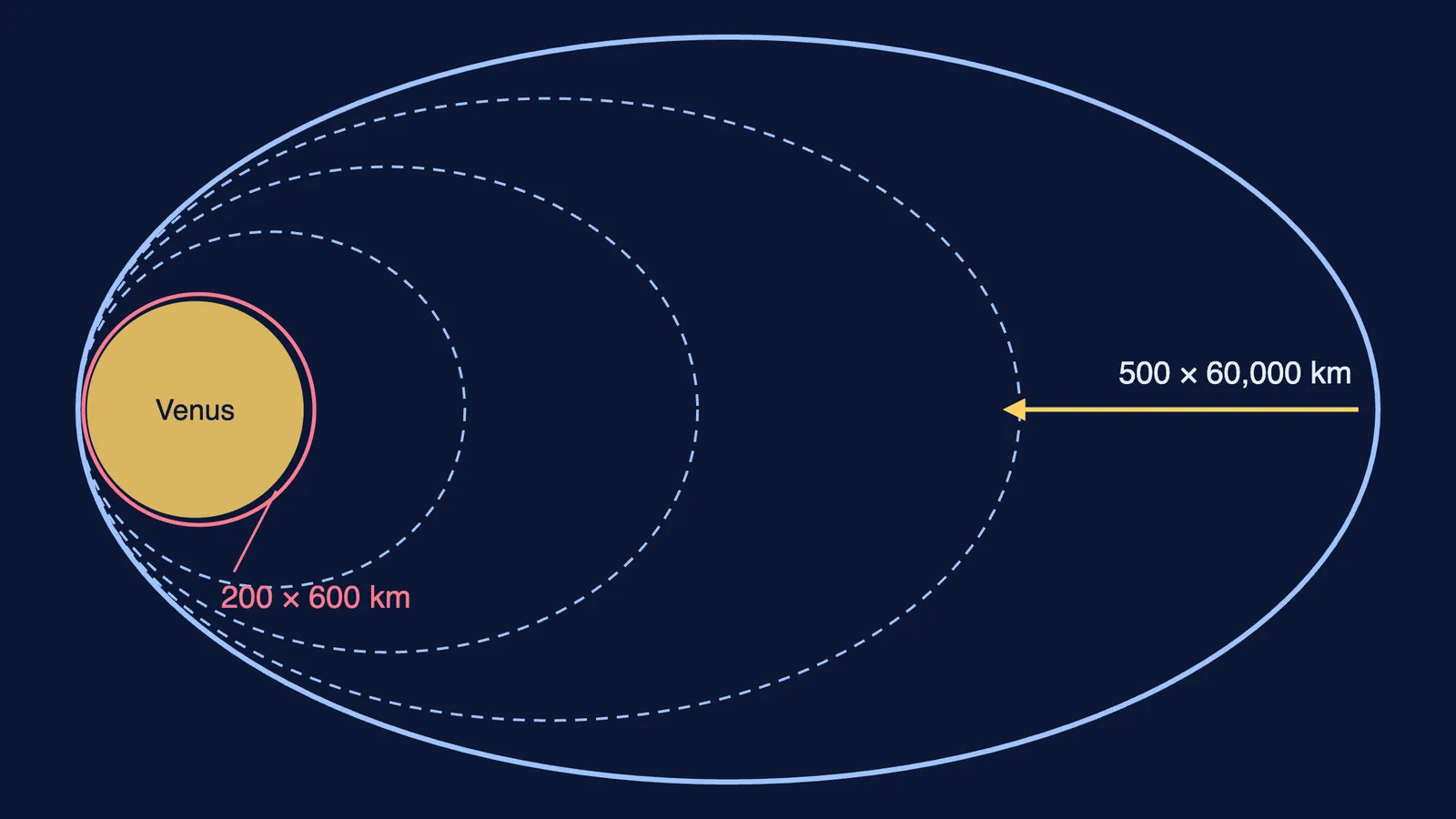
After the cruise to Venus, Venus Orbit Injection puts it in a long, stretched orbit of 500 km × 60,000 km.
Aerobraking over 6 to 8 months lowers it to a science orbit of 200 km × 600 km, inclined at around 90°, so it passes over both poles.
Science operations run for 5 years, with data received at the ISRO Deep Space Network.
Why an orbiter? ISRO's note says bringing a surface sample back through Venus's thick atmosphere and sulphuric acid cloud is "one of the most difficult dreams with today's technology", so Venus is better explored from orbit and by balloons.
Why is India going to Venus?
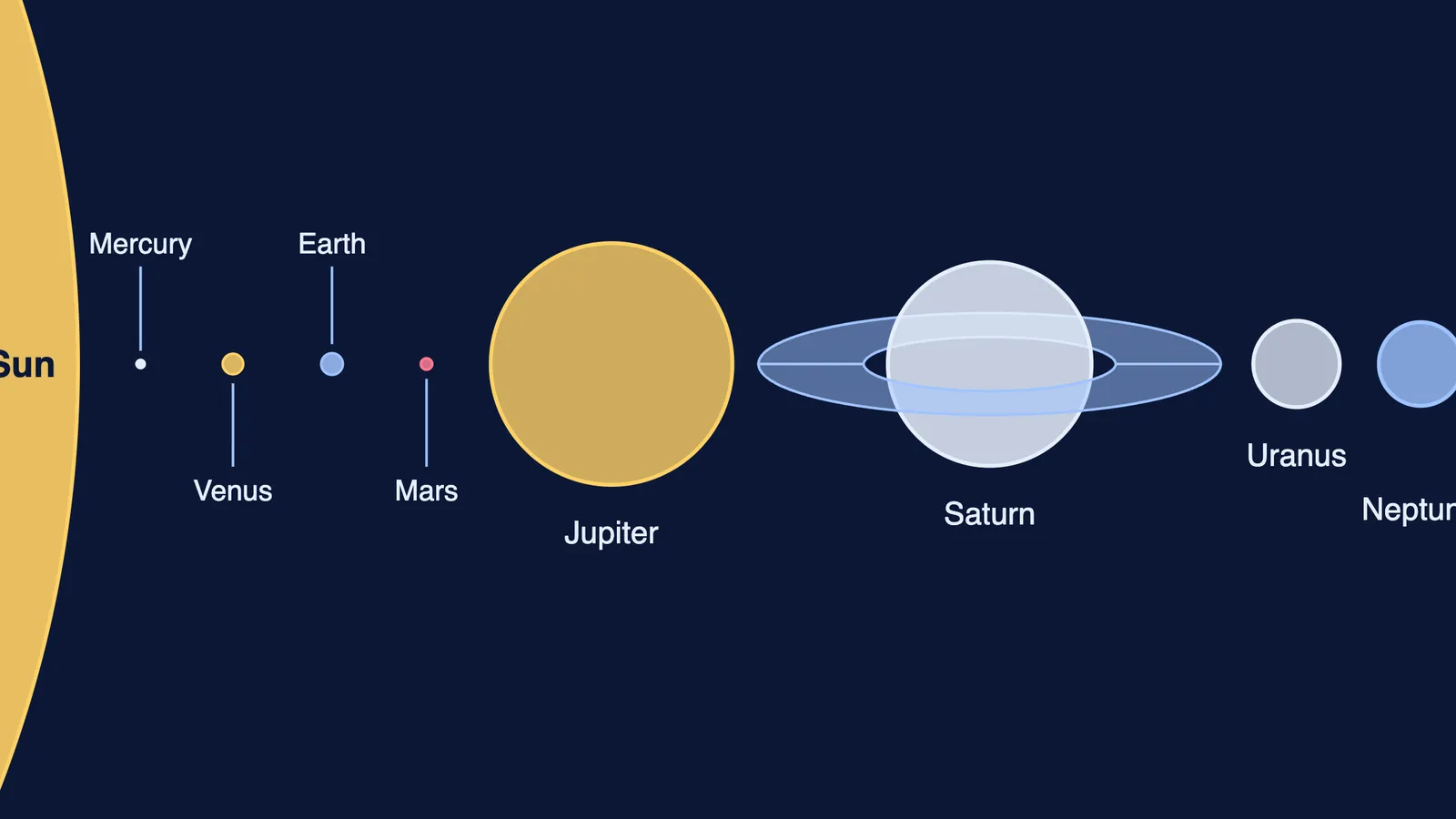
Venus is almost Earth's twin in size and utterly unlike it in conditions. Its mean radius is 6,051.8 km, 0.95 times Earth's, its surface pressure is 92 bar and its average temperature is 737 K (464 °C), according to the NASA Venus fact sheet. ISRO's note puts this down to a thick carbon dioxide atmosphere and a severe greenhouse effect; our explainer on why Venus is hotter than Mercury walks through that physics.
ISRO's mission note gives three reasons to go:
Comparative planetology. Planets born together evolved very differently; comparing them shows what steered each one.
Global coverage. Earlier missions covered only the south polar region or the equatorial belt, making global maps of winds, waves and chemistry hard to build; ISRO says VOM would cover the planet uniformly.
Technology. It tests aerobraking and thermal management in the harsh Venusian environment.
What will its 19 instruments study?
ISRO lists sixteen Indian payloads, two Indian and international collaborative payloads and one international payload, recommended by an Experts Review Committee under four themes: surface and subsurface, atmosphere, ionosphere, and solar wind interaction (ISRO). Highlights:
VSAR, an S-band radar at 2.5 GHz, will map Venus at 20-30 m resolution, which ISRO calls an order of magnitude better than the available Magellan data, and search for active volcanism.
VARTISS, a radar sounder, will probe buried lava flows and the topside ionosphere.
VSEAM will look for volcanic hotspots, VTC will map heat given off by the cloud tops, and LIVE will detect lightning from its electric-field signals.
VISWAS (with a Swedish partner) studies how the solar wind strips the upper atmosphere; VIRAL, from Russia's IKI, measures gases such as carbon dioxide, water vapour and sulphur dioxide in and above the clouds.
What is aerobraking, and why use it at Venus?
Aerobraking means using drag from a planet's upper atmosphere, instead of rocket fuel, to shrink an orbit. Each time the spacecraft passes its closest point, it skims the thin top of the atmosphere and loses a little speed, so the far end of its orbit comes in a little closer.
NASA's Magellan was the first orbiting planetary spacecraft to use aerobraking, starting on 25 May 1993; over more than 75 days it went from a 3 hour 15 minute elliptical orbit to a nearly circular 94 minute one, JPL reported.
How much speed does aerobraking remove?
You can check ISRO's plan with two formulas from your gravitation chapter. Use Venus's GM = 3.2486 × 10^5 km³/s² and radius 6,051.8 km from the NASA fact sheet, and the orbits from ISRO's note.
Arrival orbit, 500 × 60,000 km: closest distance r = 6,551.8 km, farthest 66,051.8 km, so the semi-major axis a = 36,301.8 km.
Kepler's third law, T = 2π√(a³/GM), gives T ≈ 76,000 s, about 21 hours per orbit.
Science orbit, 200 × 600 km: a = 6,451.8 km, so T ≈ 5,700 s, about 95 minutes.
The vis-viva equation, v² = GM(2/r − 1/a), gives a speed at closest approach of about 9.5 km/s on arrival and about 7.3 km/s in the science orbit.
So the speed at closest approach has to fall by roughly 2 km/s. Aerobraking lets drag do most of that work, a little on each pass over 6 to 8 months, instead of carrying the fuel for one huge braking burn. If the orbital-speed step feels shaky, our derivation of orbital velocity and time period covers it, and the energy needed to change a satellite's orbit shows the same idea in reverse.
If ellipses are hard to picture, the Fermi Simulation Lab has interactive simulations for ideas that are easier to see than to read, and the Fermi Problem Library has worked problems with a step-by-step solver that explains the reasoning.