On this page
Mercury is the planet closest to the Sun, so it seems obvious that it should be the hottest. It isn't. NASA's own fact page says it plainly: Mercury is not the hottest planet in our solar system, that title belongs to nearby Venus, thanks to its dense atmosphere. The reason uses ideas from Class 11 physics.
Why is Venus hotter than Mercury if Mercury is closer to the Sun?
Start with NASA's fact sheets for Mercury and Venus.
Mercury orbits about 57.9 million km from the Sun; Venus about 108.2 million km.
Sunlight at Mercury's distance is 9082.7 W/m²; at Venus it is 2601.3 W/m², under a third as much.
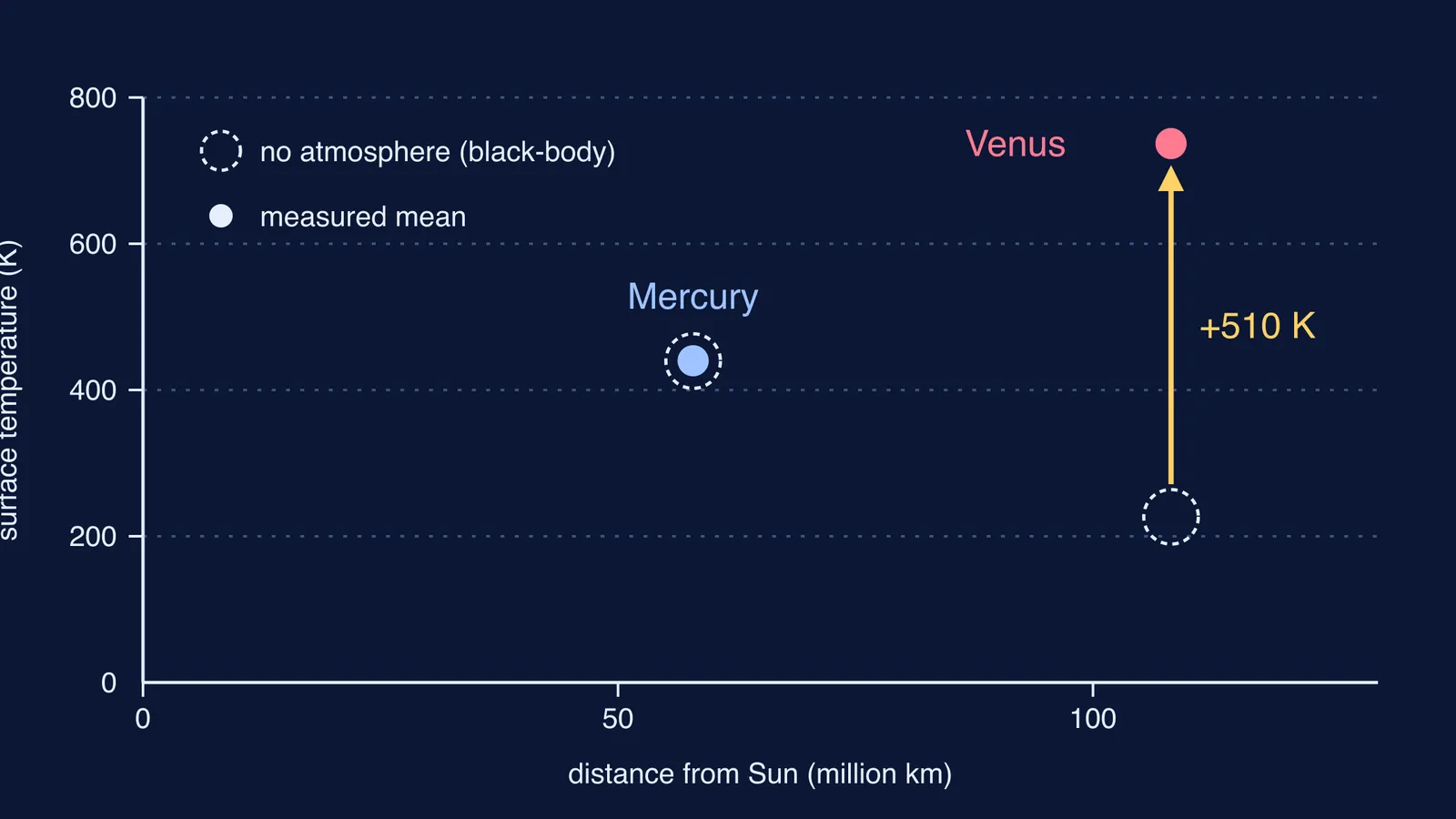
Mercury's average surface temperature is 440 K (167 °C); Venus's is 737 K (464 °C).
Venus gets far less sunlight and still ends up about 300 °C hotter. Distance sets how much energy arrives; the atmosphere decides how much stays.
Mercury has almost no air: a surface pressure below 5 × 10⁻¹⁵ bar. Venus's surface pressure is 92 bar, and its air near the ground is 96.5% carbon dioxide, according to the Venus fact sheet. With no blanket, Mercury's heat leaks straight to space: its surface reaches 430 °C by day but drops to −180 °C at night.
How does a carbon dioxide atmosphere trap heat?
The greenhouse effect is the warming of a planet's surface when its atmosphere lets sunlight in but absorbs the infrared radiation the warm surface sends back out.
The hot Sun sends most of its energy as visible light. A cooler planet surface glows in the infrared instead: Wien's law says cooler bodies radiate at longer wavelengths (see our post on black-body radiation with Stefan's and Wien's laws). Carbon dioxide absorbs infrared, so the heat the ground gives off is caught by the air and sent back down.
On Venus, the European Space Agency estimates that about 80% of incoming sunlight is reflected by the clouds and only about 10% reaches the surface. The heat the surface emits is then trapped by the same atmosphere.
How hot would Venus be without a greenhouse effect?
A planet with no greenhouse effect settles at its black-body temperature, T = [S(1 − A) / 4σ]^(1/4), where S is the sunlight per square metre, A is the fraction reflected (the Bond albedo), the 4 spreads the sunlight over the whole sphere, and σ = 5.670 × 10⁻⁸ W m⁻² K⁻⁴ is the Stefan–Boltzmann constant (NIST).
Venus: S = 2601.3 W/m² and A = 0.77 (fact sheet). Absorbed per square metre on average: 2601.3 × 0.23 ÷ 4 ≈ 150 W/m².
Divide by σ and take the fourth root: T ≈ 227 K, about −46 °C. NASA's fact sheet gives the same, 226.6 K.
Mercury: S = 9082.7 W/m² and A = 0.068 (fact sheet). The same steps give about 440 K, the fact sheet's listed average.
Compare. Mercury's listed average matches its no-atmosphere estimate. Venus's average, 737 K, is about 510 K above it.
Those 510 kelvin are the greenhouse effect. Without a greenhouse effect but with its clouds, Venus would be colder than Mercury, because its bright clouds reflect so much sunlight (the reason it shines so brightly, as in why Venus is the brightest planet in the night sky). One more step shows the scale: a surface at 737 K radiates σT⁴ ≈ 16,700 W/m², over a hundred times the 150 W/m² Venus absorbs. The atmosphere absorbs almost all of that infrared and sends much of it back down.
Why is it called a runaway greenhouse effect?
NASA says Venus's thick atmosphere traps heat in a runaway greenhouse effect, and that Venus and Earth both had oceans when young. "Runaway" means a feedback loop: warming puts more heat-trapping gas into the air, which causes more warming. To try changing the gas and watching the temperature respond, see how the greenhouse effect works, with five predictions to test. The Fermi Simulation Lab has more interactive simulations for ideas that are easier to see than to read.
How to write this answer in an exam
Mercury is closer and receives more sunlight, but has almost no atmosphere, so its heat radiates straight to space.
Venus has a thick atmosphere of about 96% carbon dioxide (NASA fact sheet).
Sunlight reaches the surface; the surface emits infrared, which carbon dioxide absorbs and re-emits downward.
This greenhouse effect keeps Venus's surface near 460 °C, hotter than Mercury.
If black-body radiation still feels shaky, the Fermi Concept Library gives each concept its own lesson and its place in the map.