On this page
Some of the most famous shapes in modern physics began as a question in pure geometry. Eugenio Calabi asked it in 1954, Shing-Tung Yau answered it in 1976, and string theorists later found they needed exactly the shapes Yau had shown must exist.
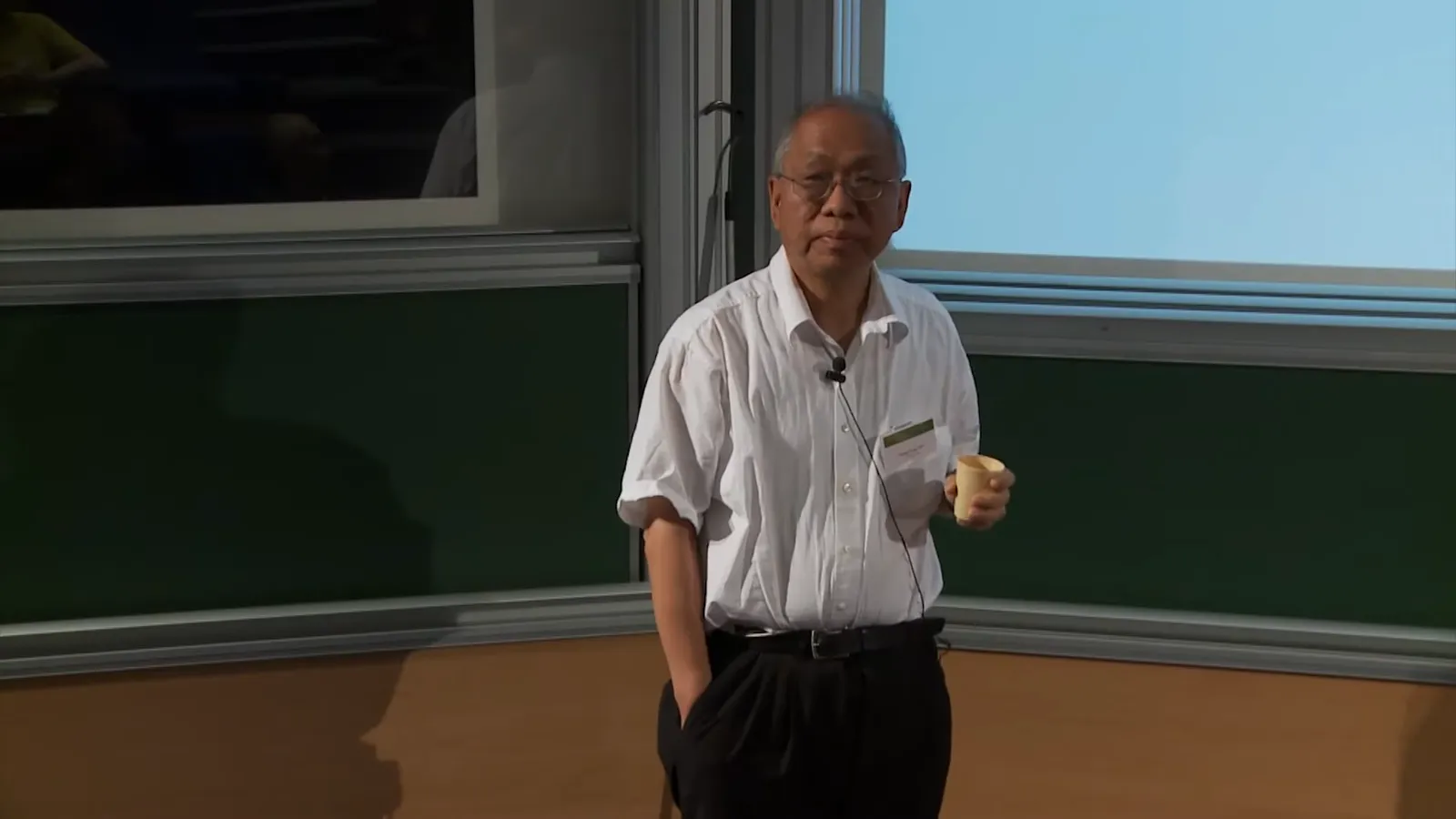
Who is Shing-Tung Yau?
Yau was born on 4 April 1949 in Guangdong, China, and his family moved to Hong Kong later that year, according to the MacTutor biography. He studied at Chung Chi College in Hong Kong, then earned his PhD at the University of California, Berkeley in 1971 under Shiing-shen Chern, the geometer whose proof of the Gauss-Bonnet theorem we have covered before.
In 1982 Yau received the Fields Medal, and the International Mathematical Union's citation names the Calabi conjecture alongside his work on differential equations and the positive mass conjecture of general relativity.
What did the Calabi conjecture say?
In his own survey of Calabi-Yau manifolds (Surveys in Differential Geometry, 2009), Yau explains that Calabi proposed the conjecture in 1954 while looking for the most natural way to measure distances on a Kähler manifold, a smooth shape described by complex numbers.
If a certain topological quantity of the shape, its first Chern class, is zero, the conjecture says there is exactly one Ricci-flat Kähler metric in every Kähler class. Ricci curvature measures one kind of bending, so "Ricci-flat" means that bending vanishes everywhere.
How did Yau prove the Calabi conjecture?
At first, he tried to prove it false. The same survey records that by the late 1960s many mathematicians doubted the conjecture, and that at a 1973 geometry conference at Stanford Yau presented a "counterexample". It was soon found to be flawed, and Yau withdrew the lecture.
As Quanta Magazine reported, Yau rechecked his calculations, found the mistake, and saw that the collapse of his counterexamples suggested the conjecture might be true. He spent the next three years proving it, and on Christmas Day 1976 he met Calabi and another mathematician, who confirmed the proof.
The method was to turn geometry into one hard equation. Calabi had already seen that his conjecture reduces to a complex Monge-Ampère equation, and Yau solved that equation. He announced the result in the Proceedings of the National Academy of Sciences in 1977 and gave the full proof in a 73-page paper in Communications on Pure and Applied Mathematics in 1978.
Why are Calabi-Yau manifolds used in string theory?
Yau's survey explains that superstring theory requires a 10-dimensional spacetime, so to match our 4-dimensional world the extra 6 dimensions are pictured as a tiny, curled-up space too small to have been detected. The survey also notes that Calabi-Yau metrics are solutions of Einstein's field equation with no matter, the equation behind general relativity's curved spacetime.
In 1985, Philip Candelas, Gary Horowitz, Andrew Strominger and Edward Witten published "Vacuum configurations for superstrings"90602-9) in Nuclear Physics B. As Yau's survey summarises it, they found that in the most basic models with N = 1 supersymmetry, the hidden 6-dimensional space must be a Calabi-Yau manifold of complex dimension 3. Calabi-Yau shapes are not the only picture of hidden dimensions; the warped extra dimensions of Lisa Randall are another.
In 2000, Maximilian Kreuzer and Harald Skarke classified all 473,800,776 reflexive polyhedra in four dimensions, each encoding data for Calabi-Yau threefolds. Yau has conjectured that each dimension has only finitely many topological types of Calabi-Yau manifold, and his 2009 survey lists that question as still open.
How can you read a big theorem like Yau's?
You can borrow Yau's habits without graduate geometry. Ask five questions of any statement, from a JEE Main problem to a research paper:
Given: what are you allowed to assume? (A compact Kähler manifold whose first Chern class is zero.)
Asked: what must be shown? (A Ricci-flat metric in each Kähler class.)
Type: is it existence, uniqueness, or both? (Both: there is one, and only one.)
Translate: can the question become an equation? (Yes, a complex Monge-Ampère equation.)
Attack: try to break it. If your counterexample fails, find exactly why, as Yau did after 1973.
Worked example at school level: "x² = 2 has exactly one positive solution." Type: both. Existence: x² − 2 is negative at x = 1 and positive at x = 2, so it crosses zero in between. Uniqueness: x² keeps increasing for positive x, so it cannot cross twice. Two jobs, two arguments, as in Calabi's conjecture.
If a word in the chain, such as determinant or complex number, feels shaky, the Fermi Concept Library gives every concept in mathematics its own lesson and its place in the map, so you can fill that gap first. And when your own attempted proof stalls, Fermi's AI tutor notices where you are stuck and decides whether to explain, ask or show.
Yau's lesson is step 5: a failed counterexample is not wasted time. It can point you to the proof.