

On this page
If you pick up a paperclip with a small fridge magnet, you are witnessing a profound mystery. That tiny magnet is effortlessly overpowering the gravitational pull of the entire Earth to lift the metal. In physics, this massive discrepancy in strength between gravity and the other fundamental forces is known as the hierarchy problem.
For decades, scientists struggled to explain why the Weak scale (the energy level of the Standard Model forces, around 10³ GeV) is roughly 16 orders of magnitude smaller than the Planck scale (the fundamental energy of gravity, around 10¹⁹ GeV) source.
In 1999, physicists Lisa Randall and Raman Sundrum published a paper titled "A Large Mass Hierarchy from a Small Extra Dimension" source. Their solution, now known as the RS1 model, reimagined the geometry of the universe.
What is the hierarchy problem?
The Standard Model of particle physics describes electromagnetism, the strong nuclear force, and the weak nuclear force. However, gravity refuses to fit neatly into this framework.
Gravity's fundamental energy scale is the Planck scale, an unimaginably high 10¹⁹ GeV. If you compare the gravitational attraction between two electrons to their electrical repulsion, gravity is roughly 10⁴⁰ times weaker source. To calculate the energy density in an electric field, you do not need to factor in gravity at all. Explaining why this gap exists without relying on unnatural mathematical "fine-tuning" is the hierarchy problem.
How do warped extra dimensions work?
Before Randall and Sundrum, some physicists proposed that gravity "leaks" into extra spatial dimensions that are relatively large. The RS1 model took a different path: it uses a single, highly curved extra dimension that does not need to be physically large.
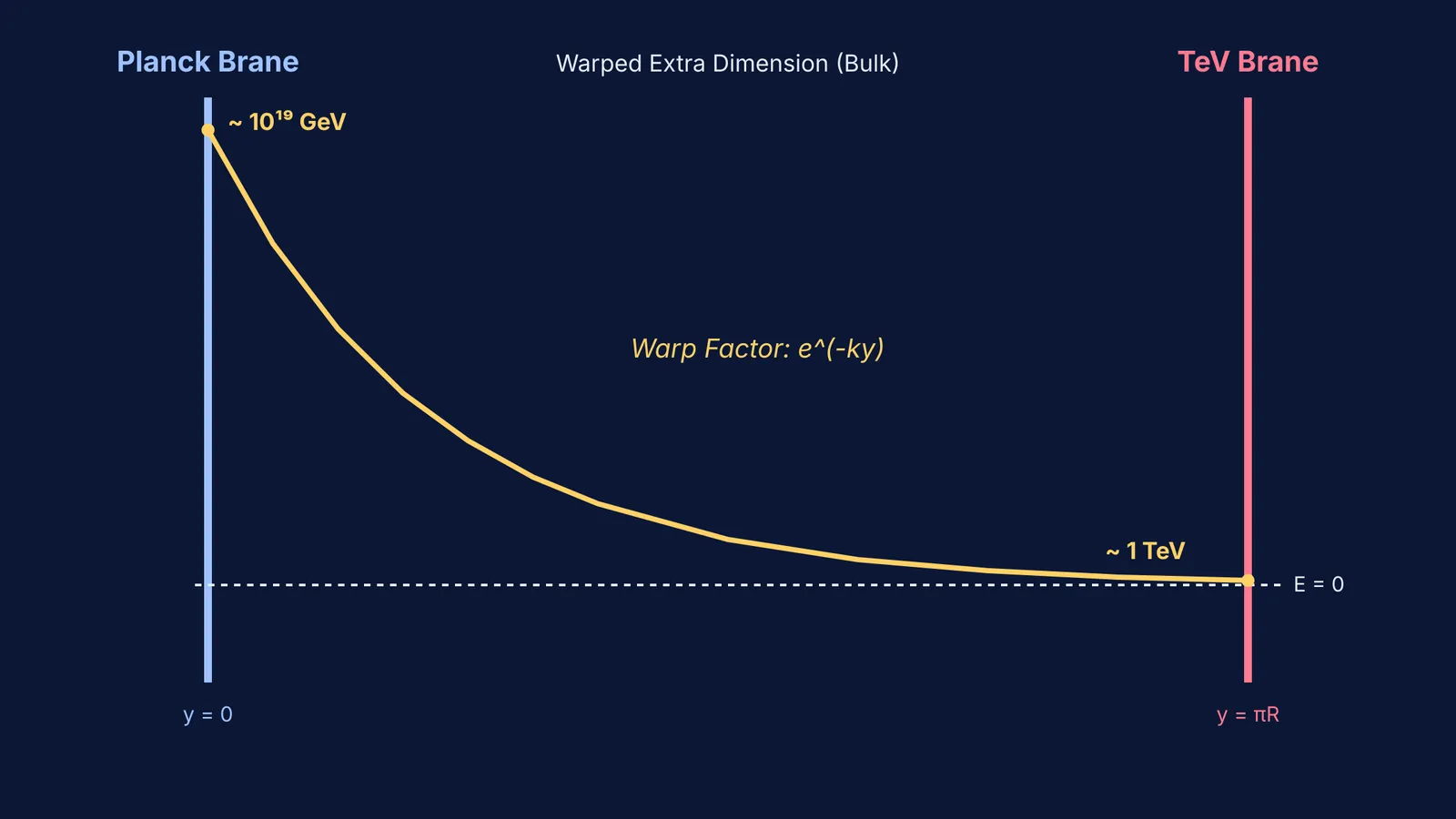
Their model pictures the universe as a five-dimensional space (the "bulk") bounded by two four-dimensional walls, or "branes":
The Planck Brane (Hidden Brane): This is where gravity originates in its full, unadulterated strength.
The TeV Brane (Visible Brane): This is where our universe and all Standard Model particles exist.
The space between these branes is not flat. It is a slice of Anti-de Sitter (AdS₅) spacetime, meaning its geometry is severely warped by a negative cosmological constant. As gravity propagates from the Planck brane across the fifth dimension toward our TeV brane, the metric of spacetime is multiplied by an exponential warp factor, e^(-kr_cπ). By the time gravity reaches us, its strength has been exponentially suppressed down to the Weak scale of 10³ GeV (1 TeV) source.
If you are trying to picture how fields operate, the Fermi Concept Library holds every concept in physics, chemistry, biology, mathematics and computing, each with its own lesson and its place in the map, letting you trace how fundamental forces and energy scales relate to one another.
Is the Randall-Sundrum model testable?
Yes, and this is what made the 1999 paper so important. Unlike string theories that operate exclusively at unreachable energy scales, the RS model makes predictions that can be tested in modern particle accelerators.
The model predicts the existence of Kaluza-Klein (KK) gravitons—heavy excitations of the standard graviton that can travel through the bulk. Because of the warp factor, these KK gravitons should have masses on the order of a few TeV and couple to our particles with Weak-scale strength. If you calculate the number of photons emitted per second in high-energy particle collisions, a decaying KK graviton would appear as a sudden spike in specific particle pairs.
To date, searches by the ATLAS and CMS collaborations at CERN's Large Hadron Collider (LHC) have not found these resonances. Current CMS data from 13 TeV proton collisions excludes RS gravitons with masses below 3.85 TeV for standard coupling parameters source. While this rules out the simplest versions of the theory, researchers continue to look for them in higher energy ranges.
What is the conceptual framework for extra dimensions?
It is difficult to visualize a warped fifth dimension, but you can approach it using a conceptual framework of "scale suppression":
Identify the Source: Assume the fundamental force (gravity) originates at a maximum strength in a domain we cannot directly access (the Planck brane).
Apply the Warp: Picture a medium that dampens energy exponentially over distance, much like light travelling through deep water.
Measure the Remnant: Calculate the remaining energy at the boundary where we live (the TeV brane).
If you are working through the complex mathematics of physics, the Fermi Problem Library has worked problems with a step-by-step solver that explains the reasoning rather than printing an answer.


