On this page
In 1944, the mathematician Shiing-Shen Chern solved a major problem of differential geometry without ever stepping outside the shape he was studying. His new proof of the Gauss-Bonnet theorem showed how a surface's local curvature is permanently locked to its global topology, or its number of holes.
Before Chern's paper, mathematicians had proved the theorem for higher dimensions, but their methods required embedding the shape into a larger, flat space. Chern's achievement was to prove the result intrinsically, relying only on the geometry of the surface itself.
What is the Gauss-Bonnet theorem?
The Gauss-Bonnet theorem connects the local geometry of a surface—how it bends at any given point—to its global topology, which is its overall shape.
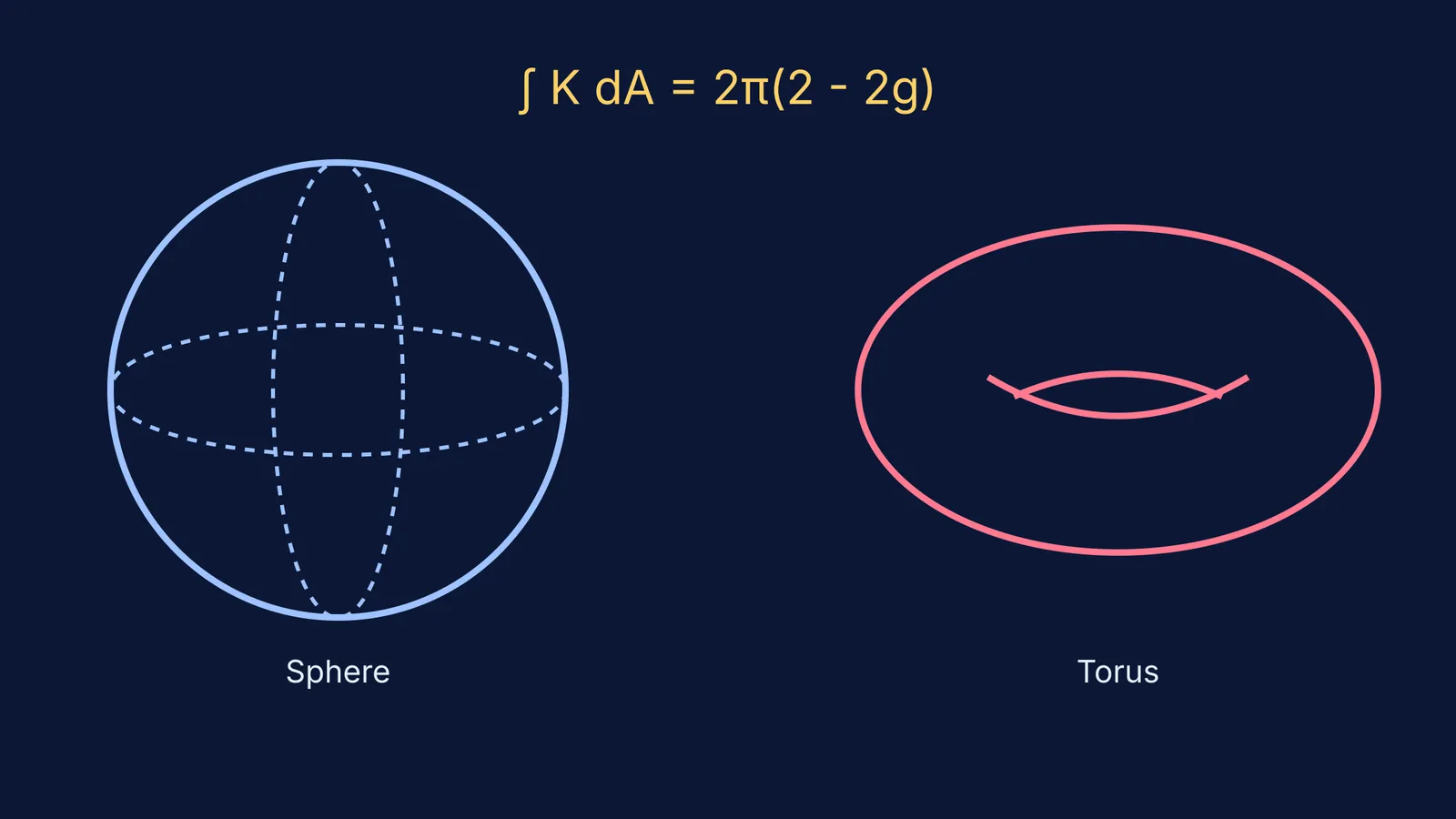
If you draw a triangle on a flat piece of paper, its interior angles will always add up to exactly 180 degrees. But if you draw a triangle on the surface of a sphere, the angles will add up to more than 180 degrees. The theorem captures this idea for entire surfaces using a formula: the integral of the Gaussian curvature over the area equals 2π times the Euler characteristic.
The Euler characteristic is a topological number that drops by 2 for every hole in the surface, following the rule χ = 2 − 2g, where g is the number of holes. This means the total curvature of a shape is fixed entirely by how many holes it has:
A sphere has zero holes (g = 0), giving it an Euler characteristic of 2 and a total curvature of 4π.
A torus, or doughnut, has one hole (g = 1), giving it an Euler characteristic of 0 and a total curvature of zero.
No matter how you stretch, dent or deform a sphere, as long as you do not tear a hole in it, its total curvature will always sum to 4π.
How did Shiing-Shen Chern prove the Gauss-Bonnet theorem?
In the early 1940s, Chern was working at the Institute for Advanced Study in Princeton. While the Gauss-Bonnet theorem was well understood for two-dimensional surfaces, extending it to higher-dimensional mathematical spaces had proved cumbersome.
Earlier mathematicians had managed to prove the higher-dimensional version, but their proofs were extrinsic. They had to pretend the manifold was sitting inside a much larger, flat Euclidean space, which felt philosophically unsatisfying to geometricians who wanted to understand the space on its own terms.
In October 1944, Chern published his paper, "A Simple Intrinsic Proof of the Gauss-Bonnet Formula for Closed Riemannian Manifolds", in the *Annals of Mathematics*.
What does an intrinsic proof mean?
An intrinsic proof relies only on the internal properties of the space. Imagine you are an ant walking on the surface of an apple. You cannot see the apple from the outside (an extrinsic view), but you can measure distances and angles along the surface itself (an intrinsic view).
Chern used the method of moving frames and the theory of fiber bundles to prove the theorem using only the measurements available from within the manifold itself. He showed that the global topological properties of a space could be found without ever leaving it.
If you are trying to picture the difference between local curvature and global topology, the Fermi Concept Library covers every concept in physics, chemistry, biology, mathematics and computing, each with its own lesson and its place in the map.
Why does the Gauss-Bonnet theorem matter today?
The implications of Chern's intrinsic proof extended far beyond abstract mathematics, eventually reaching modern physics. Because the theorem links local geometry to global topology, it helps physicists understand systems where the overall shape of a space dictates its physical properties.
In the decades following his 1944 paper, the mathematics of characteristic classes became a crucial language for theoretical physics. For instance, in string theory, the universe is modelled as a higher-dimensional space where extra dimensions are curled up tightly. The topological properties of these hidden dimensions—calculated using the tools Chern helped invent—determine the types of particles and forces that can exist in our observable universe.
Furthermore, in condensed matter physics, the Gauss-Bonnet theorem and Chern classes are used to explain topological insulators. These are materials that act as insulators on the inside but conduct electricity perfectly along their surfaces. The robustness of this surface conduction is guaranteed by a topological invariant, much like how the total curvature of a sphere is locked at 4π regardless of its local bumps and dents.
By showing that geometry and topology are fundamentally connected from the inside out, Chern gave scientists a vocabulary to describe the fundamental rules of the natural world.
For more on the mathematics of shape, read about Nikolai Lobachevsky and the first published non-Euclidean geometry or how Grigori Perelman and the proof of the Poincaré conjecture solved the ultimate problem in topology.