On this page
The Pantheon in Rome was dedicated in 128 CE and still has the world's largest unreinforced concrete dome, according to MIT News. Roman harbour piers have lasted about 2,000 years in seawater, while modern marine concrete can crumble within decades, as the University of Utah reported. Two things explain it: chemistry that keeps working after the concrete sets, and shapes that keep it squeezed.
What was Roman concrete made of?
Romans mixed volcanic ash with lime and seawater to make a mortar, then packed chunks of volcanic rock into it (University of Utah). The reaction between lime and volcanic ash is called a pozzolanic reaction, named after Pozzuoli on the Bay of Naples. Modern concrete is bound with Portland cement instead, which you can read about in our explainer on what Portland cement is made of and why gypsum is added.
Why does Roman concrete last so long?
Roman concrete is dotted with millimetre-sized bright white lumps called lime clasts. Researchers long dismissed them as a sign of sloppy mixing. In 2023, a team led by Admir Masic at MIT, with first author Linda Seymour, argued that they matter (Seymour et al., Science Advances).
Their evidence suggests the Romans used hot mixing: they added quicklime (calcium oxide) instead of, or alongside, slaked lime. Quicklime reacts with water and gives off heat, and the clasts it left behind are brittle and a ready source of reactive calcium (MIT News). When a crack forms, it tends to run through a clast. Water seeping in dissolves calcium, and the solution recrystallises as calcium carbonate that fills the crack.
The team tested this by cracking hot-mixed samples and running water through them. Within two weeks the cracks had completely healed and water stopped flowing; an identical sample made without quicklime never healed (MIT News).
How does seawater make Roman concrete stronger?
A 2017 study led by Marie Jackson found that seawater percolating through Roman piers and breakwaters dissolved parts of the volcanic ash and let new minerals, aluminous tobermorite and phillipsite, grow at low temperature long after the concrete hardened (Jackson et al., American Mineralogist; summary from the University of Utah). Their interlocking plates increase the concrete's resistance to brittle fracture. Around 79 CE, Pliny the Elder wrote that such harbour concrete becomes "a single stone mass, impregnable to the waves and every day stronger", as quoted by the University of Utah.
How does an arch turn load into compression?
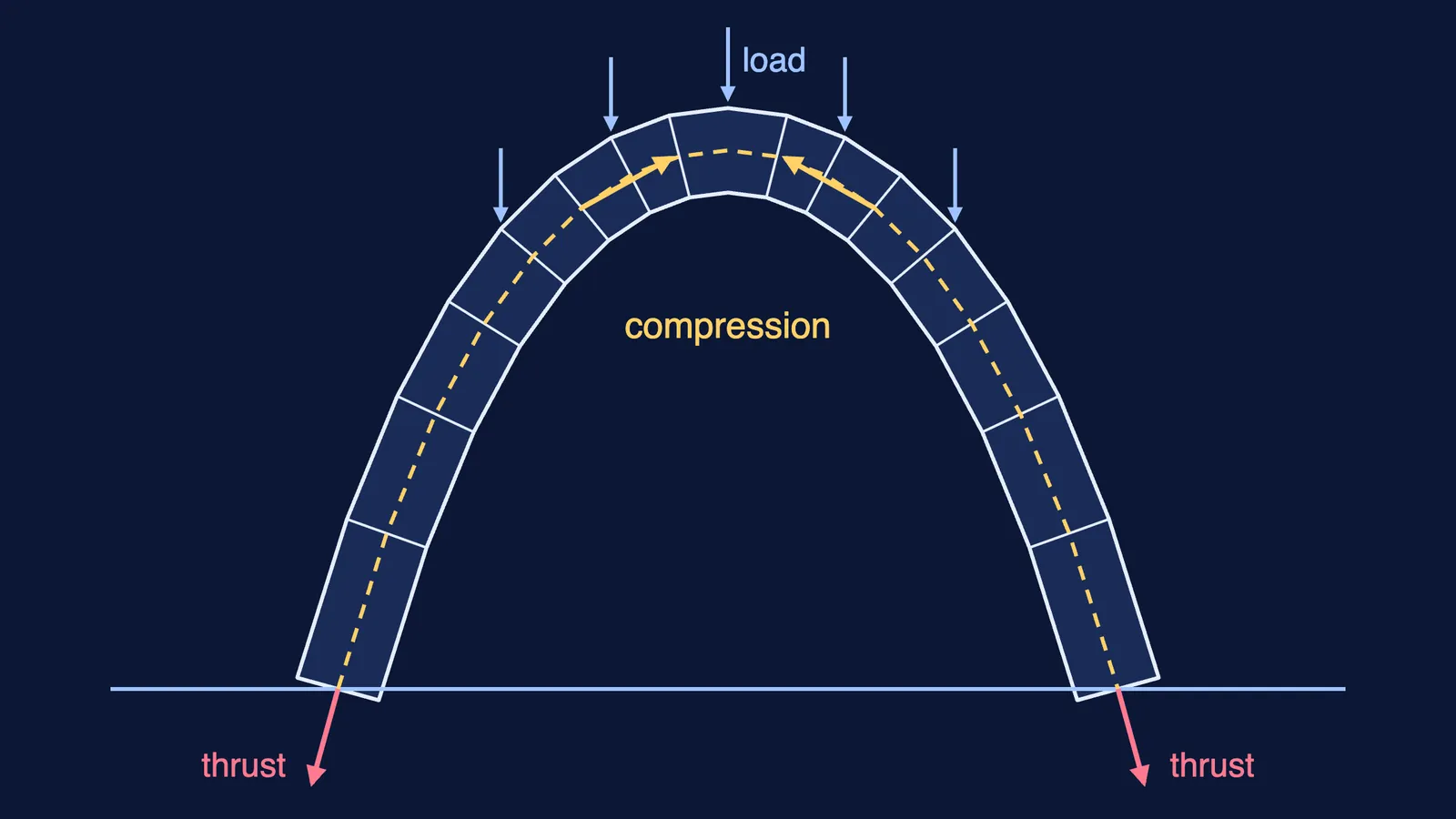
Stone and unreinforced concrete are strong when squeezed and weak when pulled. A beam laid across a gap bends, and its bottom face is pulled, so it cracks. In a true arch the parts are mostly in compression, and the arch turns the vertical load into vertical and horizontal pushes at its ends (Arch, Wikipedia). The bending in any part of an arch is much smaller than in a beam of the same span and load.
The horizontal push is called thrust, and it is why arches need heavy supports, or abutments, at their feet. Robert Hooke announced in 1671 that he had found the ideal shape and published it in 1675 as a Latin anagram: "As hangs a flexible cable so, inverted, stand the touching pieces of an arch" (Catenary, Wikipedia). A chain hanging under its own weight is in pure tension, so the same curve turned upside down is in pure compression.
Worked example: how hard does an arch push sideways?
Use the force triangle at one foot of the arch (the vertical and horizontal reactions described in Arch, Wikipedia). Say each half of an arch weighs 50 kN. The foot holds that 50 kN up, and the force runs along the last stone. If that stone meets the ground at angle θ, the sideways thrust is H = 50 / tan θ.
Tall arch, θ = 75°: H = 50 / 3.73 = 13.4 kN.
Medium arch, θ = 45°: H = 50 / 1 = 50 kN.
Flat arch, θ = 30°: H = 50 / 0.577 = 86.6 kN.
The flatter the arch, the harder it pushes its supports apart. In a row of equal arches, neighbouring thrusts cancel at each shared pier, so only the two end piers must resist them.
If forces in a structure are hard to picture, the Fermi Simulation Lab has interactive simulations for ideas that are easier to see than read.
What can modern builders learn from Roman concrete?
The MIT team made modern mixes containing lime clasts and reported that they showed self-healing potential, which points towards more durable concrete (Seymour et al., Science Advances). See how Robert Maillart used the arch to build a bridge with less concrete and more physics, or test the same idea on an eggshell dome.
Next time you pass an old arch, look for its thrust: the heavy piers or walls at its feet that keep it standing.