On this page
The eggshell-dome challenge is a school favourite: a few half-shells, a stack of books and a bet about when the crunch comes. Here is how to guess well, two tests to run, and a 2025 result that changes the usual story.
Why is an eggshell strong at the ends?
The usual answer is the arch. In its eggshell activity, Science Buddies explains that "the shape of the arch distributes the compressive forces to the load-bearing piers that support the arch," which "eliminates some tension stresses in the structure."
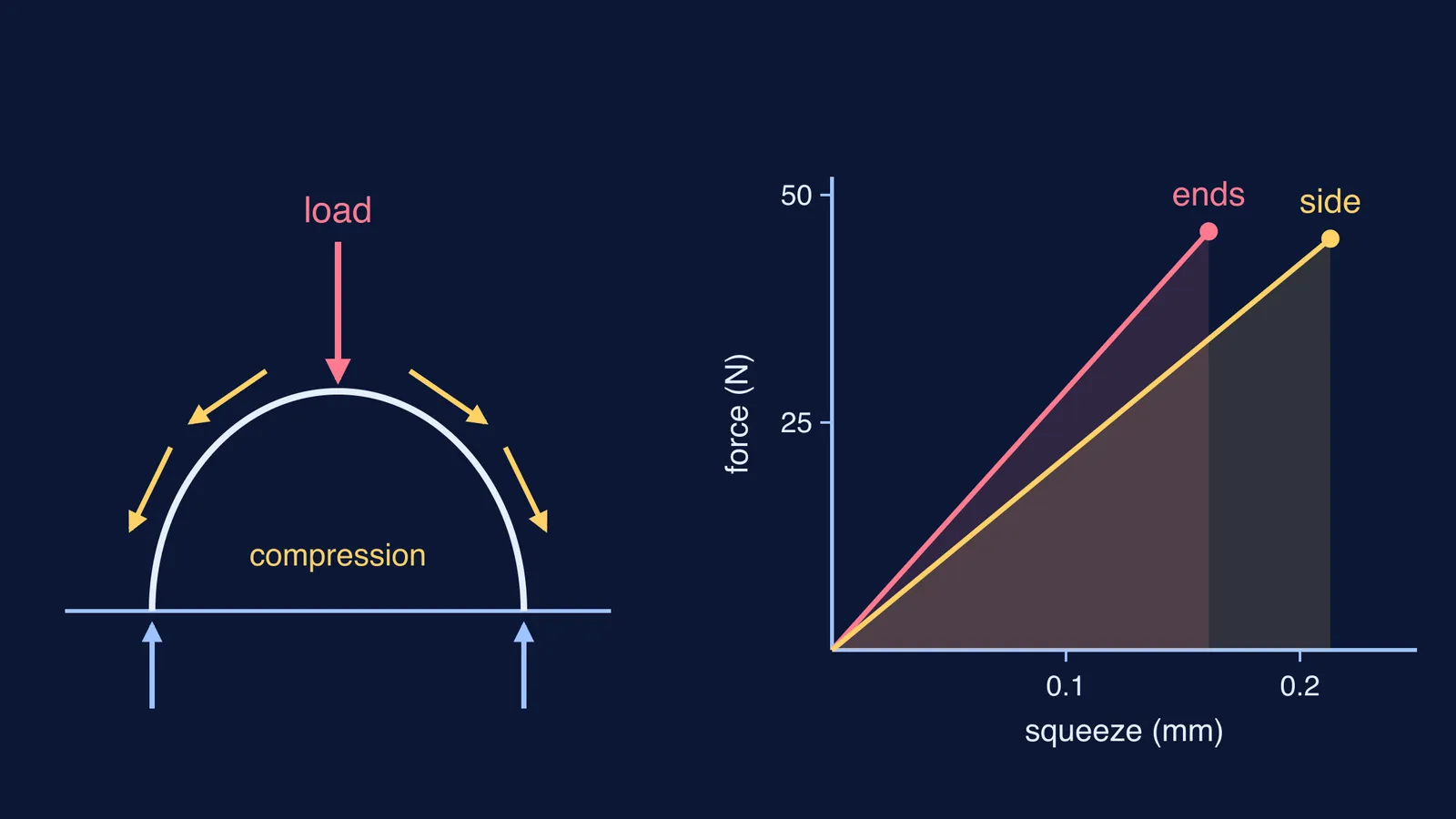
Shell, like chalk, copes well with being squeezed and badly with being pulled or bent. A dome lets a load on its top travel down the curve as compression to the rim on the table, instead of bending the wall. The 2025 MIT egg paper traces the idea to Robert Hooke in 1675 and sums it up as "As hangs the chain, so stands the arch".
The dome works best in one direction. Fan Liu and colleagues found that the internal breaking load needed is much lower than the external breaking load: handy for a chick that has to get out.
Is an egg really stronger on its ends than on its side?
Not in the way most explanations claim. In a study published in Communications Physics in May 2025, Tal Cohen's group at MIT ran 60 compression tests on whole eggs.
Loaded on the ends, eggs cracked at an average of 46.0 N.
Loaded on the side, they cracked at 45.2 N, and the team found no statistical difference between the two.
On the side, eggs squeezed about 30% further before cracking (0.213 mm against 0.161 mm), so they absorbed about 30% more energy.
The ends are stiffer, not stronger. In 180 drop tests from 8, 9 and 10 mm, fewer eggs cracked when they landed on their side. The paper's own summary: "eggs need to be tough, not stiff, in order to survive a fall." MIT News compares it to bending your knees when you land.
How many books can eggshell domes hold?
Make the prediction on paper first. Here is a worked example built on the measured numbers.
Start from the crack force of a whole egg squeezed between two plates in the MIT tests: about 46 N, the weight of roughly 4.7 kg (46 ÷ 9.8).
The Science Buddies setup uses three domes in a triangle. If they share the load equally, a first estimate is about 3 × 4.7 = 14 kg.
Weigh one of your books on a kitchen scale. If it is 0.5 kg, that estimate is about 28 books.
Adjust for what is different. A half-shell on its rim is not a whole egg between plates, a cut rim can hide hairline cracks, and a dome a millimetre taller than the others takes the load alone.
Write your final guess with one sentence of reasoning.
How do you test load on the curve and on the side?
Prepare the shells as Science Buddies describes: crack each egg at the pointy end, drain it, mark a line around the widest part, score along it with a file and break back to the line so every shell is the same height. Raw shell can carry Salmonella, so wash your hands and wipe every surface afterwards.
Test A, load on the curve: stand three domes rim-down in a triangle, lay a hardcover book on top, then add books or magazines one at a time until a shell cracks. Weigh the stack.
Test B, load on the side: take three fresh domes, lay each on its side in a small ring of dough so it cannot roll, and repeat with a flat card on top.
Before Test B, ask: can the load still run along the curve to a rim on the table, or must the wall bend? Keep a record sheet:
Estimate from the worked example
Your guess and your result for Test A
Your guess and your result for Test B
Where the first crack started each time
For more builds, see our bridge, tower and egg-drop challenges at home; why a cushion stops an egg breaking picks up the impact side of the MIT result.
What does this teach you for physics exams?
The MIT paper uses two lines of school physics. Stiffness is k = F/Δ, and for a straight force-squeeze line the energy absorbed before cracking is E = FΔ/2, the area of the triangle under the line. Put Δ = F/k and you get E = F²/(2k). Same F, smaller k, more energy: that is the whole ends-versus-side story. You meet the same area-under-the-graph idea in the stress-strain curve of a wire.
If a force-squeeze graph is hard to picture, the Fermi Simulation Lab has interactive simulations for ideas that are easier to see than to read. If stiffness, energy or arches feel shaky on paper, each has its own lesson in the Fermi Concept Library.
Write your prediction down tonight, crack the eggs tomorrow, and compare.