On this page
In 1930 a thin, pale concrete arch was finished across the Salgina gorge near Schiers in the Swiss canton of Graubünden. Its designer, Robert Maillart (1872 to 1940), studied graphical statics in Zurich under Wilhelm Ritter, according to his Wikipedia biography. His idea was simple to state and hard to do: work out where the forces go, then put concrete only there.
What makes the Salginatobel Bridge special?
The numbers come from the bridge's own technical fact sheet. The arch spans 90.04 m and rises 12.99 m. The road sits about 90 m above the water, the whole bridge is 132.30 m long, and the roadway is just 3.50 m wide.
The American Society of Civil Engineers (ASCE) calls it a three-hinged, hollow-box arch of reinforced concrete, and notes that Maillart's design was the lowest-cost of 19 designs submitted. In 1991 ASCE made it the thirteenth International Historic Civil Engineering Landmark and the first concrete bridge so designated.
According to the Graubünden tourism page, the concreting took only three months in 1930, and the scaffolding came down in mid-August.
How did Maillart use less concrete?
His Zuoz Bridge of 1901 is described as the first box-girder bridge built of reinforced concrete. A full-scale load test found acceptable minor cracking, which grew over the bridge's life. On his 1904 bridge at Tavanasa, he removed the segments of wall that were subject to cracking.
ASCE notes that Maillart believed in using the best materials, but using them sparingly, and rejected massive structures that would more easily crack and shrink with temperature changes. At Salginatobel, the arch ring and the deck are joined by long concrete side walls, so the three work together as one hollow box.
How does an arch's shape follow the forces?
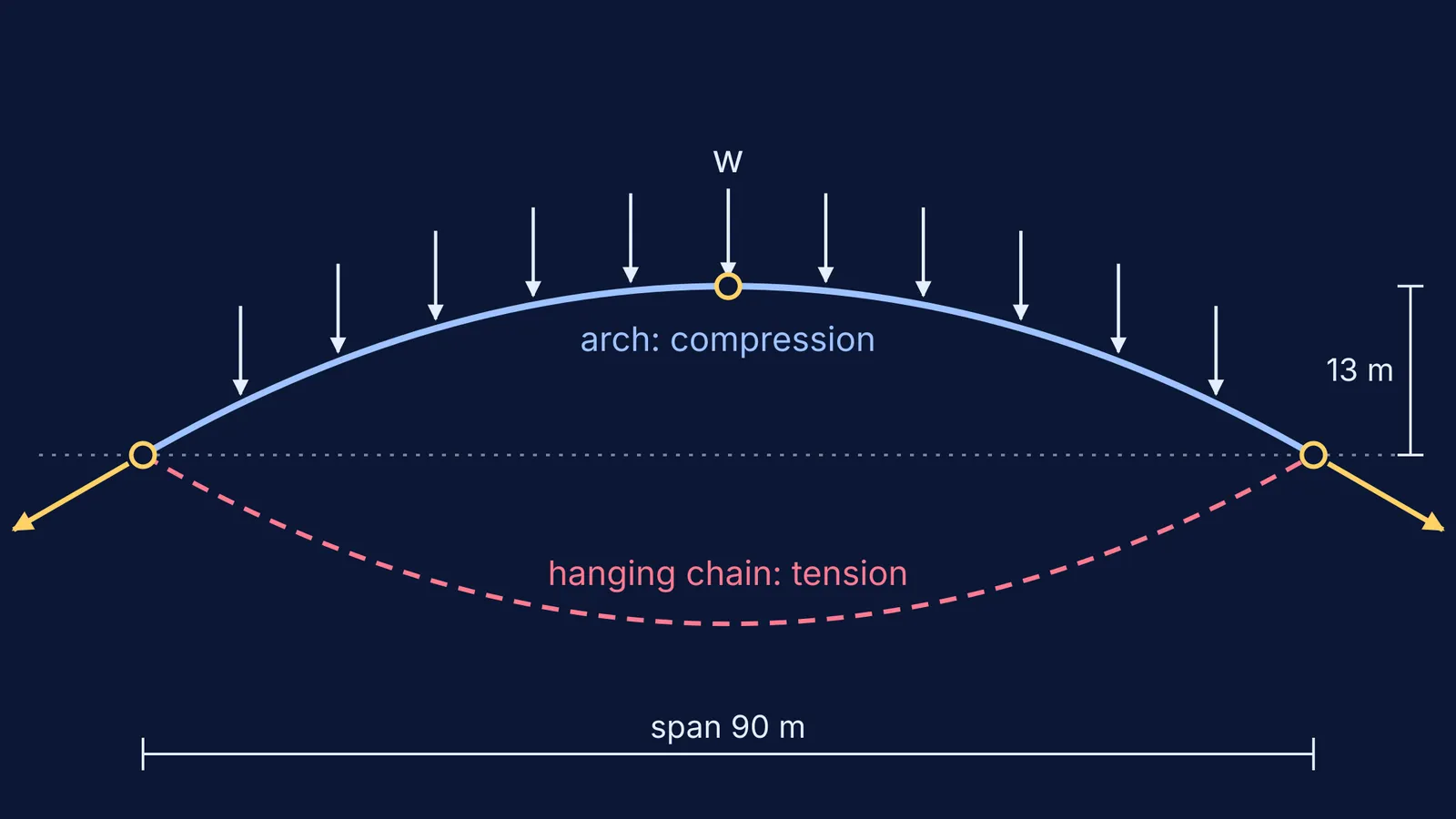
A chain hanging from two hooks settles into a curve where every link is in pure tension. Flip it and you get an arch in pure compression under the same loads, which engineers call the line of thrust or funicular shape. Concrete is strong in compression and weak in tension, so an arch that follows its line of thrust barely needs to bend.
For a load spread evenly along the span, the ideal shape is a parabola, drawn to Salginatobel's real span and rise in our diagram. Researchers Corentin Fivet and Denis Zastavni studied Maillart's original 1928 working drawings. In a 2012 paper in the Journal of the International Association for Shell and Spatial Structures, they show he used graphical methods: graphically controlled parabolas, keeping bending moments in the bridge small, and defining the geometry of the foundation block.
The three hinges, at both supports and the crown, let the arch rotate slightly as the concrete shrinks, warms or settles, so the forces stay predictable.
How hard does the arch push on the rock?
A worked example with Class 11 statics: treat the arch as a parabola of span L and rise f, carrying a total load W spread evenly.
Each support carries half the weight, so the vertical reaction is V = W/2.
Cut the arch at the crown hinge, where there is no bending. Take moments about one support for half the arch: the half-load W/2 acts at L/4, and the horizontal thrust H acts at height f. So H × f = (W/2) × (L/4), which gives H = WL/(8f).
Use the fact sheet's numbers, L = 90.04 m and f = 12.99 m. Then L/(8f) is about 0.87, so H is about 0.87W.
The resultant at each support is the square root of (0.87W)² + (0.5W)², which comes out at almost exactly W. It points about 30 degrees below the horizontal. That is the same as the slope of the parabola at its end, 4f/L, which is about 0.58.
Halve the rise and H doubles: a flatter arch pushes much harder sideways. ASCE notes that here the rock walls of the ravine take that push directly, with no stone abutments.
What can you try at home or in class?
Hang a light chain or a beaded necklace against a wall, trace its curve, then turn the paper upside down. That is your arch.
Hang small equal weights at equal horizontal spacing and watch the curve move towards a parabola.
Compare the two curves with our post on whether a hanging chain is a parabola.
Practise the algebra with parabolic arch word problems.
See a different answer to the same problem in the Forth Bridge's cantilevers.
If thrust lines are hard to picture on paper, interactive simulations in the Fermi Simulation Lab are built for ideas that are easier to see than to read. If you get stuck on step 2 of the worked example, the Fermi Problem Library has worked problems with a step-by-step solver that explains the reasoning rather than printing an answer.
Next time you cross a bridge, ask where the force runs, and whether the material is there and only there.