

On this page
When you encounter a word problem about an arch or a suspension cable, the physical structure does not come with coordinate axes. Choosing where to place the origin is the single choice that determines whether your algebra takes two lines or twenty. Under the CBSE Class 11 mathematics curriculum, conic section word problems test your ability to translate physical boundaries into standard equations. Setting the origin at the vertex eliminates shifted terms like (x − h)² and aligns the vertical centerline with x = 0. For deeper background on standard forms and focal parameters, see our guide on the parabola for JEE and standard tangents.
Where should you place the coordinate axes for an arch?
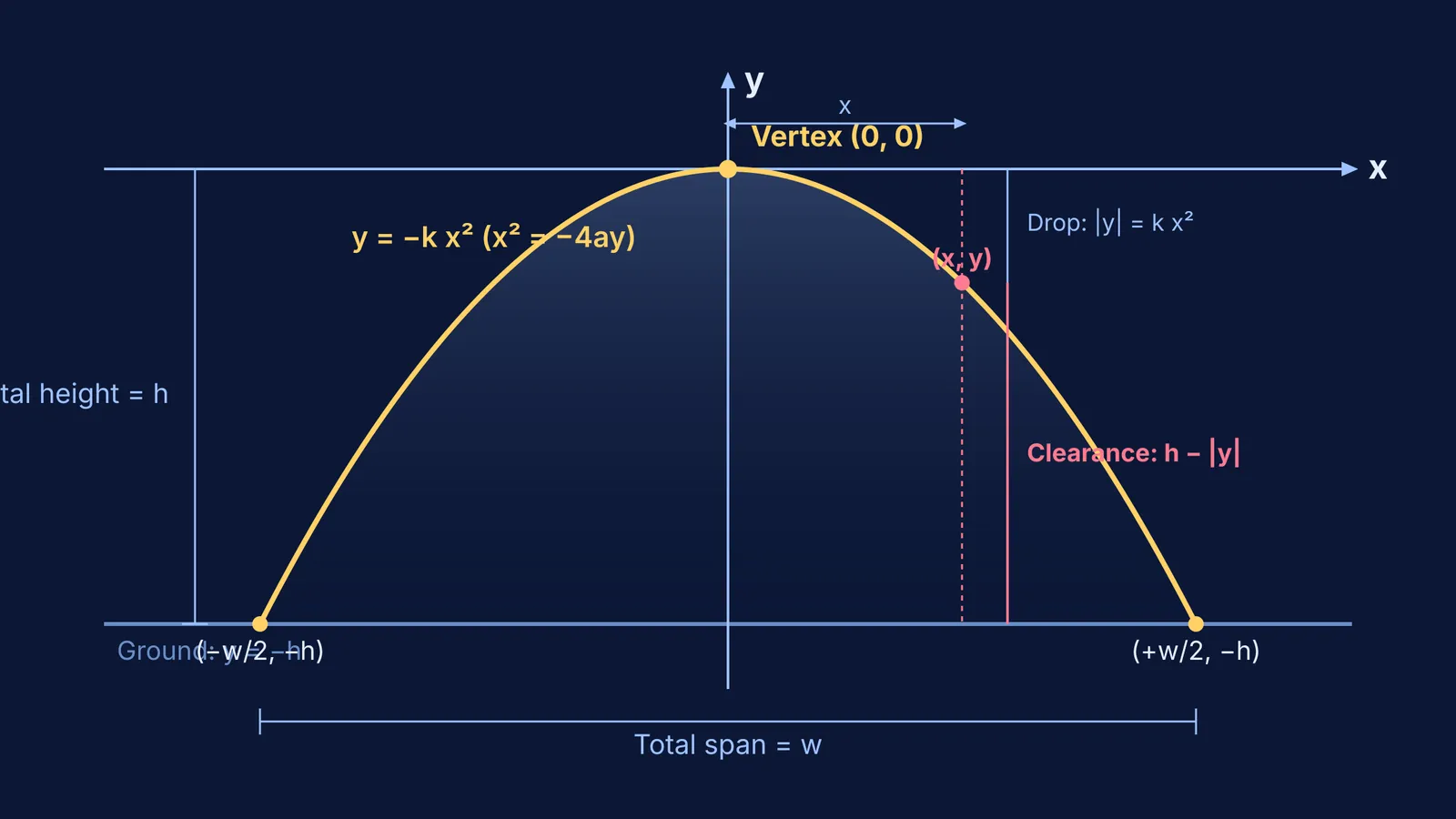
For an arch opening downward, place the origin (0, 0) directly at the crown—the highest point of the curve, as outlined in analytic geometry (OpenStax Precalculus). The horizontal tangent at the peak becomes the x-axis, and the vertical centerline becomes the y-axis.
In this coordinate frame, the parabola opens downward with equation: y = −k x², or x² = −4ay
Here, k = 1 / (4a) is the positive curvature parameter. Because the ground lies a vertical distance h below the crown, the ground line is y = −h, and the base touches the ground at (−w/2, −h) on the left and (+w/2, −h) on the right.
How do you find the height of a parabolic arch from its span?
Under the senior secondary mathematics curriculum outlined by CBSE Academic, finding the clearance height of an arch from its span follows three steps. Consider an arch 10 m high with a 40 m base span, where you need the height 10 m from the center:
Identify the boundary point: The ground lies at y = −10 m. With a span of 40 m, the half-span is 20 m, giving the right ground endpoint (20, −10).
Fit the curvature parameter: Substitute (20, −10) into y = −kx² to get −10 = −k(20)², which yields k = 10 / 400 = 1/40 (corresponding to 4a = 40 in x² = −4ay).
Compute the clearance height: At x = 10 m from the centerline, the vertical drop is y = −(1/40)(10)² = −2.5 m. The clearance height above the ground is 10 − 2.5 = 7.5 m.
If a problem instead specifies the vertical position and asks for arch width—such as an arch 10 m high and 5 m wide where width is needed 2 m from the vertex—substitute y = −2 m into x² = −(5/8)y to get x = (√5)/2 m, giving total width 2x = √5 ≈ 2.24 m.
How do you calculate suspension bridge cable lengths?
Suspension bridge cables hang downward from towers, forming an upward-opening curve. In structural mechanics and the physics of the catenary, when a cable supports a uniform horizontal roadway through vertical suspenders, the curve takes the shape of a parabola rather than a catenary.
In the standard bridge problem from the Class 11 curriculum, a 100 m roadway is supported by vertical wires: the longest wire is 30 m at the towers and the shortest is 6 m at the center. To find the wire length 18 m from the middle:
Set the vertex: Place (0, 0) at the cable's lowest point. The equation is x² = 4ay.
Establish the boundary: Towers stand at x = ±50 m. The cable rises 30 − 6 = 24 m at the towers, giving (50, 24).
Solve for 4a: Substituting (50, 24) gives 50² = 4a(24), so 4a = 2500/24 = 625/6.
Calculate wire length: At x = 18 m, 18² = (625/6)y, yielding y = (324 × 6)/625 ≈ 3.11 m. Adding the 6 m baseline gives a total wire length of 6 + 3.11 = 9.11 m.
For more on focal parameters across conic curves, see our guide on latus rectum length formulas.
What changes when the arch is semi-elliptical instead of parabolic?
Unlike a parabola, an ellipse has two independent semi-axes: the semi-major axis a (half the base span) and the semi-minor axis b (the crown height). As presented in OpenStax Precalculus, real-world arch problems model semi-ellipses centered at the base midpoint.
For a semi-elliptical arch 8 m wide and 2 m high at the center, to find the height 1.5 m from one end:
Write the equation: With the base center at (0, 0), a = 4 m and b = 2 m, giving x²/16 + y²/4 = 1.
Coordinate from center: The base ends at x = 4 m, so 1.5 m from the end is x = 4 − 1.5 = 2.5 m.
Solve for height: Substituting x = 2.5 gives 6.25/16 + y²/4 = 1, so y²/4 = 0.609375 and y = √(2.4375) ≈ 1.56 m.
For related curve techniques, read our guide on ellipse tangents, normals, and properties for JEE.
What are the common calculation pitfalls in conic word problems?
Most errors stem from simple coordinate mistakes:
Forgetting to halve the span: Substituting the total width instead of the half-span into x.
Overlooking baseline clearance: Calculating the rise y without adding the shortest central wire length.
Measuring from the edge: Substituting the distance from the outer pillar rather than the horizontal offset from the center.
Inverting the equation: Using x² = 4ay instead of x² = −4ay for a downward-opening arch.
When practicing these setups, the Fermi Problem Library offers worked problems with a step-by-step solver that explains the reasoning rather than printing an answer. For reviewing how parameters govern conic curves, the Fermi Concept Library covers every concept in mathematics, each with its own lesson and its place in the map.


