On this page
In the 1850s, Manchester ran on coal, and Scottish chemist Robert Angus Smith set out to show, by chemical analysis, that the smoke was changing the rain itself. He is credited with discovering acid rain and with giving it its name.
Who was Robert Angus Smith?
Smith was born in Glasgow in 1817, earned his PhD under Justus von Liebig at Giessen in 1841, then moved to Manchester to work with Lyon Playfair, according to his Wikipedia biography.
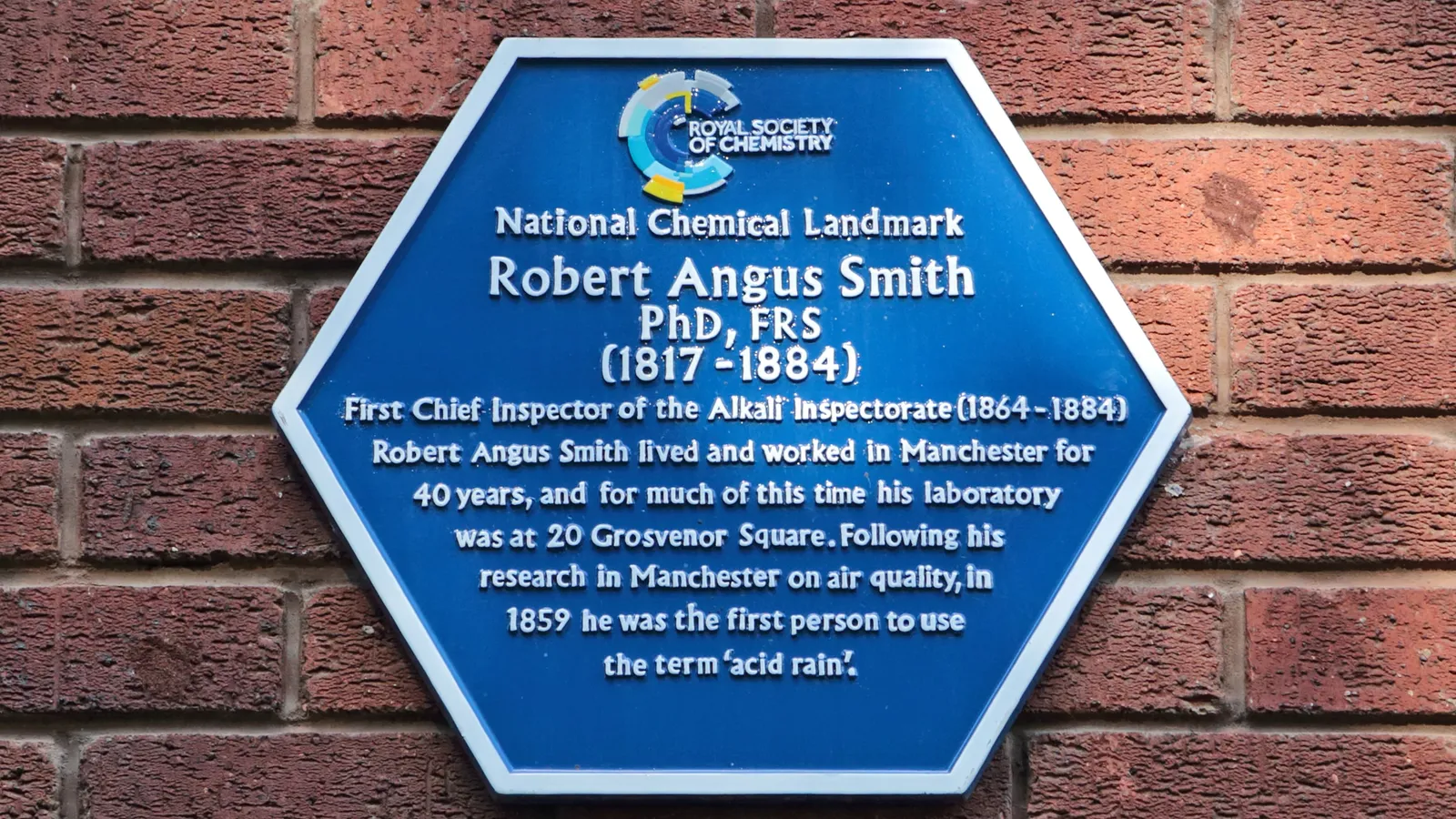
After the Alkali Act of 1863, Smith became the first Chief Inspector of the Alkali Inspectorate, serving from 1864 until his death in 1884, as the Royal Society of Chemistry's blue plaque at Manchester Metropolitan University records.
How did Smith discover acid rain in Manchester?
In June 1851 he caught rain in cleaned dishes from town to countryside, then tasted, boiled, evaporated and burned it. He reported the results in a paper read in 1852, *On the Air and Rain of Manchester*, reprinted in his 1872 book Air and Rain: The Beginnings of a Chemical Climatology.
Rain from Cavendish Street in town “is acid, and on boiling becomes very acid, until it may be readily tasted as sour”, while rain from Timperley, six miles out, “was strongly alkaline” (Air and Rain, pp. 229–230). He summed up the pattern:
“We may therefore find easily three kinds of air — that with carbonate of ammonia in the fields at a distance; that with sulphate of ammonia in the suburbs; and that with sulphuric acid, or acid sulphate, in the town.”
He tied the acid to everyday damage: “The presence of free sulphuric acid in the air sufficiently explains the fading of colours in prints and dyed goods, the rusting of metals, and the rotting of blinds.”
What did acid rain do to buildings and plants?
Smith noticed that stone and brick crumbled faster in large towns “where much coal is burnt”, and wrote that he “was led to attribute this effect to the slow, but constant, action of the acid rain” (Air and Rain, p. 444, quoting his study *On the Air of Towns*).
On plants, his conclusions in the Alkali Act report for 1868 set a threshold: when rain held “two to three grains” of acid in a gallon, “or forty parts in a million, there is no hope for vegetation” in a northern English climate (Air and Rain, p. 246). In the same list he wrote that sulphates “rise very high in large towns, because of the amount of sulphur in the coal used”, as well as from decomposition.
How acidic is acid rain today?
The US Environmental Protection Agency defines acid rain as any form of precipitation with acidic components such as sulphuric or nitric acid, formed mainly from sulphur dioxide and nitrogen oxides, most of which come from burning fossil fuels.
Normal rain has a pH of about 5.6, and acid rain usually has a pH between 4.2 and 4.4, according to the EPA.
How much acid was in the rain and in Smith's mortar?
1. How much more acidic? pH is a log scale, so each unit is a factor of 10 in hydrogen-ion concentration. Using the EPA's figures:
Find the pH gap: 5.6 − 4.4 = 1.2.
Raise 10 to that power: 10^1.2 ≈ 15.8.
So rain at pH 4.4 has about 16 times the H⁺ of normal rain; at pH 4.2 the factor is 10^1.4 ≈ 25.
2. Smith's crumbling mortar. He took 9.18 grains of rotten mortar from a building behind the house of the Literary and Philosophical Society of Manchester, precipitated the sulphate as barium sulphate and got 7.57 grains of it (Air and Rain, p. 444). He reported “28.33 per cent of sulphuric acid”; the arithmetic shows he meant SO₃.
Molar masses: BaSO₄ ≈ 233, SO₃ ≈ 80, CaSO₄ ≈ 136.
SO₃ in the precipitate: 7.57 × 80 ÷ 233 ≈ 2.60 grains.
Share of the mortar: 2.60 ÷ 9.18 × 100 ≈ 28.3%, matching his figure.
As calcium sulphate: 28.33 × 136 ÷ 80 ≈ 48.2%, matching his “48.16 per cent of sulphate of lime”.
By his figures, almost half the weight of that mortar was now calcium sulphate.
If step 2 is where you lose track, the Fermi Problem Library has worked problems with a step-by-step solver that explains the reasoning rather than printing an answer. If the log scale still feels abstract, the Fermi Simulation Lab has interactive simulations for ideas that are easier to see than to read.
What can you learn from Smith's method?
Compare places: town, suburb and field made the pattern visible.
Rule out your own error: he re-caught an oily-tasting sample in a platinum basin first kept red-hot, and found no difference.
Tie the number to a cause: sulphur in coal.
Next, read how Arnold Beckman invented the pH meter, try diluting strong and weak acids in a pH simulation, or check whether pH 7 is neutral at every temperature.