On this page
Post-it notes have two inventors, both at 3M. Chemist Spencer Silver made the weak, reusable glue in 1968, and colleague Art Fry turned it into a bookmark that would not fall out of his hymn book. It is neat chemistry, and a lesson in handling a result that looks like a failure.
Who invented Post-it notes?
In 1968 Spencer Silver (1941 to 2021) was a senior scientist at 3M working on new classes of adhesives, according to the National Inventors Hall of Fame. What he made was the opposite of a super-glue: tiny spheres giving “a high level of tack but a low degree of adhesion”.
The Lemelson-MIT Program describes the glue as “tiny, indestructible acrylic spheres” that could be used again and again. Silver pictured it as a spray or a surface for bulletin boards, and, according to The Register's obituary, spent five years trying to interest people at 3M.
Art Fry, another 3M researcher, sang in a church choir, and the paper slips marking his hymns kept falling out. After hearing Silver present the glue at a company seminar, Fry realised it would give his bookmarks the temporary hold they needed (Lemelson-MIT). A prototype note was made in 1974, and 3M later launched it in four US cities as Press 'n Peel (The Register). Post-it Notes went on sale across the United States in 1980 (National Inventors Hall of Fame).
Why does Post-it glue peel off without tearing the paper?
Silver's patent, US 3,691,140, “Acrylate copolymer microspheres”, was filed on 9 March 1970 and granted on 12 September 1972. It says most of the spheres are about 5 to 150 microns across.
Three properties in that patent do the work:
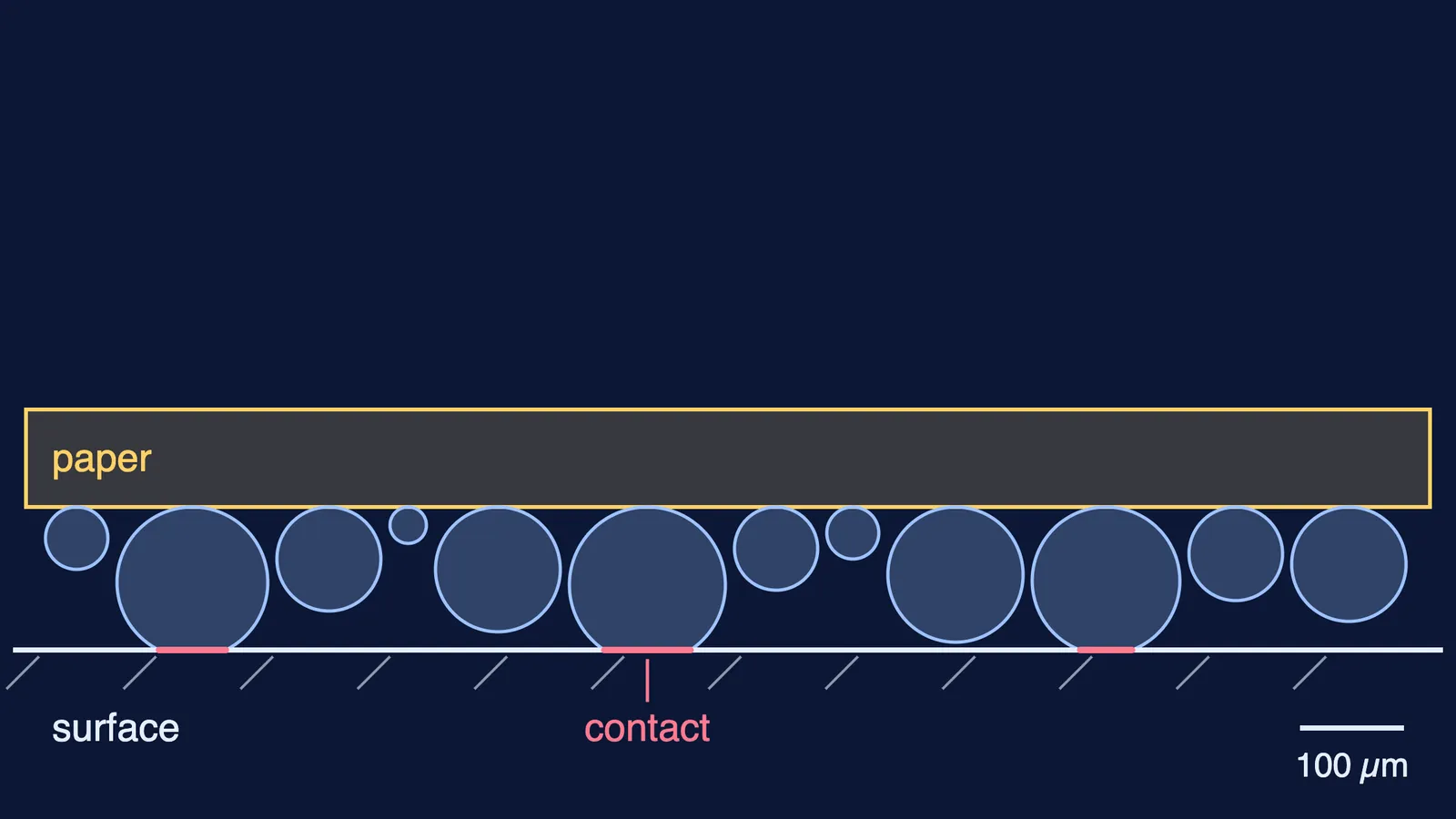
Spheres, not a film. Ordinary glue spreads into a flat layer. Silver's spheres stick “only where they were tangent to a given surface”, as Lemelson-MIT puts it, so only small patches touch.
Elastic. The patent calls them elastomeric, meaning rubbery: a sphere can squash a little when pressed and spring back when peeled.
They keep their shape. They are infusible and solvent-insoluble, so they do not melt or dissolve into a flat layer, and the paper can be stuck down again “without application of additional adhesive”.
The grip comes mainly from weak attractions between molecules where the spheres touch, the same family of forces explained in how house lizards walk on ceilings. Less contact means less total grip: enough to hold paper, not enough to rip its fibres.
How much of a sticky note actually touches the page?
Here is a rough estimate with numbers we chose for illustration, inside the size range in Silver's patent. It is not a measurement of a real note.
Picture spheres 50 microns across in a square grid. Each owns a patch of 50 × 50 = 2,500 square microns.
Suppose pressing flattens each sphere's bottom into a circle 10 microns across. Its area is π × 5² ≈ 79 square microns.
Contact fraction = 79 ÷ 2,500 ≈ 0.03, about 3%.
A smooth film of ordinary glue can cover nearly the whole area, roughly 30 times more than in this example.
Press harder and each patch grows, which is why running your thumb along the strip helps. Real spheres vary in size, so at first only the tallest reach the page, as in the diagram at the top of this post.
If contact area or intermolecular forces still feel abstract, the Fermi Concept Library has a lesson for every concept in physics, chemistry, biology, mathematics and computing. For how chain structure decides stretch and stickiness, read elastomers to fibres: polymers ranked by intermolecular force.
What can students learn from a glue that failed?
Silver's glue failed only against the goal he started with. Described by what it actually did, it was a useful property waiting for a job, like the burrs in how George de Mestral turned burdock burrs into Velcro. When an experiment, project or mock test goes wrong, run this five-question log:
What did I want? One line: “full marks on rotational motion”.
What did I get, as a property, not a verdict? “Right formula, wrong axis” beats “I'm bad at physics”.
Where is that result useful? It may be a pattern you can now spot in other questions.
Who should hear about it? Fry found the glue only because Silver kept presenting it. Tell a teacher or study partner.
What is the smallest next test? Fry tried bookmarks before anyone built a factory. Try one fresh problem of the same type tomorrow.
For question 2 on a maths or physics paper, the Fermi Problem Library has worked problems with a step-by-step solver that explains the reasoning, so you can find the exact step where your method went off.
The next yellow square you peel off a textbook is a 1968 lab result that took 12 years to reach the shops.