

On this page
George de Mestral did not invent Velcro by sitting down to design a fastener. He got annoyed by weeds stuck to his clothes, and then he got curious about them. That second step is the part you can copy.
How did George de Mestral invent Velcro from burrs?
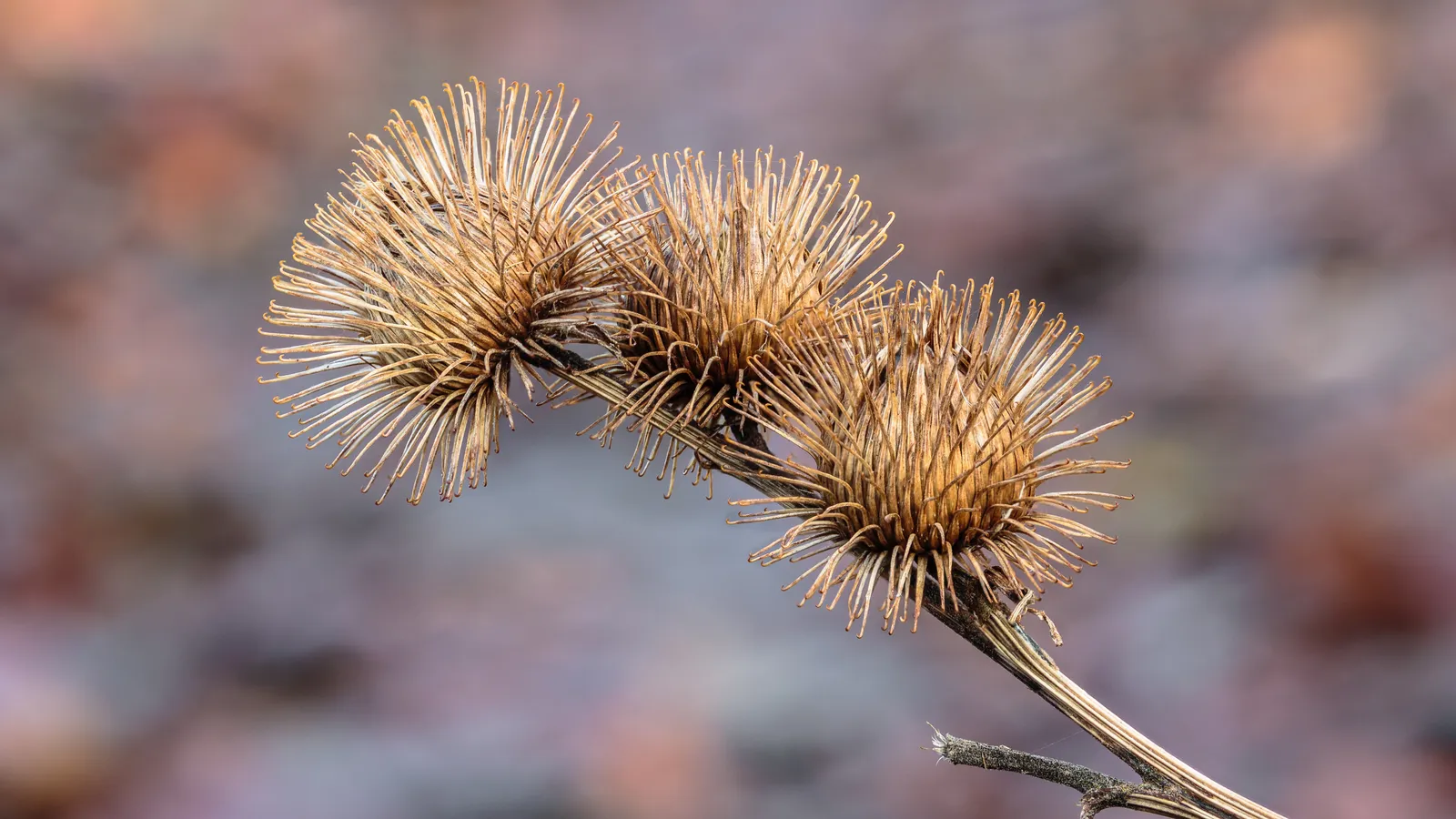
De Mestral was born in 1907 in Nyon, in the Swiss canton of Vaud, and studied at the Federal Institute of Technology in Lausanne, according to Swissinfo's history of the invention. One summer morning in 1941 he went on a hunting trip in the Jura mountains with his dog, and back home he found his trousers and the dog's fur covered in burdock burrs, as the World Intellectual Property Organization (WIPO) tells the story.
He put them under a microscope. The burrs were covered with hundreds of tiny but strong hooks, which is why they clung so tightly to cloth and fur (WIPO).
That gave him the design. One strip of fabric would carry thousands of tiny hooks like the burr, and the other thousands of soft loops (WIPO). Press them together and they hold; pull them apart and you can close them again. He named it Velcro, from the first syllables of the French words velours (velvet) and crochet (hook).
Biomimicry means finding solutions inspired by nature by learning from and copying its forms and processes, as the Biomimicry Institute describes it. Velcro is one of the best-known examples.
Why did it take years to turn burrs into a fastener?
Spotting the hooks was quick. Making a fastener took most of a decade: WIPO says it took nearly eight years of research and development with a weaver from a textile plant in France to reproduce the burr's grip (WIPO). His early designs used cotton, but he found that nylon worked much better.
Swissinfo reports that nylon sewn under infrared light formed tough hooks, and that few people took the idea seriously at first; several openly laughed at it (Swissinfo).
The patents track his progress. He filed Swiss patent CH295638 in 1951, it was granted in 1954, and patents in France and the United States followed (WIPO). The US patent, "Velvet type fabric and method of producing same", was granted on 13 September 1955; it describes nylon pile threads shaped into hooks by heat treatment, for use as "closing means or fasteners for garments, curtains and the like" (US 2,717,437 on Google Patents). The patent on his hook-and-loop fastener expired in 1978 (WIPO).
Is Velcro an exact copy of the burdock burr?
No, and this is the most useful lesson in the story. In a 2015 paper in Robotics and Biomimetics, Bruce E. Saunders tensile-tested burdock (Arctium minus) hooks and compared them with Velcro (Saunders, 2015). He found marked differences: the natural hooks have a needle-like profile for pushing in, they are not reusable, and they are a different size. In how it works, he concluded, Velcro resembles another plant, enchanter's nightshade (Circaea lutetiana), more than burdock.
So de Mestral kept the principle, many small hooks catching many loops, and changed the material, size and shape until the fastener could open and close again and again. Saunders calls the result a probabilistic fastener. Put simply, no single hook has to catch, because out of thousands, enough find a loop.
For the physics of why the two strips hold, read our explainer How does Velcro work and where did the idea come from?. For another surface that nature designed, see why water beads on lotus leaves.
How can you use de Mestral's method on your own questions?
Here is his path as five steps.
Notice the annoyance and write it as a question: why does this happen?
Look closer. De Mestral used a microscope; a magnifying glass or your phone camera zoomed in is enough to start.
Name the mechanism in one sentence, such as "hooks catch loops". If you cannot, look again.
Separate the principle from the part: what must stay, and what could change (size, material, shape)?
Build, test, and change one thing at a time. Expect many rounds.
A worked example, using an old hook-and-loop strip from a school bag or shoe:
Step 2: under a magnifier, one side shows stiff curved hooks and the other a soft mat of loops.
Step 3: hooks catch loops.
Step 4: predict before you test. Will the strip need more force if you peel it slowly from one end, or if you pull both strips straight apart all at once? Write your guess and the reason.
Step 5: try both, then compare the results with your guess.
If a step needs an idea you have not met yet, such as friction or how materials bend, the Fermi Concept Library has a lesson for every concept in physics, chemistry, biology, mathematics and computing, so you can read it and come back to your test.
More ideas for this are in our guide to encouraging curiosity at home.
Next time something sticks to you on a walk, take it home and look closer.


