

On this page
In 1941, the Swiss engineer George de Mestral went on a hunting trip in the Alps. When he returned, he found his wool trousers and his dog's fur covered in burdock burrs. While most people would simply pull them off and throw them away, de Mestral put one under a microscope. He saw that the burr was covered in hundreds of tiny, stiff hooks.
These natural hooks had caught onto the soft, flexible loops of his clothes and the dog's hair. This simple observation led to the invention of the hook-and-loop fastener, better known today as Velcro.
What is biomimicry?
The invention of Velcro is a classic example of biomimicry: looking to nature to solve a human engineering problem. De Mestral realised that if he could duplicate the burr's hooks and the fabric's loops in a synthetic material, he would have a reusable fastener that could be used on almost anything.
Taking a design from a plant and turning it into a mass-produced product was not easy. He spent ten years trying to manufacture his idea. De Mestral initially tried to use cotton, but the cotton hooks proved too soft and wore out quickly. He eventually settled on nylon, a relatively new synthetic material at the time. Nylon was durable and, crucially, could be heat-treated. De Mestral discovered that heating nylon under infrared light caused it to form tough, permanent hooks that would not easily snap or lose their shape. He patented the final hook-and-loop design in 1955 (Wikipedia; NIHF).
How do the hooks and loops catch?
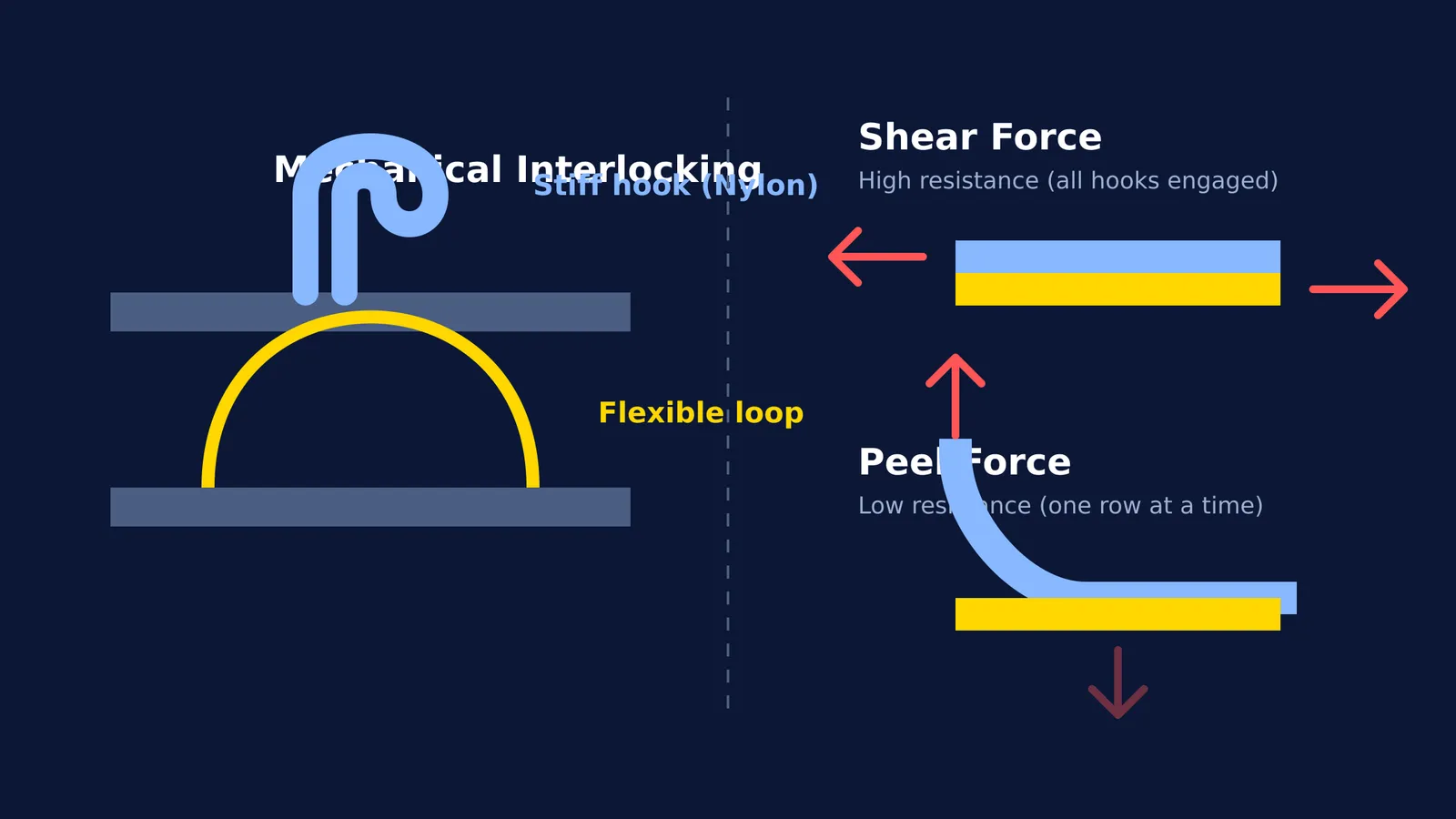
A hook-and-loop fastener works entirely through mechanical interlocking. There are no chemicals or adhesives holding the two sides together. One side is covered in thousands of stiff nylon hooks, while the other side is a soft surface made of thin, flexible multifilament loops.
When you press the two sides together, the stiff hooks push past the loops and snag them. Because there are so many hooks packed into a small area, they create a strong, distributed bond. When you pull them apart, the loops temporarily stretch and deform, allowing the hooks to slip out. The characteristic ripping sound is the rapid snapping of hundreds of hooks releasing their stored energy at once. Once separated, both the hooks and the loops spring back to their original shapes, ready to be used again.
What are the physics of shear and peel forces?
The physical strength of a hook-and-loop fastener depends almost entirely on the direction of the force you apply to it. There are two main ways to pull the two surfaces apart:
Shear force (sliding): If you try to slide the two strips parallel to each other, you are pulling almost all the engaged hooks against their loops at the exact same time. This simultaneous, distributed resistance requires a huge amount of force. Standard nylon fasteners can resist a shear force of 10 to 15 pounds per square inch (HookandLoop). This is why a surprisingly small square of Velcro can hold a heavy object on a wall.
Peel force (unzipping): If you pull one strip back from the edge, like peeling a banana, you are only fighting one row of hooks at a time. The force is concentrated on a thin line, requiring only about 1 pound of force per inch of width to separate the strips.
When you use Velcro on shoes or a backpack, you are relying on its high shear strength to hold the straps tight against pulling forces, and its low peel strength so you can open it easily with one hand. Understanding how forces act at different angles is a core part of mechanics, much like calculating the minimum force to drag a block across a rough floor.
How can you see contact forces in action?
Hook-and-loop fasteners are a brilliant everyday example of contact forces. When two surfaces meet, the microscopic way they interlock dictates how they behave on a large scale. If you are studying mechanics — such as the contact force between blocks pushed together — drawing the free-body diagram helps you see exactly where the force is applied and how it is distributed.
For the ideas that are easier to see than to read, you can model forces, tension and friction directly in the Fermi Simulation Lab.


