On this page
A headline says "a new study shows" something surprising. Before you believe it or forward it, ask one question: has anyone outside the team checked this work? That check is called peer review, and knowing how it works tells you how much weight a study can carry.
What is peer review?
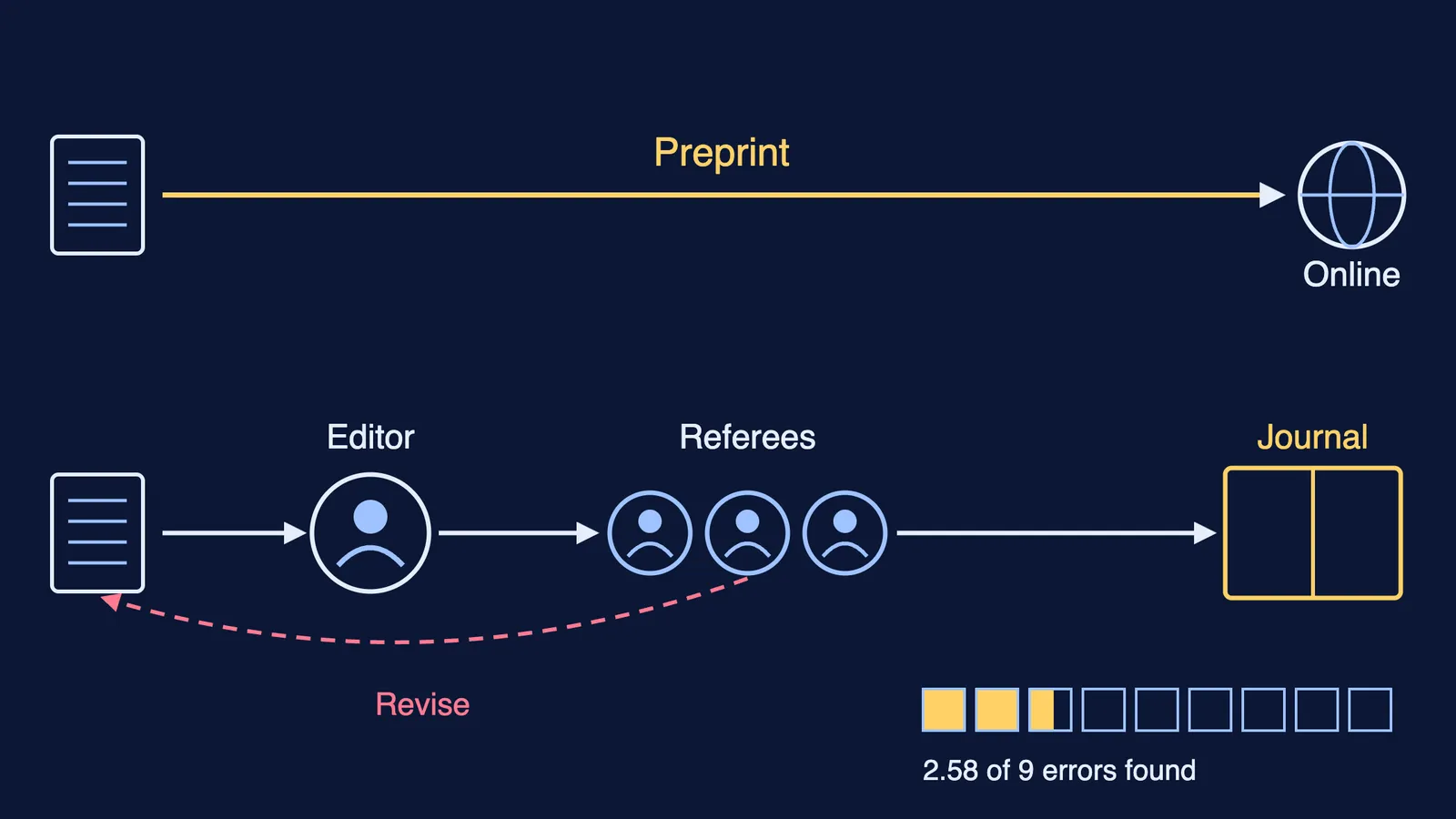
Peer review is the check a journal runs before it publishes a research paper: independent experts in the same field read the manuscript and judge whether its methods and conclusions hold up. Nature's description of its editorial process shows the usual steps:
Editor's screen. An editor first decides whether the paper is worth sending out at all. At Nature, authors are usually told within a week if it is not being considered.
Referees. Most papers go to two or three referees, who must declare competing interests.
Reports. The referees write reports on what is wrong, missing or overclaimed. Nature asks for these within about two weeks.
Revise and resubmit. Nature says every article it publishes goes through at least one round of review, usually two or three.
Decision. The editor, not the referees, makes the final call.
Think of a strict teacher checking your lab report: they read it closely, but they do not redo your experiment.
What does peer review catch, and what does it miss?
Researchers have tested the testers by planting mistakes in papers. In a randomised trial published in JAMA in 1998, researchers at the BMJ took a paper already accepted for publication, inserted 8 weaknesses and sent it to 420 reviewers from the journal's database. Of the 221 who replied, the average reviewer commented on only 2 of the 8 weaknesses.
A larger BMJ trial reported in 2008 gave 607 reviewers test papers containing nine major errors each. On the first paper, reviewers found an average of 2.58 of the nine major errors, and short training courses improved this only slightly. The error found most often was biased randomisation, a flaw in how patients were split into groups.
What these trials suggest:
Easier to catch: a big, visible flaw in the design, like biased randomisation, which over 60% of the BMJ reviewers who rejected the papers spotted.
Easier to miss: the rest of the list. Across the three test papers, the average reviewer found at most a third of the major errors.
Out of reach: anything the paper does not show. Referees read the manuscript; they do not visit the lab or rerun the experiment.
Sometimes the miss is serious. In 2010 The Lancet formally retracted a paper60175-4) on bowel disease and developmental disorder in children that it had published in 1998. Other findings pass review honestly and still fail when other labs repeat them, as happened with the ego depletion studies on willpower.
How is a preprint different from a peer-reviewed paper?
A preprint is a complete research paper that the authors post online before, or while, a journal reviews it. Scientists use preprints to share results quickly and get comments early.
Two major preprint servers say plainly that they do not peer review. arXiv, founded by Paul Ginsparg in 1991 and now serving physics, mathematics, computer science and other fields, runs a moderation check for topic and scholarly value but states that material "is not peer-reviewed by arXiv". bioRxiv, founded by Cold Spring Harbor Laboratory in 2013 for the life sciences, screens for non-scientific content and plagiarism, but its articles "are not peer-reviewed, edited, or typeset before being posted online."
Preprints are not bad science. bioRxiv lets authors post before or alongside submitting to a journal, so many preprints are later reviewed and may change. But a preprint has had fewer outside eyes on it, so treat its claims as early.
How can you tell if a study was peer reviewed?
Use this five-step check on any "study shows" claim:
Find the original. Look for a link, a DOI (a code starting with 10.) or the journal's name. No source at all is a red flag.
Check where it lives. A web address on arxiv.org, biorxiv.org or medrxiv.org means a preprint.
Look for a retraction or correction notice on the paper's page.
Read the abstract, not just the headline. Our guide on using AI to understand a research paper abstract walks you through it.
Ask how big. One small study is weaker than several larger ones that agree.
Here is a worked example. Say a family WhatsApp group shares "Scientists find a fruit that doubles memory". You trace the link to biorxiv.org. Step 2 tells you it is a preprint. The abstract (step 4) says the test was done in mice. A fair reply to the group: "An early, unreviewed mouse study suggests a possible effect. Worth watching, not worth changing your diet over."
Papers often lean on ideas from school science, such as control groups, sample size and blinding, which our explainer on the placebo effect and blinded trials covers. If a term in a methods section stops you, the Fermi Concept Library has a lesson for every concept in physics, chemistry, biology, mathematics and computing, so you can fill the gap and get back to the paper.