On this page
You take a tablet for a headache and feel better almost at once. Part of that relief may be the placebo effect. Here is how strong it really is, and why trials are built around it.
What is the placebo effect?
A placebo is "an inactive substance that looks like the drug or treatment being tested", in the words of the US National Center for Complementary and Integrative Health (NCCIH).
The placebo effect is "a beneficial health outcome resulting from a person's anticipation that an intervention will help", according to the same NCCIH page.
A placebo can be a sugar pill, a saltwater injection or a fake procedure; it looks real and does nothing on its own.
Is the placebo effect real, and how strong is it?
It is real, but smaller and narrower than its reputation. In 2001, Asbjørn Hróbjartsson and Peter Gøtzsche reviewed 130 trials that randomly gave patients either a placebo or no treatment (New England Journal of Medicine). Placebo had no significant effect on objective outcomes. In 27 pain trials it had a small benefit: about 6.5 mm on a 100 mm pain scale.
Their updated Cochrane review covered 234 trials across 60 conditions. It found no important clinical effects of placebo in general, but said placebos can influence what patients report, especially pain and nausea. The authors added that it is hard to separate a true placebo effect from biased reporting.
So there is no good evidence that a dummy pill clears an infection; it can change how you feel and what you report.
In a three-week trial with 80 people with irritable bowel syndrome, patients who were openly told their pills were placebos (and told placebos had helped IBS in earlier studies) still reported more improvement than a no-treatment group (Kaptchuk and colleagues, PLoS ONE).
Why do clinical trials use control groups and blinding?
People get better for many reasons: illnesses run their course, symptoms rise and fall, and patients who feel watched report differently. If most people improve on a new drug, you cannot tell how many would have improved anyway. A control group answers that: comparing the two groups, as NCCIH puts it, suggests whether changes come from the treatment or occur by chance. Our explainer on why experiments need a control group walks through the same logic for school biology.
Three design rules make the comparison fair:
Randomisation: chance, not the doctor, decides who gets what, so the groups start alike.
Placebo control: the control group gets an identical-looking dummy, so both groups expect to be treated.
Blinding: in a double-blind trial, neither the patients nor the people measuring results know who got what.
Blinding matters most when the outcome is a judgement call. An analysis of 1,346 trials found that trials without blinding exaggerated treatment effects for subjective outcomes, but showed little bias for objective ones such as death from any cause (Wood and colleagues, BMJ). The same habit of fair comparison is behind the question of whether generic medicines work as well as branded ones.
What is the nocebo effect?
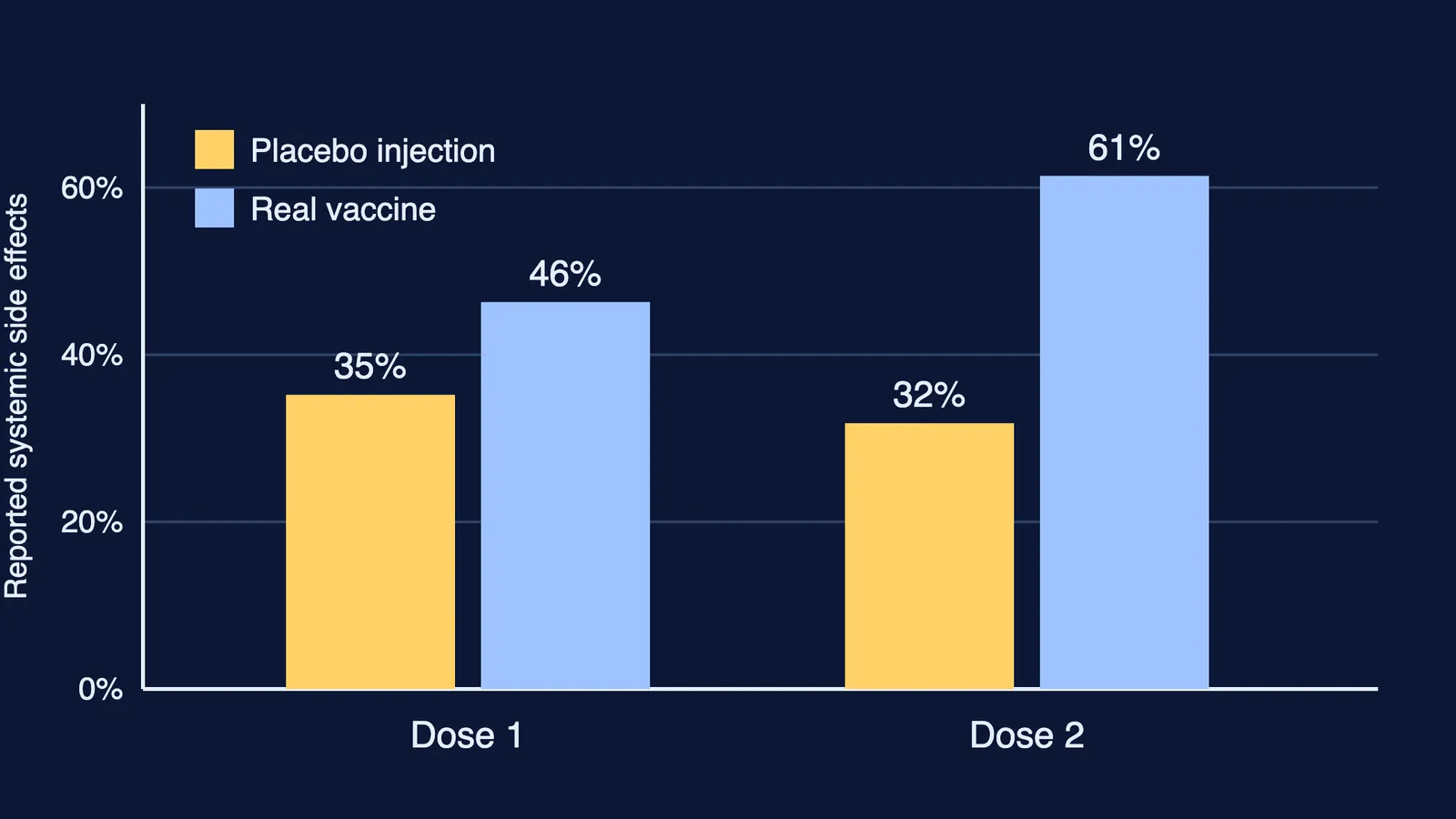
The nocebo effect is the reverse: expecting harm makes people feel harm. A meta-analysis of COVID-19 vaccine trials covering 45,380 participants found that 35.2% of people given a placebo injection reported systemic side effects such as headache and fatigue after the first dose (Haas and colleagues, JAMA Network Open). The authors estimated that nocebo responses accounted for 76% of systemic side effects after the first dose and 51.8% after the second. Vaccine recipients still reported significantly more side effects, so those were real too.
The everyday lesson: reading a long list of side effects can make you notice ordinary aches; if one worries you, ask the doctor or pharmacist who gave you the medicine.
How can you test a claim the way a trial would?
Worked example. Before board exams, a family WhatsApp group praises a "memory booster" drink: "Everyone who tried it felt sharper." Run it through five questions:
Compared with what? No control group. Students who skipped it may also feel sharper as revision builds up.
Who chose? The people who bought it wanted it to work.
Who knew? Everyone knew what they drank, so expectation alone could explain "feeling sharper".
What was measured? A feeling, the kind of outcome most open to placebo and bias.
How many, and was it repeated? A few people, once. Famous findings often shrink on retesting, as our piece on what the ego depletion replications found shows.
Verdict: untested, not disproved. A fair test would randomly give half the group the drink and half an identical-tasting dummy, keep everyone (including whoever marks the papers) blind, and compare scores on the same mock test.
To revise experimental design, the Fermi Concept Library has a lesson for every concept in biology, chemistry, physics, mathematics and computing. If an exam question on controls trips you up, Fermi's AI tutor can work out what you already know and build a plan for the session.
If health worries feel heavy, talk to a parent, a school counsellor or a doctor.