On this page
The chemist offers a strip with an unfamiliar name at a fraction of the price. Same medicine, they say. Is it? The molecule doing the work is identical, and regulators test that it reaches your blood in the same way. Here is what that testing means and how to check a strip yourself.
Are generic medicines the same as branded?
A tablet holds the active ingredient, the molecule that acts on your body, and excipients: fillers, binders, coatings and colours. The US Food and Drug Administration requires a generic to have the same active ingredient, strength, dosage form and route of administration as the brand-name drug (FDA, Generic Drug Facts).
What may differ is the outside. The FDA allows minor differences in appearance, such as colour, and says these do not affect how the medicine works (FDA, Generic drugs: questions and answers). The same page notes that in a minority of patients, inactive ingredients may affect tolerability or absorption.
How do regulators test that a generic works the same?
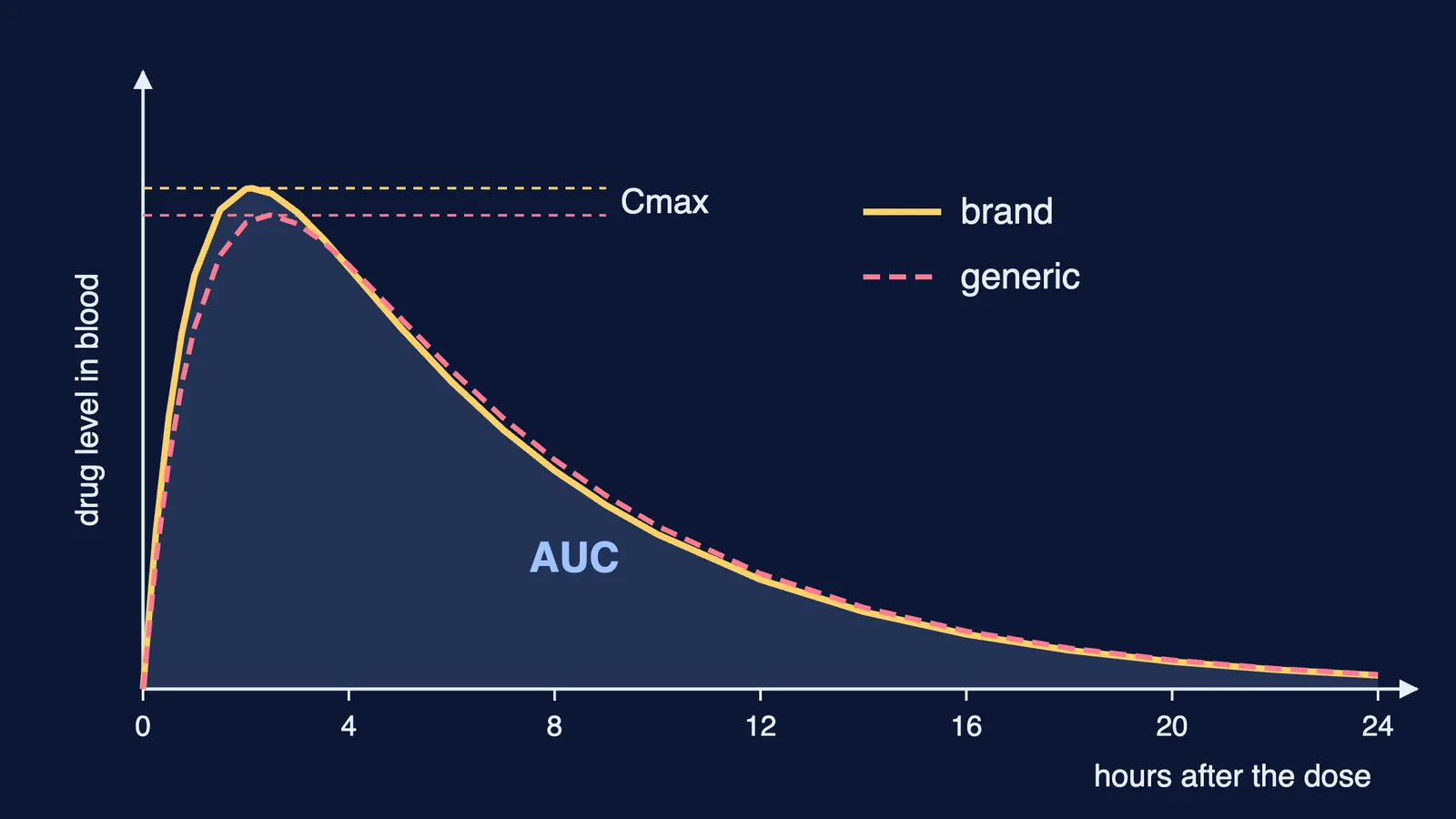
They run a bioequivalence study. Healthy volunteers take the generic on one occasion and the brand on another, and blood samples trace the drug level over time. Two numbers come out of each curve: Cmax, the highest level reached, and AUC, the area under the curve, which measures the total amount absorbed. It is the same rise-and-fall curve from our explainer on why medicine is taken every few hours.
India's drug regulator says bioequivalence is achieved when the rate and extent of absorption are not statistically significantly different from those of the reference product at the same dose (CDSCO, bioavailability and bioequivalence). Health Canada's guidance sets a numeric test: the 90% confidence interval of the generic-to-brand AUC ratio must lie within 80.0% to 125.0%, and the average Cmax ratio must also fall within 80.0% to 125.0% (Health Canada, comparative bioavailability standards). For critical dose drugs such as warfarin, the same guidance narrows the AUC interval to 90.0% to 112.0%.
Does the 80-125% rule mean a generic can have 20% less drug?
No. For AUC, the whole 90% confidence interval, not just the average, has to sit inside the window (Health Canada). Two made-up results show why:
Generic A: average AUC ratio 97%, interval 92% to 102%. Everything is inside 80-125%, so it passes.
Generic B: average 85%, interval 76% to 95%. The lower end falls below 80%, so it fails, even though its average is inside.
Real data agree. An FDA team reviewed 2,070 bioequivalence studies of generics approved from 1996 to 2007 and found the average difference from the brand was 4.35% for Cmax and 3.56% for AUC (Davit et al., Annals of Pharmacotherapy, 2009). In nearly 98% of those studies, AUC differed by less than 10%.
Do matching blood levels mean matching results in patients? A systematic review and meta-analysis of 47 studies of heart medicines, 38 of them randomised trials, found no evidence that brand-name drugs were superior to generics (Kesselheim et al., JAMA, 2008). That included all 5 randomised trials of warfarin, a blood thinner where small dose changes matter.
Why does the generic cost so much less?
The brand company paid for discovery and clinical trials. A generic maker does not have to repeat the animal and clinical studies; it proves bioequivalence instead (FDA, Generic Drug Facts). Competition does the rest: in the US, the same FDA page says a single generic competitor can lead to price reductions of 30%, and five competitors are associated with drops of nearly 85%.
In India, you can see the gap at a Jan Aushadhi Kendra. The March 2026 government backgrounder says over 18,000 Kendras are operational, with MRPs generally 50-80% lower than comparable branded medicines, bought from WHO-GMP compliant makers and batch-tested in NABL-accredited labs (PIB backgrounder on PMBJP).
How do you check a generic before you switch?
Use this checklist at the counter:
Read the molecule name printed on the strip, not the brand name.
Match the strength: 500 mg is not 650 mg.
Match the form. SR, ER, CR or XL mean modified release, not a plain tablet.
If the brand lists two molecules, the generic must list the same two.
Mention allergies to dyes or lactose, since excipients differ between makers.
For medicines where the dose must be precise, such as warfarin, ask your doctor before switching.
A script you can use: This is a generic of my prescribed medicine. Can you confirm it has the same molecule, strength and release type?
This is everyday guidance, not medical advice. If a new strip seems to act differently, talk to your doctor or pharmacist before changing anything.
If AUC or confidence intervals feel shaky, the Fermi Concept Library has every concept in physics, chemistry, biology, mathematics and computing, each with its own lesson. Next, read how antihistamines and tranquilizers pick their target, or see six places pharmacists work after B Pharm.