On this page
B.Pharm runs eight semesters under the Pharmacy Council of India's regulations and syllabus, and it leads to jobs that look nothing alike: a hospital dispensary, a chemist counter, a tablet line, a testing lab, a regulatory desk, a research bench. Here is what each involves and how to test them.
What can you do after B Pharm?
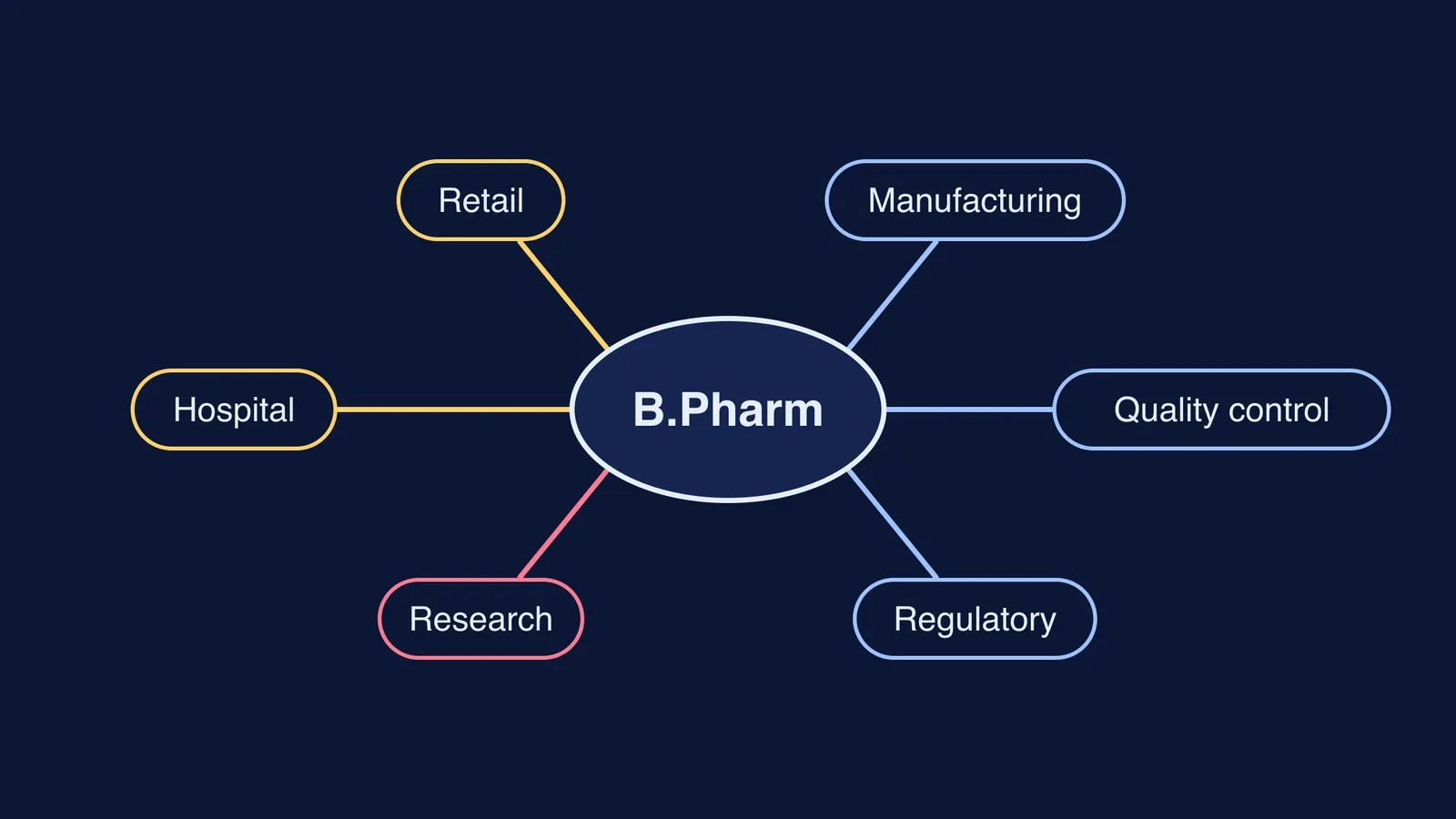
Most roles fall into six groups:
Hospital pharmacy: dispensing to wards and outpatients, checking prescriptions and managing medicine stock.
Retail (community) pharmacy: the chemist counter, where you dispense and explain doses to the public.
Manufacturing: running and recording batches of tablets, injections and syrups in a plant.
Quality control and quality assurance: testing raw materials and finished batches, and checking the system that makes them.
Regulatory work: preparing the files companies submit to regulators, or inspecting companies as a government Drugs Inspector.
Research: formulation, analytical methods, pharmacology and clinical research, usually after a master's degree.
The industry behind four of these is large. India's pharmaceutical industry is the world's 3rd largest by volume and 11th largest by value, according to the Department of Pharmaceuticals Annual Report 2025-26. The same report says India supplies about 20 percent of the world's generic medicines.
Which pharmacy jobs need a registered pharmacist?
Hospital and retail work depend on one rule. Under Section 42 of the Pharmacy Act, 1948, no person other than a registered pharmacist may compound, prepare, mix or dispense medicine on a doctor's prescription, with narrow exceptions for doctors dispensing to their own patients.
The work is patient-facing: reading prescriptions, spotting a duplicate or a clash between medicines, and explaining how to take a dose. The B.Pharm syllabus prepares you for it through Pharmacy Practice and the Practice School in Semester VII. If you like talking to people more than running instruments, start here.
What do manufacturing and quality control jobs involve?
Factories run on written rules. On 28 December 2023 the government notified a revised Schedule M, its good manufacturing practice rules for medicine makers, the Press Information Bureau reported. Large manufacturers had to comply from 28 June 2024, and smaller firms that filed an upgrade plan had until 31 December 2025.
In practice, a production pharmacist runs a batch and records each step, a quality control analyst tests samples against standards, and quality assurance staff review the records and investigate anything that went wrong. Industrial Pharmacy, Quality Assurance and Instrumental Methods of Analysis are the courses that map onto this work. Read more on production jobs in pharmaceutical companies for B.Pharm graduates.
Can a B Pharm graduate become a Drugs Inspector or work in regulatory affairs?
Yes to both. Rule 49 of the Drugs and Cosmetics Rules, 1945%20dt_19.10.1993_%20Rule%2049_Qulaification%20of%20Inspectors.pdf), as substituted in 1993, says an Inspector must hold a degree in pharmacy or pharmaceutical sciences, or in medicine with a specialisation in clinical pharmacology or microbiology. To inspect plants making Schedule C products, an Inspector also needs at least 18 months of manufacturing or testing experience, or three years of inspecting such firms.
On the company side, regulatory affairs staff prepare and track the documents a product needs for approval. Pharmaceutical Jurisprudence (Semester V) and the Pharmaceutical Regulatory Science elective (Semester VIII) are your first taste. See what a regulatory affairs career involves day to day.
Do you need an M.Pharm for research jobs?
Research roles often ask for a master's degree. On the way to one, GPAT is "a national level examination for awarding scholarships to qualified candidates seeking entry into the Master of Pharmacy (M. Pharm) course", according to the National Board of Examinations in Medical Sciences, which conducts it with the Pharmacy Council of India. Our guide to research careers after B Pharm, M Pharm and PhD covers the steps beyond that.
If an idea such as reaction mechanisms or receptor binding never quite made sense, the Fermi Concept Library has a lesson for every concept in chemistry and biology, so you can rebuild it.
How do you choose between hospital, retail and industry?
Use the semesters you already have as trial runs, and after each one write down what you enjoyed and what drained you.
Semester V: Industrial Pharmacy I and Pharmaceutical Jurisprudence. Did process and rules interest you?
Semester VI: Quality Assurance. Did checking and documenting feel satisfying or tedious?
Semester VII: Pharmacy Practice and Practice School. If you lean towards patients, ask whether your college can place you in a hospital or community pharmacy.
Semester VIII: pick the elective that matches the path you are testing (Pharmaceutical Regulatory Science, Pharmacovigilance or Experimental Pharmacology) and treat Project Work as a small research trial.
When you visit a pharmacy, plant or lab, ask three questions: "What did you do in the last hour?", "What mistake would worry you most here?" and "What did you study after B.Pharm to get this job?"
If you are not sure where to begin revising the chemistry and biology behind these courses, Fermi's AI tutor can work out what you already know and build a plan for the session, so you start with a clear next step.