On this page
In short India ranks third globally in pharmaceutical production volume, making production roles a stable career path for B.Pharm graduates. Starting as a Production Officer, you oversee the manufacture of tablets and injections and enforce strict cleanroom standards, such as the ISO Class 5 limit of 3,520 particles per cubic metre.
The pharmaceutical industry is one of the most reliable employers for B.Pharm graduates in India. Because India ranks third globally in pharmaceutical production by volume, companies need trained professionals to run their manufacturing plants. A career in production puts you directly on the shop floor, turning raw chemical ingredients into finished medicines.
If you are looking at production jobs in pharmaceutical companies for B.Pharm graduates, you will typically start as a Production Officer or Trainee. This role requires technical knowledge of machines, strict adherence to rules, and the ability to manage operators and technicians.
What do production jobs in pharmaceutical companies involve?
As a Production Officer, your main job is to ensure that medicines are manufactured according to standard operating procedures (SOPs) and Good Manufacturing Practices (GMP). You act as the link between the management and the shop-floor operators.
Your daily tasks will include checking the weights of dispensed raw materials, setting up machinery, and maintaining detailed documentation. In the pharmaceutical industry, the rule is "if it is not documented, it did not happen." You will fill out Batch Manufacturing Records (BMR) and Batch Packing Records (BPR), which are critical when regulatory bodies inspect the plant. With India hosting 703 USFDA-approved pharmaceutical plants, following these global rules is non-negotiable.
What happens in tablet manufacturing?
Tablet production is known as Oral Solid Dosage (OSD) manufacturing. This is a non-sterile process, meaning the product does not need to be completely free of microorganisms, but it must still be highly controlled.
The process involves several stages:
Dispensing: Weighing out the Active Pharmaceutical Ingredients (APIs) and excipients.
Granulation: Mixing the powders to form granules.
Compression: Using high-speed presses to shape the granules into tablets.
Coating: Adding a protective or coloured layer to the tablets.
These activities are typically carried out in an ISO Class 8 (Grade D) environment. While the air is filtered, it is not as strict as the areas where injections are made.
What are the cleanroom rules for injection manufacturing?
Manufacturing injections (sterile liquids or freeze-dried powders) is the most critical and sensitive area of pharma production. It requires an environment called a cleanroom, where airborne particles and microbes are strictly limited.
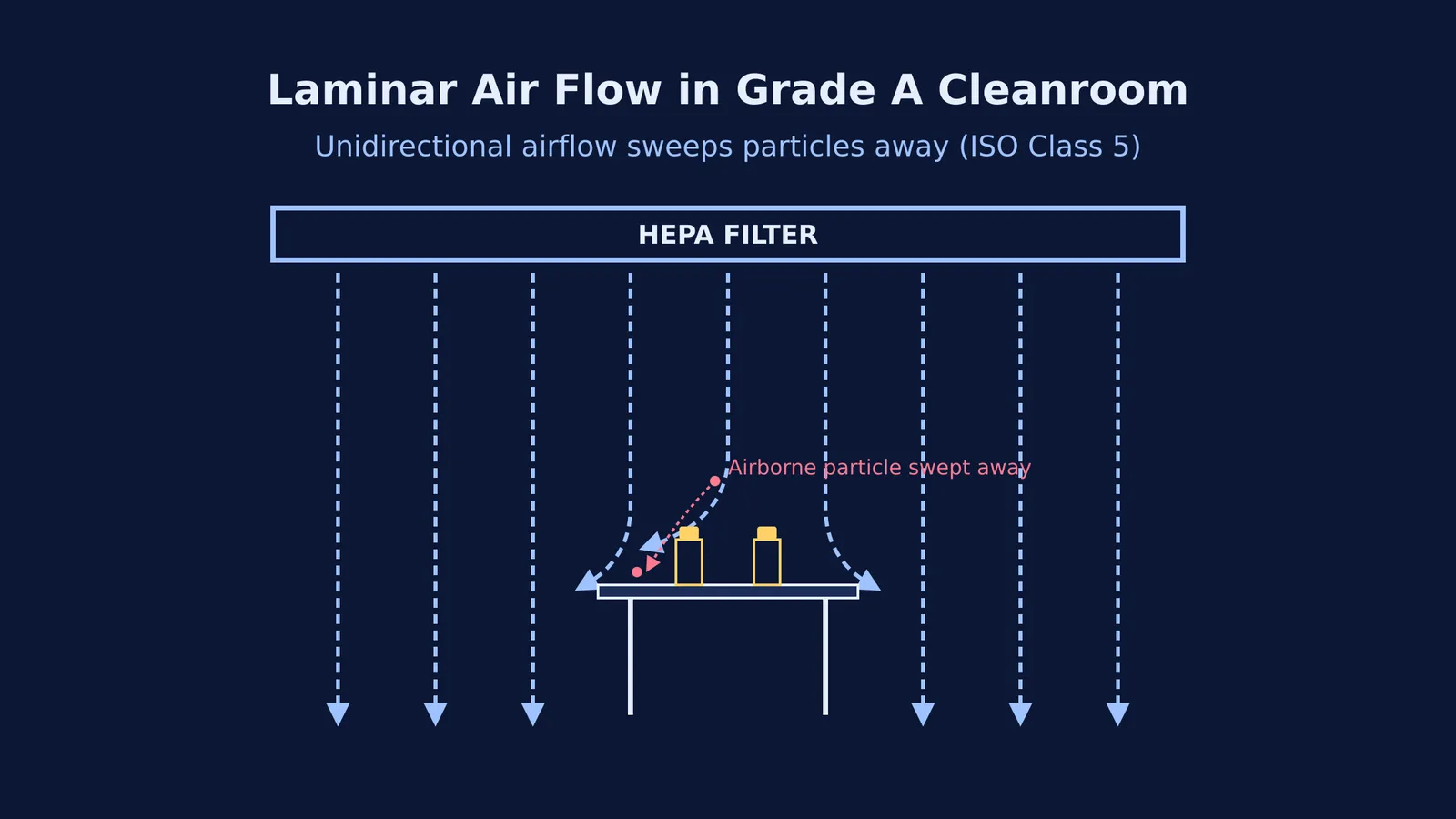
Injectables must be filled into vials or ampoules in an ISO Class 5 (Grade A) environment. Under this specification, the air must not contain more than 3,520 particles of 0.5 µm size per cubic metre, both when the room is at rest and during operation.
To maintain this standard, a Production Officer in a sterile facility must follow strict rules:
Gowning: You must wear full-body sterile coveralls, hoods, masks, goggles, and double gloves. No skin can be exposed.
Airflow: Laminar Air Flow (LAF) and HEPA filters push a constant stream of clean air downwards, sweeping particles away from the product.
Movement: You must move slowly and deliberately. Fast movements generate particles and disrupt the protective airflow.
Understanding the physics of fluids and heat transfer—like how an autoclave sterilises equipment with steam—is crucial here. If you need to review the science behind these processes, you can explore the Fermi Concept Library, which covers the core principles of physics and chemistry. Similarly, maintaining pure water systems is critical; you can read about the related physics of osmotic pressure in How an RO water purifier works.
What is the career growth and salary for B.Pharm in production?
The career path in production is well-structured. For a fresher, the starting salary as a Trainee or Junior Production Officer typically ranges from ₹1.8 Lakhs to ₹3.0 Lakhs per annum. However, this increases steadily as you gain experience and technical expertise.
The typical growth path is:
Trainee / Junior Officer: (0–2 years) Learning the machines and documentation.
Production Officer / Executive: (3–5 years) Running shifts independently.
Assistant Manager: (6–10 years) Managing multiple shifts and handling internal audits.
Plant Head: (15+ years) Overseeing the entire manufacturing facility.
If you are looking for your first job, it helps to understand the wider market. For more on getting hired, see How to get a job off campus as a fresher in India.
If you are deciding between different paths, such as further study or working in a lab instead of a plant, you might also want to read Should You Do an MSc or a Job After a BSc in Chemistry? (many of the same decision factors apply to a B.Pharm). Production demands long hours and shift work, but it offers a clear, stable path to senior management for those who master the art of clean, precise manufacturing.