

On this page
For students finishing a degree in pharmacy or the life sciences, the standard career paths usually look like working in a research laboratory or moving into medical sales. But the pharmaceutical industry relies on another critical function: regulatory affairs.
A regulatory affairs professional acts as the bridge between a pharmaceutical company and government regulatory agencies (source). Their job is to ensure that a new drug, biologic or medical device meets all legal, safety and scientific requirements throughout its lifecycle.
If you prefer reading clinical data, understanding the law and planning a strategy over running experiments at a lab bench, this desk-based career offers a way to use your scientific training to have a direct impact on public health.
What does a regulatory affairs professional do?
Every medicine has gone through years of testing. Before a company can sell it, they must prove to a regulator—such as the US Food and Drug Administration (FDA) or India's Central Drugs Standard Control Organization (CDSCO)—that the drug works and is safe.
A regulatory team compiles the scientific evidence from clinical trials and manufacturing tests into a massive application called a dossier. They must understand the exact guidelines of the country they are applying to. They also answer queries from the regulators. If a reviewer asks why a certain chemical test was skipped, the regulatory professional works with the company's scientists to write a scientific defence of their methods. Reviewers like Frances Kelsey rely on these dossiers to ensure public safety.
What is the Common Technical Document (CTD)?
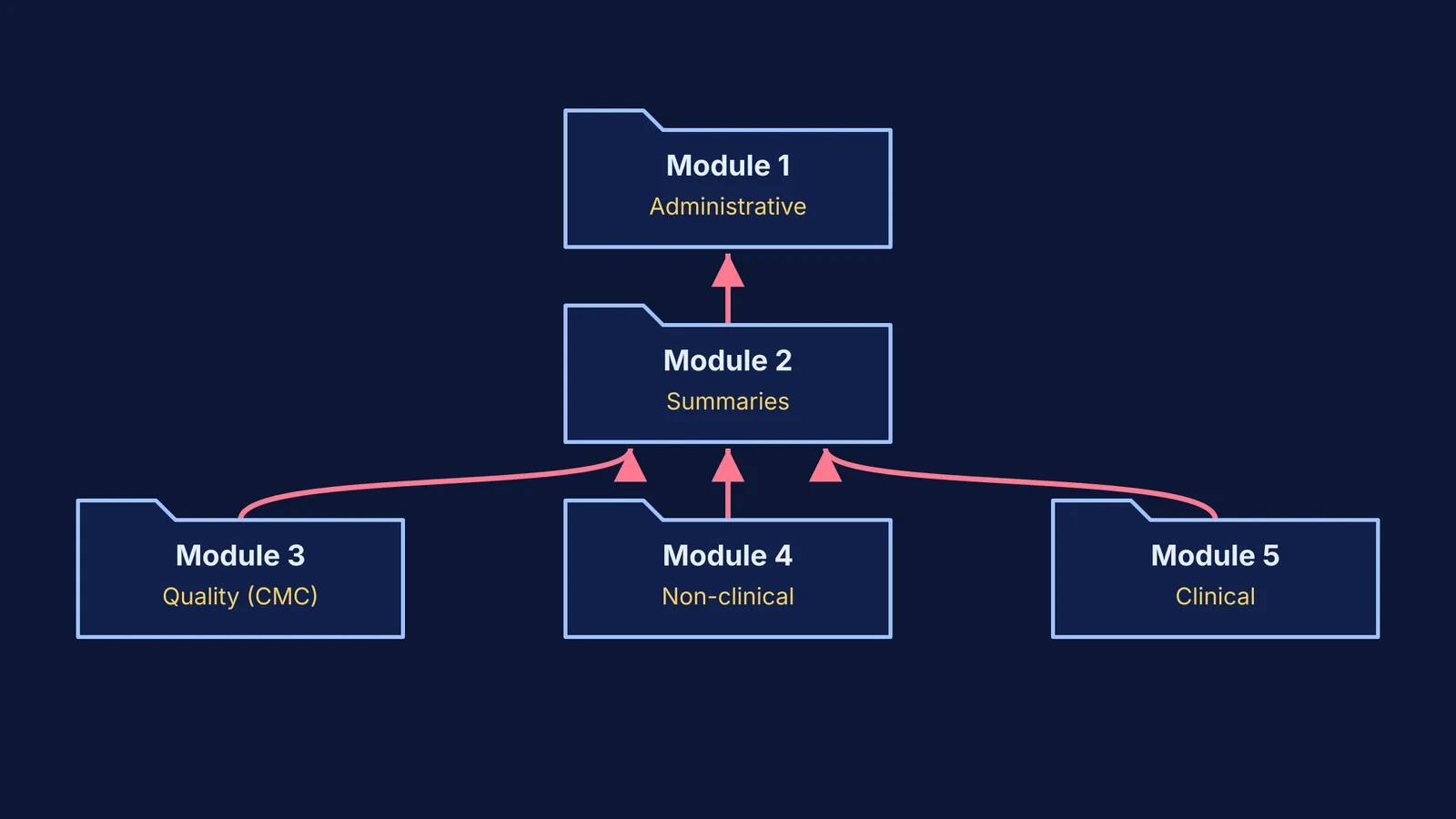
When compiling a dossier for a new drug, regulatory professionals organise thousands of pages of data into the Common Technical Document (CTD) format (source). This internationally agreed structure is divided into five modules:
Administrative information: Specific legal forms and cover letters for the region.
Summaries: High-level overviews of the drug's quality and trial results.
Quality: Chemistry, manufacturing and controls (CMC) data showing how the drug is made.
Non-clinical study reports: Data from tests on cells and animals.
Clinical study reports: Data from human trials.
In India, companies submit these dossiers digitally through the SUGAM portal. The SUGAM portal is the CDSCO's e-governance system for filing applications for drugs and clinical trials, managing queries, and ensuring transparency (source). Managing digital submissions on platforms like this is a daily task in the role.
How does the regulatory process work in practice?
Once a dossier is submitted, the work is not over. The regulatory agency reviews the application over several months. During this time, they often issue a list of technical queries.
For example, the agency might ask for more data on how the drug's quality holds up in hot, humid climates. The regulatory affairs professional must coordinate with the quality control laboratory to gather this data, format it into a formal response, and submit it back to the agency before the deadline. In India, this back-and-forth query management is handled entirely online through the SUGAM portal.
Because regulations change frequently, professionals must also engage in regulatory intelligence. This means tracking new laws and advising their company on how to adapt. If a country updates its rules on animal testing or packaging labels, the regulatory affairs team ensures the company's future applications reflect those changes immediately.
What skills do you need for a regulatory affairs career?
A bachelor's or master's degree in pharmacy (B.Pharm or M.Pharm) provides a strong foundation. Graduates in chemistry or biotechnology can also join, often after taking a postgraduate diploma or short courses in regulatory guidelines.
To succeed, you need:
Scientific knowledge: You must be able to read and understand pharmacological data, such as the steps involved in making human insulin by rDNA.
Attention to detail: A single missing form in a CTD module can delay a drug's launch by months. The work requires a rigorous, methodical approach. If you are currently studying and want to train yourself to work through problems methodically, the Fermi Problem Library has worked problems with a step-by-step solver that explains the reasoning rather than printing an answer.
Clear writing: You must summarise complex clinical data into persuasive regulatory arguments.
Regulatory affairs demands a strong foundation in core science concepts. If you need to revise your understanding before applying for roles, the Fermi Concept Library has every concept in physics, chemistry, biology, mathematics and computing, each with its own lesson and its place in the map.


