On this page
Here is a question that catches many Class 12 students. Histamine gives you a blocked nose during a cold, and it also tells your stomach to make acid. So why does an allergy tablet do nothing for acidity? The answer is the central idea of chemistry in everyday life: a drug works on a specific target, not on a symptom.
Unless another source is linked, the facts below come from the 2022-23 NCERT Class 12 Chemistry unit Chemistry in Everyday Life.
What is a drug target in chemistry?
NCERT defines drugs as chemicals of low molecular mass (about 100 to 500 u) that interact with macromolecular targets and produce a biological response (NCERT, Unit 16). Its two main targets are enzymes, which catalyse reactions, and receptors, which are proteins in the body's communication system.
A chemical messenger binds to a receptor in the cell membrane, changes its shape and passes the message into the cell without entering it. Receptors are selective because their binding sites differ in shape, structure and amino acid composition. Hormones use the same principle, as our post on how hormones act through receptors explains.
An antagonist is a drug that binds to the receptor site and blocks its natural function.
An agonist is a drug that mimics the natural messenger by switching the receptor on.
How do antihistamines like brompheniramine and terfenadine work?
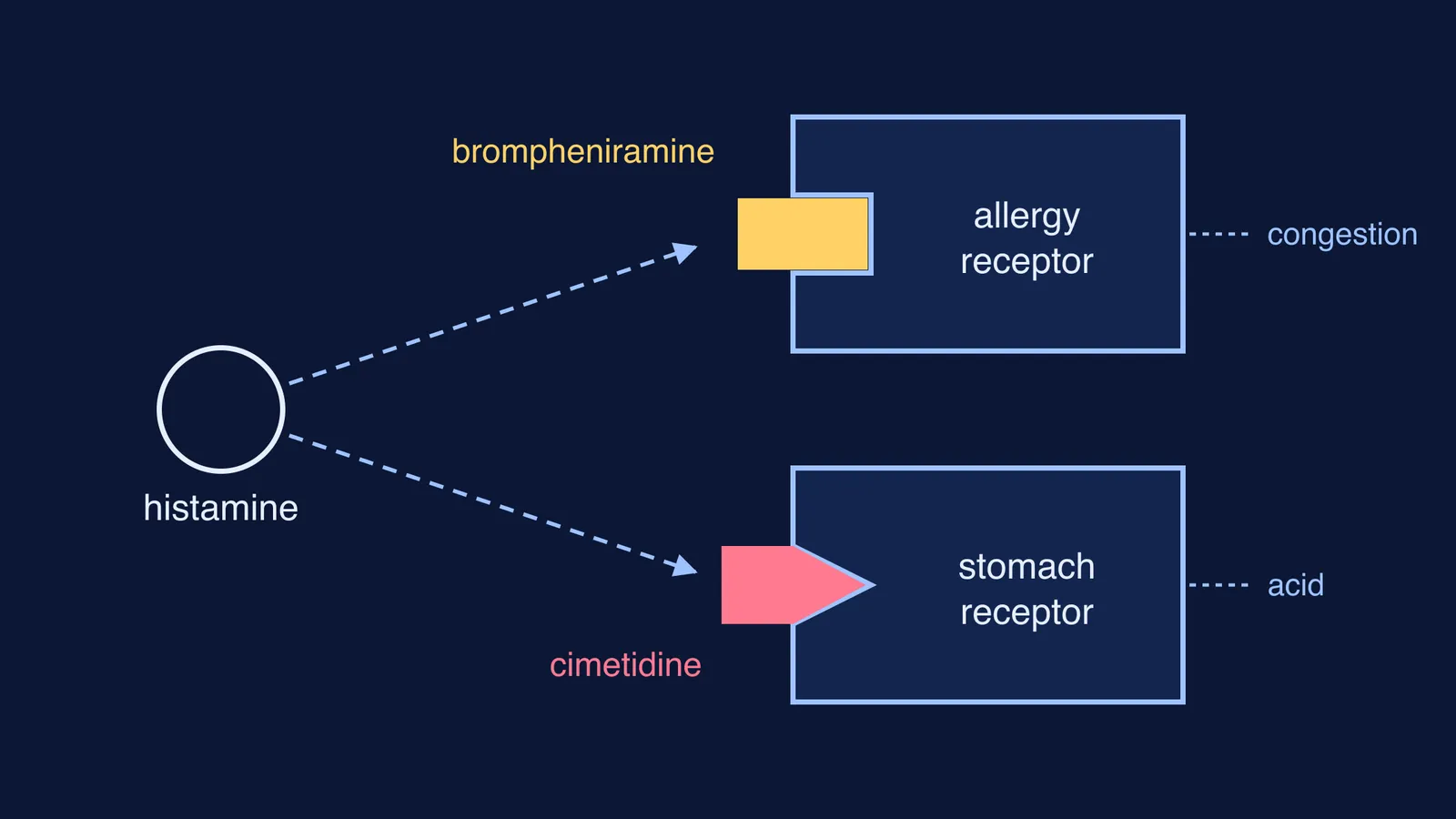
Histamine is a potent vasodilator and, according to NCERT, causes the nasal congestion of a cold or of pollen allergy (NCERT, Unit 16). Brompheniramine (Dimetapp) and terfenadine (Seldane) compete with histamine for the binding sites of the receptor where histamine acts, so they are antagonists. MedlinePlus adds that brompheniramine may make you drowsy (MedlinePlus).
Terfenadine also shows that a drug can hit a target nobody intended. A 2014 review describes it as a withdrawn drug that blocked a potassium channel in the heart, prolonging the QT interval and triggering a dangerous rhythm called torsades de pointes (Olasińska-Wiśniewska et al., 2014). The review stresses that this is not a class effect of all antihistamines.
Why don't antihistamines reduce stomach acid?
Histamine also stimulates the stomach to secrete pepsin and hydrochloric acid. Cimetidine (Tagamet) was designed to stop histamine acting on the receptors in the stomach wall, so less acid is released; ranitidine (Zantac) came later (NCERT, Unit 16). NCERT's answer is one line: antiallergic and antacid drugs work on different receptors. MedlinePlus places cimetidine in a class of medicines called H2 blockers (MedlinePlus).
Older antacids such as sodium hydrogencarbonate, or aluminium and magnesium hydroxides, simply neutralise acid already present. NCERT notes they treat the symptom, not the cause, and that too much hydrogencarbonate can trigger even more acid. Our post on how an antacid tablet neutralises acid covers that chemistry.
What are tranquilizers, and how do barbiturates work?
NCERT groups tranquilizers with analgesics as neurologically active drugs that affect how messages pass from nerve to receptor (NCERT, Unit 16). Tranquilizers relieve anxiety, stress, irritability or excitement, and are an essential component of sleeping pills.
Barbiturates are derivatives of barbituric acid, such as veronal, amytal, nembutal, luminal and seconal. NCERT calls them hypnotic, that is, sleep-producing.
Mild tranquilizers named in the unit are chlordiazepoxide and meprobamate.
Antidepressants such as iproniazid and phenelzine inhibit the enzymes that break down noradrenaline. Their target is an enzyme, not a receptor.
MedlinePlus says barbiturates are addictive, and that about 1 in 10 people who overdose on barbiturates or a mixture containing them will die (MedlinePlus). Our post on drug tolerance and dependence explains the biology.
A three-question receptor test for exam answers
When a question names a drug, ask:
What is the target: an enzyme or a receptor?
What does the drug do: block it, mimic the messenger, or inhibit the enzyme?
Which tissue, and which messenger?
Applied to this unit:
Brompheniramine blocks the histamine receptor behind allergy symptoms, so it is an antihistamine.
Cimetidine blocks the histamine receptor in the stomach wall, so it is an antacid.
Iproniazid inhibits the enzyme that breaks down noradrenaline, so it is an antidepressant.
Sodium hydrogencarbonate binds no receptor or enzyme; it neutralises acid directly, so it treats only the symptom.
A model answer to the classic question: "Antihistamines such as brompheniramine block the histamine receptors involved in allergy. Stomach acid secretion is controlled by different receptors, blocked by antacids such as cimetidine, so antihistamines do not affect it."
If receptors and enzymes still blur together, the Fermi Concept Library gives each concept in chemistry and biology its own lesson and its place in the map. For practice, the Fermi Problem Library has a step-by-step solver that explains the reasoning rather than printing an answer.
Next time a question names a drug, start by asking what it binds to.