On this page
You have probably heard it: willpower is like a phone battery. Spend it resisting your phone in the afternoon and there is nothing left for physics at night. The trouble is that when psychologists tested it carefully, across dozens of labs, the effect mostly disappeared.
Where did the idea that willpower runs out come from?
In 1998, Roy Baumeister and colleagues published a set of experiments titled Ego depletion: is the active self a limited resource? In the best-known one, people who made themselves eat radishes instead of tempting chocolates gave up sooner on unsolvable puzzles than people who had not had to resist. The authors concluded that many different acts of self-control draw on one shared, limited resource. They called its using-up ego depletion.
Many studies followed. A 2010 meta-analysis of 83 studies by Martin Hagger and colleagues found a significant ego-depletion effect, and the idea spread into self-help books and classrooms.
Is willpower really limited?
A 2015 series of meta-analyses by Evan Carter and colleagues found very little evidence that the depletion effect is real, at least with the lab methods most often used.
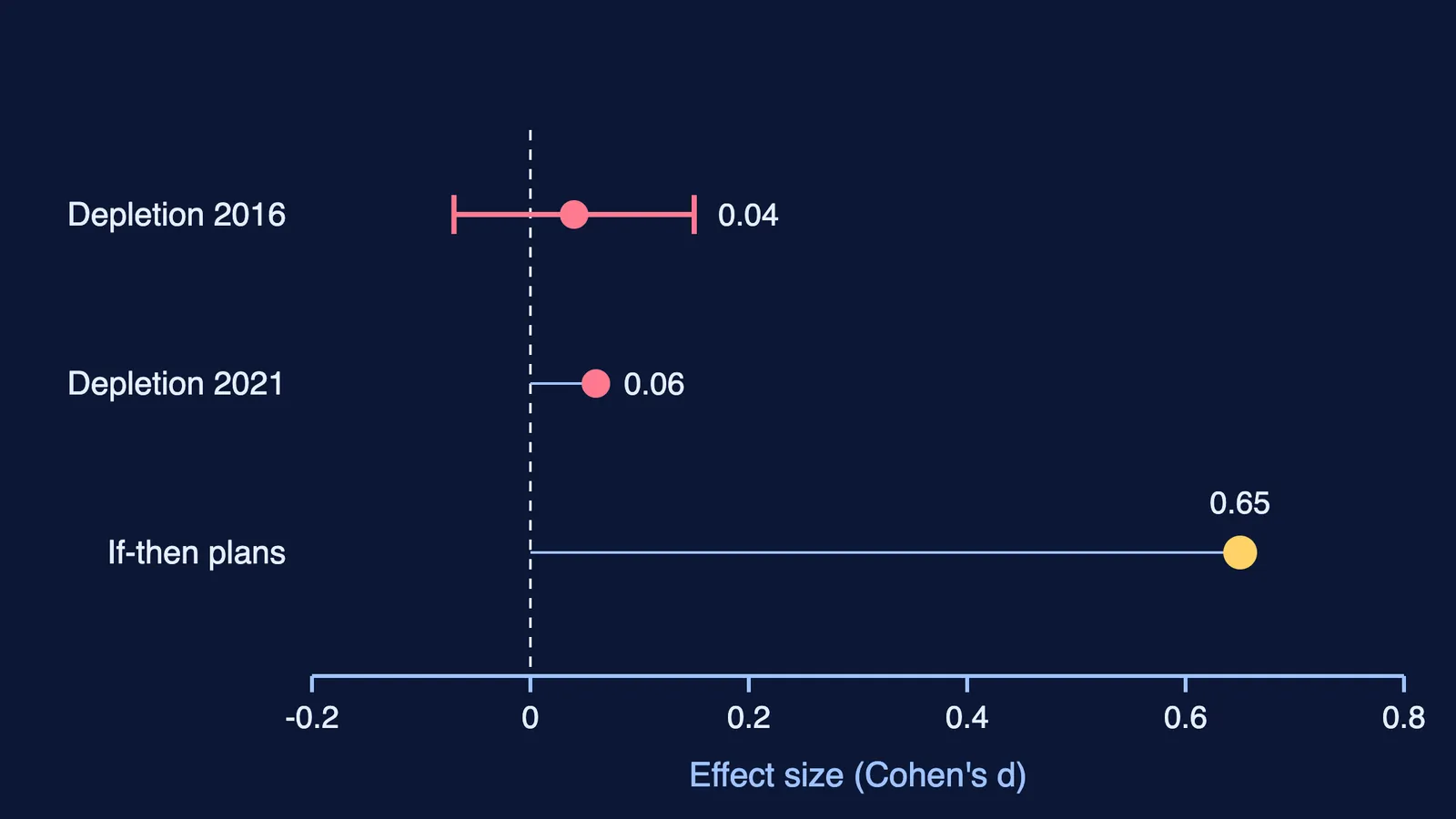
In a preregistered replication across 23 labs with 2,141 participants, every lab ran the same ego-depletion procedure. The pooled effect was d = 0.04, with a 95% confidence interval from -0.07 to 0.15, which includes zero.
A 2021 preregistered test across 36 labs with 3,531 participants, led by Kathleen Vohs, found a non-significant effect of d = 0.06. Its Bayesian analysis found the data about 4 times more likely if there was no depletion effect than if there was a modest one. An exploratory reanalysis of all participants found a small significant effect (d = 0.08).
So the honest answer is this: in careful lab tests, doing one hard self-control task does not reliably make the next one worse, and any effect is small. Tiredness is still real: an exploratory analysis in the 2021 study suggested the effect was larger in people who reported more fatigue. But "you used up your fixed quota of willpower" is not what the best evidence shows.
Do your beliefs about willpower change anything?
In 2010, Veronika Job, Carol Dweck and Gregory Walton reported in Ego depletion: is it all in your head? that people who saw self-control as not limited did not show the usual drop after a draining task, and that these beliefs predicted procrastination during demanding periods in a longitudinal field study. In the larger 2021 test above, however, an exploratory analysis found the effect did not depend on willpower beliefs. So treat belief alone as unproven.
What works better than willpower?
Decide in advance. An implementation intention is a plan in the form "If situation Y happens, then I will do X." A meta-analysis by Peter Gollwitzer and Paschal Sheeran found that, across 94 independent tests, these if-then plans had a medium-to-large effect (d = 0.65) on goal attainment. The review is from 2006, so treat the exact size with some caution. Our guide to writing if-then study plans that stick has more examples.
Change the situation before the urge grows. Angela Duckworth, Tamar Gendler and James Gross argue in Situational strategies for self-control that choosing or changing your surroundings can stop a temptation early, like a student who goes to the library without a phone. For the phone in particular, see what studies say about keeping your phone away while you study.
How do you replace willpower with a plan tonight?
Take Riya, in Class 11, who wants 90 minutes of organic chemistry after school but keeps ending up on her phone. Her setup:
Fix the time and place: "On weekdays at 6:30 pm, at the dining table."
Make the first action small and exact: "If it is 6:30, then I open the hydrocarbons chapter and do the first three exercise questions."
Remove the main temptation before the slot: the phone goes to charge in another room at 6:25.
Plan for the urge: "If I want to check messages, then I write it on a sticky note and check at the 45-minute break."
Review on Sunday: which if-then fired and which did not. Change the plan, not your opinion of yourself.
Parents can help with the questions they ask. Swap "You have no willpower" for "What time will you start, where, and what is the first question?" If starting is the hard part, try this five-minute start rule for a child who keeps delaying study.
If the stuck point is not knowing what that first action should be, Fermi's AI tutor can work out what you already know and build a plan for the session, so you sit down to a clear next step.
Tonight, write one if-then plan for tomorrow and move your phone before you need to resist it.