On this page
"Study physics daily" is a wish, not a plan. It says what you want but not when, where or what you will do, so each evening you argue with yourself about it again, and the phone often wins. An if-then plan settles that argument in advance.
What is an implementation intention?
An implementation intention is an advance plan of the form "if situation Y comes up, then I will do X", as described in Peter Gollwitzer and Paschal Sheeran's 2006 meta-analysis. The "if" is a cue you reliably meet: a time, a place or something you already do. The "then" is one small, concrete action.
When the cue arrives, you don't decide whether to study. You decided last week.
Do if-then plans really help you study?
Across 94 independent tests, forming implementation intentions had a medium-to-large effect on goal attainment (d = 0.65), according to Gollwitzer and Sheeran's meta-analysis. The plans helped people start, stay on track despite distractions and drop strategies that were not working.
In a 2011 study by Angela Duckworth and colleagues, 66 high-school students preparing for a high-stakes exam were randomly assigned to a 30-minute written exercise that combined mental contrasting with if-then plans, or to a placebo writing task. Students who did the exercise completed more than 60% more practice questions than the control group.
Expect a smaller effect than that. A 2021 meta-analysis of 21 studies with 15,907 participants found the combined method had a small-to-medium effect (g = 0.336), which may be smaller still because of publication bias. It worked better when an experimenter took people through it than when they worked from a document alone.
How do you write an if-then study plan?
Apply one test to every plan: could someone watching you say yes or no to whether you did it? "Study physics daily" fails. "After dinner, I sit at my desk and do 5 PYQs from this week's chapter" passes.
Pick a cue you already hit every day: finishing dinner, getting home from school, your morning alarm. Not "when I get free".
Make the action small and countable: 5 previous-year questions, one page of NCERT, 10 flashcards.
Plan for your usual obstacle with a second if-then.
Write the plans down where you will see them at the cue.
A worked example for a Class 12 student:
If I finish dinner, then I sit at my desk and do 5 physics PYQs from this week's chapter.
If I get a question wrong, then I write one line on why before I read the solution.
If I reach for my phone after dinner, then I put it in another room and start question 1.
If it is Sunday at 10 a.m., then I redo every question I got wrong that week.
To work out first what usually stops you, our guide to WOOP and if-then plans for study goals covers the mental-contrasting step. If you are unsure whether to plan by hours or by tasks, read fixed hours or task lists: which study timetable works.
How do you track whether your if-then plans stick?
Keep a two-week tracker in your notebook:
Write one row per if-then plan and one column per day.
Tick if the cue came and you did the action. Cross if the cue came and you didn't. Leave it blank if the cue never came (you ate out).
Every Sunday, count the ticks and crosses for each plan.
Three or more crosses in a week means the plan needs fixing, not you. Move the cue to a better moment or shrink the action, say from 5 questions to 3.
Add a new plan only when the current ones get a tick on most days.
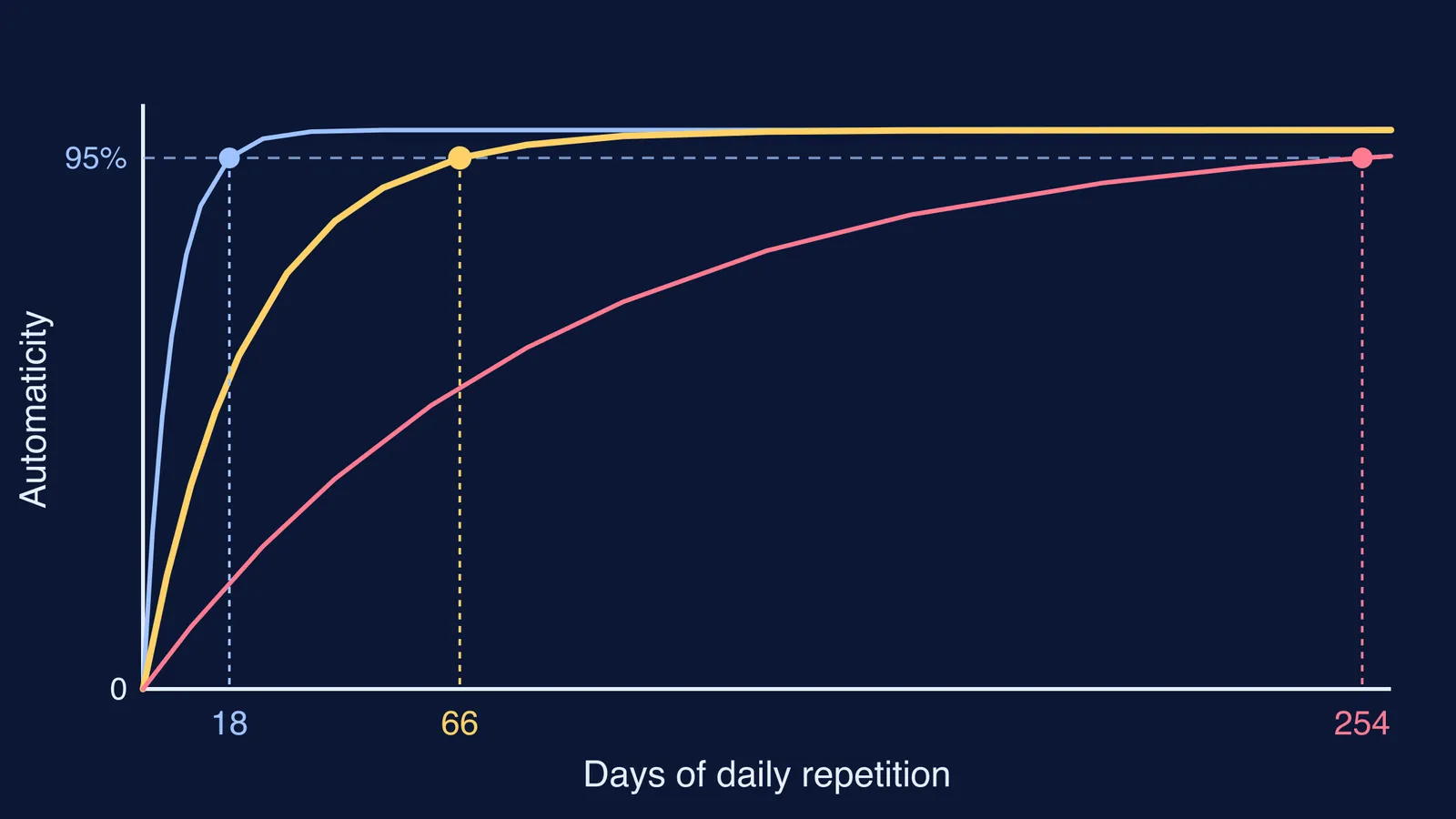
Don't panic over one missed day. In a study of 96 volunteers who repeated one daily behaviour in the same context, such as "after breakfast", for 12 weeks, a single missed day had little impact on later progress, as the British Psychological Society's Research Digest reported. The same report says the average time to reach maximum automaticity was 66 days, ranging from 18 days to a predicted 254 days. So judge a plan after two weeks, and the habit after two months.
What if you don't know what comes after "then"?
Often the hard part is picking the action: which chapter, which questions, how many. Fermi's AI tutor works out what you already know and builds a plan for the session, so your "then" starts with a concrete first step. For the questions themselves, the Fermi Problem Library has worked problems with a step-by-step solver that explains the reasoning.
If you still keep delaying the start, try the five-minute start rule. And if stress or low mood is behind weeks of crosses, talk to someone you trust or call Tele MANAS, the national mental-health helpline, on 14416.