

On this page
Most students have tried both kinds of timetable. One is a grid of hours: physics from 5 to 6, maths from 6:15 to 7:15. The other is a list: finish 20 rotational motion problems, revise the p-block notes. Each fails differently; the fix keeps the useful half of each.
What is the difference between a clock-based and a task-based timetable?
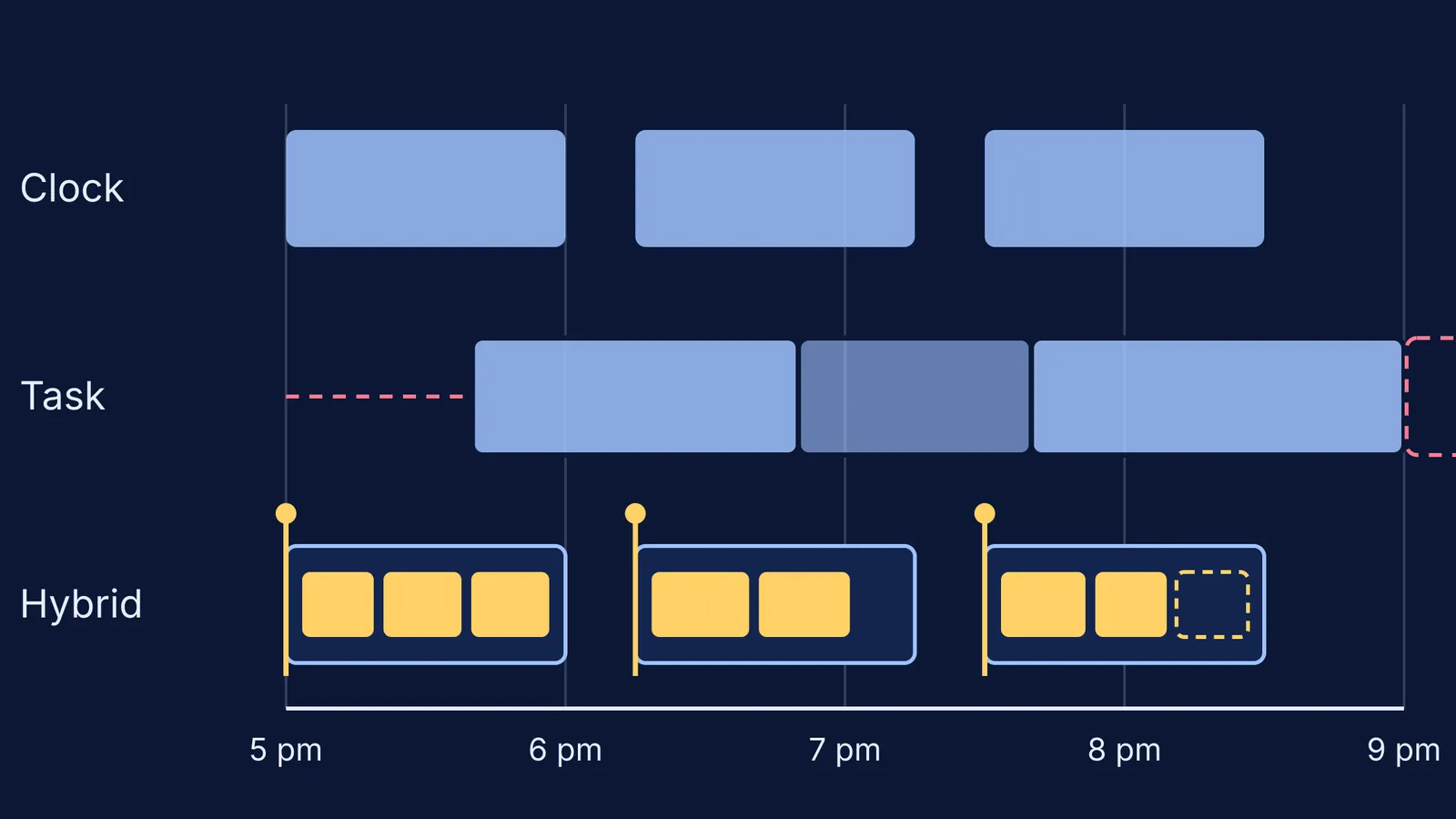
A clock-based timetable fixes when you study and for how long, whatever you get done. A task-based timetable fixes what you will finish, whenever that happens.
The clock version is easy to keep, but an hour at the desk can become an hour of rereading one page. The task version measures real output, but it has no start time and depends on guessing how long each task will take.
Why do fixed start times make studying easier to begin?
A fixed start time can take the decision out of starting. In a habit study, Lally and colleagues asked 96 volunteers to repeat one behaviour daily in the same context, such as "after breakfast", for 12 weeks. Repetition in a consistent context made the behaviour more automatic over time, though the time to get close to each person's plateau ranged from 18 to 254 days. A study block at the same time and place each day can work as that kind of cue.
A related tool is the if-then plan, which psychologists call an implementation intention: "If it is 5 pm and I am home, then I open my physics notebook at the desk." A meta-analysis by Gollwitzer and Sheeran38002-1) found that across 94 independent tests, implementation intentions had a medium-to-large effect on goal attainment (d = 0.65).
Why do task lists keep running over time?
Because most people underestimate how long their own work will take, a bias psychologists call the planning fallacy. In the first study of a 1994 paper by Buehler, Griffin and Ross, psychology students in their final semester predicted they would finish their thesis in 33.9 days on average; they actually took 55.5 days. Fewer than one in three (29.7%) finished within their own best estimate.
A plan to "finish chapters 4, 5 and 6 tonight" has the same problem: the evening ends late and sleep gets cut.
How do you build a hybrid timetable?
Pick two to four fixed start times on school days and write each as an if-then plan ("If it is 5:00 pm, I sit down with the day's physics list").
Give every block a fixed length, such as 60 minutes, with a short break before the next.
The night before, write a task list for each block, using tasks with a visible finish ("10 questions on friction", not "study friction").
Put the most important task first, so even a short block covers it.
When the block ends, stop. Move anything unfinished to the top of tomorrow's list.
Once a week, compare what you planned with what you finished, and shrink next week's lists to match.
The weekly check makes you use your own past record: in a later study in the same 1994 paper, the optimistic bias disappeared when people were told to connect past experiences with their predictions.
What does a hybrid evening timetable look like?
Say you are in Class 11, preparing for JEE Main alongside school. Your weekday evening might look like this:
5:00 pm, physics, 60 minutes: 8 friction problems from your module, then redo one solved example you got wrong.
6:15 pm, maths, 60 minutes: 12 questions on quadratic equations, marking any that take over 5 minutes.
7:30 pm, chemistry, 45 minutes: flashcards for 10 named reactions.
On Monday you finish only 5 friction problems; the other 3 go to the top of Tuesday's list. By Saturday your record shows about 6 problems an hour, so next week's lists say 6, not 8. The start times never moved; only the lists did.
If you sit down at the fixed time unsure what belongs on the list, Fermi's AI tutor can work out what you already know and build a plan for the session. For problem-heavy blocks, the Fermi Problem Library has a step-by-step solver that explains the reasoning.
Which kind of timetable should you choose?
Lean clock-based if your trouble is getting started, or if school and coaching already fix most of your day; see time blocking for students juggling school and coaching.
Lean task-based on holidays and in revision weeks, but keep a fixed start each morning.
Use the hybrid for most school weeks.
If you keep missing the start time itself, procrastination is often about feelings, not laziness. To keep any timetable going past the first week, read how to build a study routine that lasts.
If study stress feels heavy for weeks, talk to a school counsellor or call Tele MANAS on 14416, a free, 24/7 Ministry of Health and Family Welfare helpline. Tonight, pick your start times, write tomorrow's lists, and let the clock decide when you begin.


