On this page
On a cold night in Shimla or a foggy January evening in Delhi, a rubber bottle of hot water can keep your feet warm until you fall asleep. A block of iron of the same mass and temperature would go cold far sooner. The reason is one property of water that turns up again and again in Class 11 thermal physics and JEE Main: specific heat capacity.
What makes a hot water bag stay warm for hours?
Two things work together: water stores a lot of heat for every degree, and that heat leaves slowly.
The specific heat of liquid water is 4186 J per kilogram per °C, according to the table in OpenStax College Physics 2e. The same table gives 452 J/(kg·°C) for iron and steel and 840 J/(kg·°C) for glass. As OpenStax puts it, the specific heat of water is five times that of glass and ten times that of iron.
So a kilogram of hot water carries far more stored energy than a kilogram of iron or glass at the same temperature, and it can only release it as fast as heat escapes through the rubber, the cover and the blanket.
What is specific heat capacity, in one line?
Specific heat is the amount of heat needed to change the temperature of 1.00 kg of a substance by 1.00 °C (OpenStax). The heat gained or lost is Q = mcΔT, where m is mass, c is specific heat and ΔT is the change in temperature.
If the difference between specific heat (per kilogram) and heat capacity (for a whole object) still trips you up, our explainer on specific heat vs heat capacity sorts it out with examples.
How much heat is in a hot water bottle? A worked example
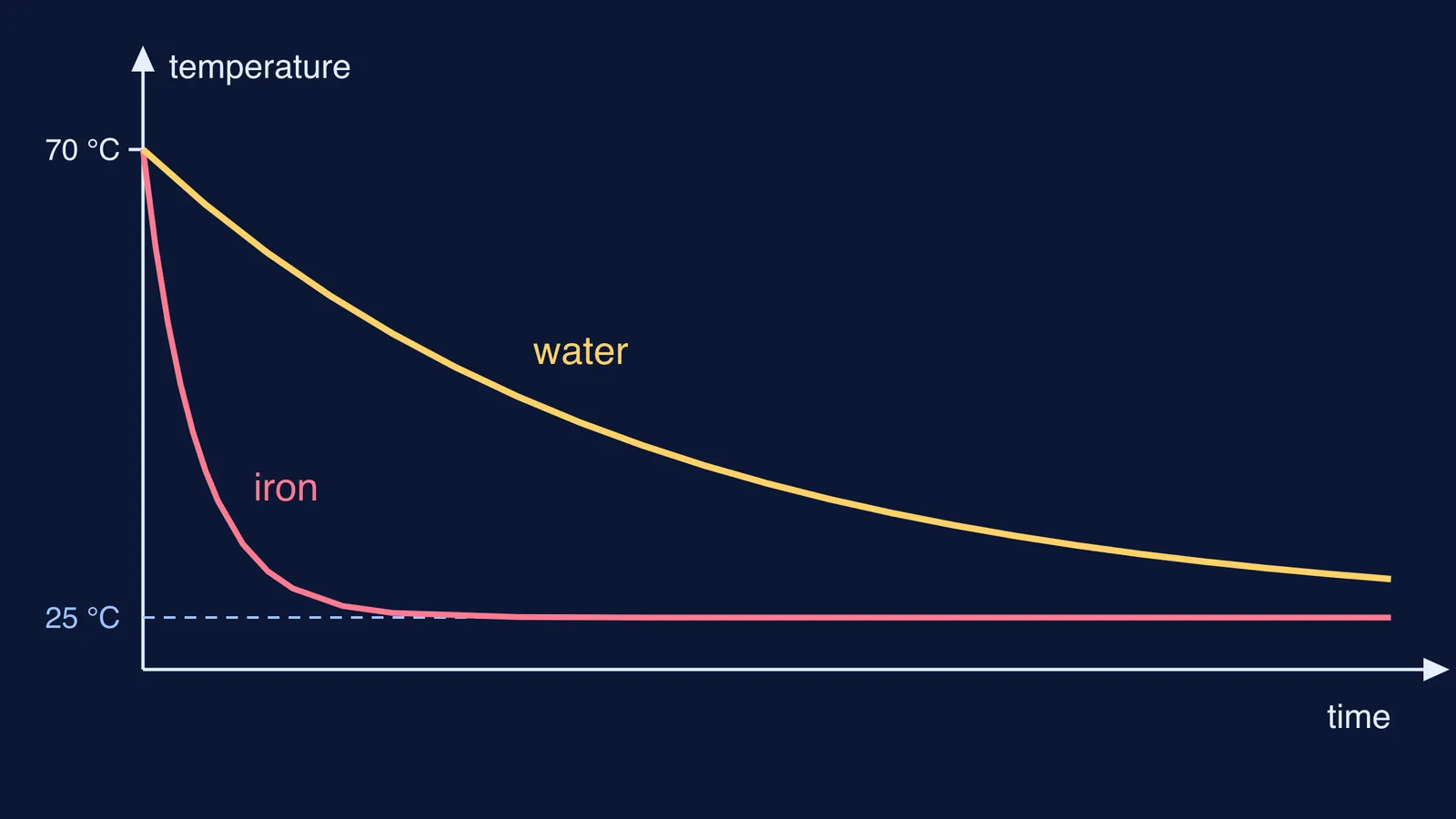
Take 1 kg of water at 70 °C. Suppose your feet feel it as warm until it falls to about 35 °C, so ΔT = 35 °C. Using the values from OpenStax:
Water: Q = 1 × 4186 × 35 = 146,510 J, about 147 kJ.
Iron, same mass and same temperatures: Q = 1 × 452 × 35 = 15,820 J, about 16 kJ.
Ratio: 146,510 ÷ 15,820 ≈ 9.3, so the water gives out about nine times as much heat over the same drop.
Now put a rough time on it. Suppose the bottle loses heat at an average of 20 W (an assumed figure, not a measurement): 146,510 J ÷ 20 W ≈ 7,300 s, about two hours. The iron would last about 13 minutes. Change the wattage and both times change, but the ratio stays the same.
The same property explains why the sea warms and cools more slowly than land, which drives the daytime sea breeze.
Why does a cover make it last longer?
Stored heat is only half the story. The rate at which heat conducts through a layer is P = kA(Th − Tc)/d, where k is thermal conductivity, A is area and d is thickness (OpenStax University Physics Volume 2).
OpenStax lists thermal conductivity of 0.04 W/(m·°C) for wool and 0.023 W/(m·°C) for air, compared with 80 W/(m·°C) for iron (source). A knitted cover and the air trapped in a quilt add thickness with a very small k, so P drops.
The formula also shows why the bottle never goes cold suddenly: as the water cools, Th − Tc shrinks, so the rate of loss shrinks too. That fast-then-slow pattern is Newton's law of cooling. You can build that curve yourself in our spreadsheet model of a cooling cup. If you would rather see it move, the Fermi Simulation Lab has interactive simulations for ideas like this that are easier to see than to read.
Put together, the time a bottle stays warm grows with:
the mass of water (more m, more stored heat)
the specific heat of what is inside
the insulation around it (low k, more thickness)
and it falls with the temperature gap between the bottle and the room.
How do you use a hot water bottle safely?
A bottle that stores this much heat can also burn. NHS Scotland's hot water bottle safety advice says:
Never use boiling water; let the water cool for a few minutes first.
Do not fill the bottle more than two thirds, and squeeze out the air before closing the stopper tightly.
Always use a cover, and do not sit or lie on the bottle.
Do not use a bottle more than two years old; the daisy wheel on the neck shows the year it was made.
If the idea of Q = mcΔT still feels shaky, the Fermi Concept Library gives each concept in physics its own lesson, so you can go back to specific heat before tackling calorimetry problems.