On this page
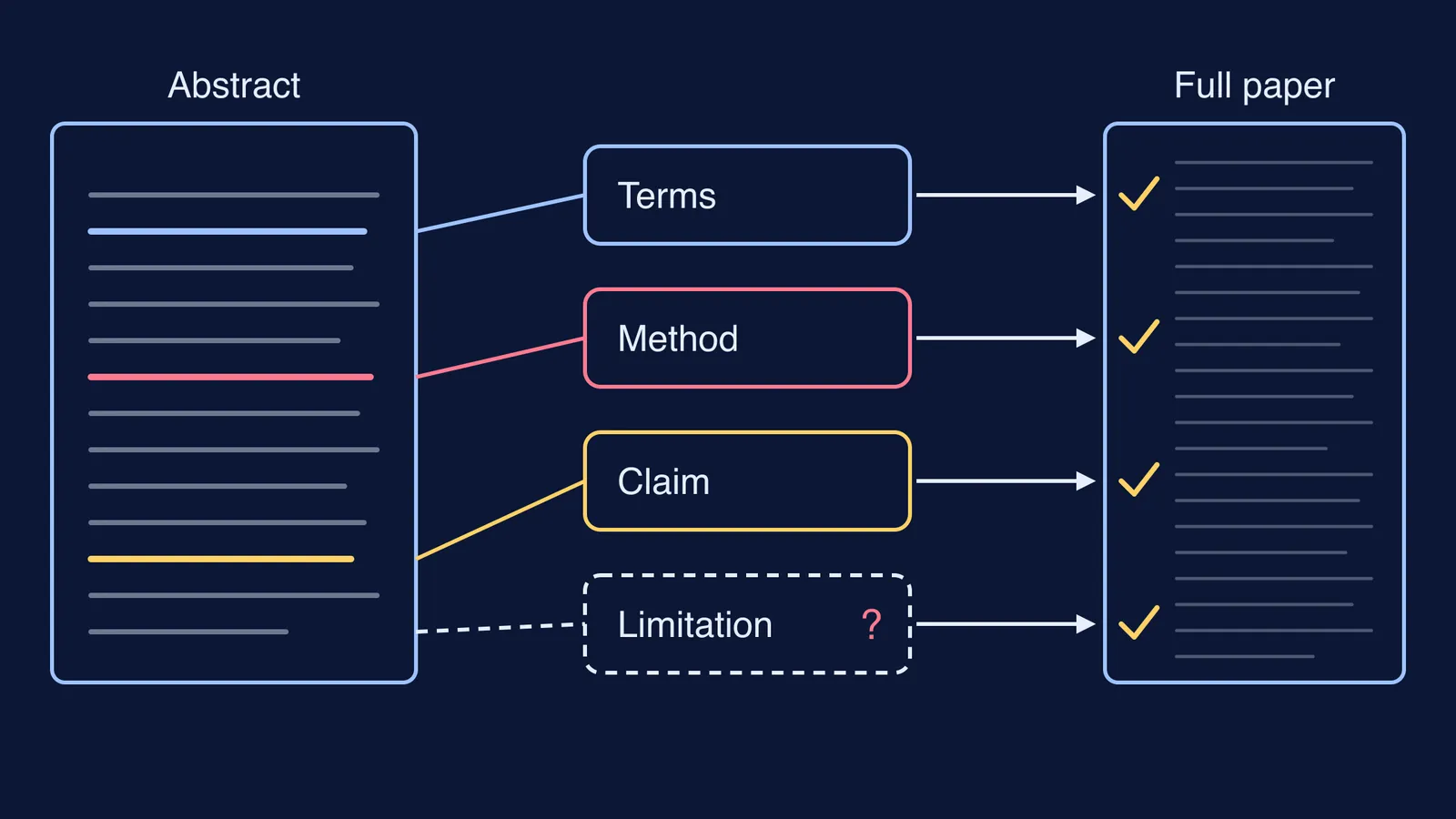
You found a paper for a project, and the abstract reads like a wall of jargon. AI can help, but only if you ask it the right way and then check what it says. Below: a prompt that splits any abstract into four parts, a worked example and a checklist.
An abstract is the short summary at the top of a paper. The US National Library of Medicine describes a structured abstract as one with “distinct, labeled sections (e.g., Introduction, Methods, Results, Discussion) for rapid comprehension” (NLM).
Why not just ask AI to summarise the abstract?
Because chatbots tend to make findings sound bigger than they are. In a 2025 study in Royal Society Open Science, Uwe Peters and Benjamin Chin-Yee compared 4,900 summaries written by 10 large language models with the original scientific texts (Peters and Chin-Yee, 2025). Most models stated results more broadly than the originals, even when explicitly prompted for accuracy. Three of them, DeepSeek, ChatGPT-4o and LLaMA 3.3 70B, overgeneralised in 26–73% of cases. In a direct comparison, AI summaries were nearly five times more likely than human-written science summaries to contain broad generalisations.
AI can also invent sources. In a study of 636 citations from short literature reviews written by ChatGPT, 55% of the GPT-3.5 citations and 18% of the GPT-4 citations were fabricated (Walters and Wilder, 2023). Those are older models, but the lesson holds: make the AI quote text you can see.
What prompt makes AI explain a research paper abstract?
Paste this, then paste the abstract below it:
I am a Class 12 student. Use only what this abstract says.
List every technical term and define it in one plain sentence. Mark any definition you are taking from general knowledge rather than from the abstract.
State the main claim in one sentence, keeping the abstract's limits: who was studied, what was measured, over what time.
State the method: who or what was studied, what was compared, and what was measured.
State the limitation. If the abstract does not mention one, write “Not stated in the abstract” and tell me what to look for in the paper.
Under each of the claim, method and limitation, quote the exact sentence from the abstract that supports it.
Step 6 is what makes the answer checkable. Step 5 matters because some abstracts, like the one below, do not state a limitation, and a chatbot asked for one may make one up.
What does this look like on a real abstract?
Take the abstract of “Test-Enhanced Learning” by Henry L. Roediger and Jeffrey D. Karpicke, published in Psychological Science in 2006 (Roediger and Karpicke, 2006). A good answer looks like this:
Terms: the testing effect is defined in the abstract itself: taking a memory test “also enhances later retention”. Free recall is not defined there, so the AI should flag its definition (writing down everything you remember, with no cues) as general knowledge for you to confirm in the methods.
Claim: on final tests given 2 days or 1 week later, students who had taken practice tests remembered substantially more than students who had restudied; on a test after 5 minutes, restudying did better.
Method: two experiments in which students studied prose passages, then took one or three free-recall tests without feedback, or restudied the material the same number of times.
Limitation: not stated in the abstract. Look in the paper for who the students were, how many took part, and what the passages were.
Notice the trap. The abstract ends: “Testing is a powerful means of improving learning, not just assessing it.” A summary that keeps only that line loses the 5-minute result and the fact that this was prose passages, tested without feedback. That is exactly the kind of broadening Peters and Chin-Yee measured.
How do you check the AI's answer against the paper?
Open the full paper through its DOI link or your library and run this checklist:
Search each quote with Ctrl+F. If it is not word for word in the abstract, the answer fails.
Check every flagged definition in the introduction or methods, where authors define their terms.
Compare the claim with the results section: same group, same measure, same time span?
Read the methods for sample size and who took part, and write the limitation yourself in one line.
Read the limitations paragraph in the discussion, if there is one, and compare it with your line.
If one term keeps blocking you, such as “odds ratio” in the Peters and Chin-Yee abstract, learn the idea properly before reading on. The Fermi Concept Library covers concepts in physics, chemistry, biology, mathematics and computing, each with its own lesson. If a whole paper feels out of reach, Fermi's AI tutor works out what you already know and builds a plan for the session, so you know where to start.
To get the full text, see our guide to using college library e-resources to find papers. Writing your own? Read how to write your first research paper as an undergraduate. For more practice at catching AI errors, try interviewing a scientist with AI, then fact-checking every answer.