On this page
Your first research paper usually grows out of a small project in a lab, a summer programme or a final-year course. The science matters most, but first papers more often stall on three other things: unclear expectations with your supervisor, a messy structure, and an authorship or journal choice nobody discussed early.
How do you start a research paper with your supervisor?
Before writing, have one meeting about the paper itself, not the experiment. A short script you can use:
"Can we agree the one question this paper answers, in a sentence?"
"Which journal or conference should I format it for, so I write to their limits from the start?"
"Can we decide authorship and author order now, and revisit it if roles change?"
"Would one draft section every two weeks work, with comments in the document?"
Send a short email afterwards listing what you agreed. If you are still choosing a mentor, the questions in our guide to choosing a supervisor by their papers, students and lab culture work for an undergraduate project too.
What sections does a research paper need?
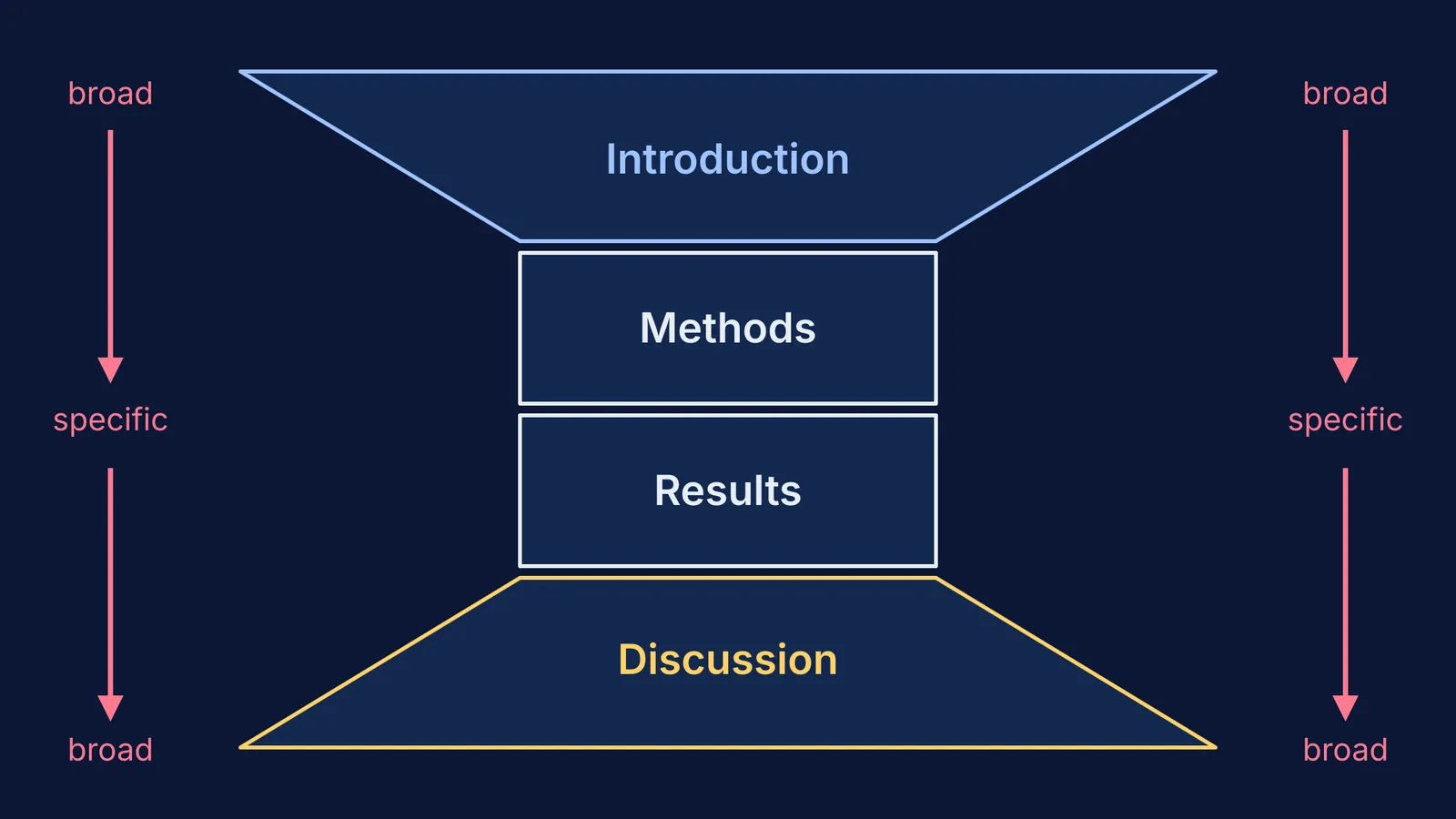
Most science papers follow IMRaD: Introduction, Methods, Results and Discussion. A survey of 1,297 articles in four major medical journals found no IMRaD articles in 1935, about 80% in the 1970s, and IMRaD as the only format in the 1980s. Check your venue's author guidelines, but expect this shape.
You do not have to write the sections in the order they appear. An order that works for many first-time authors:
Methods: what you did, in enough detail to repeat it. Write this while the lab work is fresh.
Results: figures and tables first, then one paragraph per figure saying what it shows.
Introduction: what is known, the gap, and your question.
Discussion: what the results mean, how they compare with earlier work, and the limits of your study.
Abstract and title last, once you know what the paper actually says.
A worked example for a small biology project:
Question: How does temperature between 20 and 60 °C change catalase activity in potato extract?
Methods: extract preparation, temperatures tested, how oxygen was measured, number of repeats.
Results: one graph of rate against temperature, with error bars from the repeats.
Discussion: where the rate peaked, why it fell at high temperatures, and what a basic lab setup could not control.
If the background theory feels shaky, the Fermi Concept Library has a lesson for each concept in physics, chemistry, biology, mathematics and computing, so you can check your understanding before explaining it to a reviewer.
Who should be an author on an undergraduate paper?
Authorship is a claim of responsibility, not a thank-you. The ICMJE authorship criteria require all four of: a substantial contribution to the design, data or analysis; drafting or critically revising the paper; approving the final version; and agreeing to be accountable for the whole work. The same page says funding or general supervision alone does not qualify, and contributors who are not authors can be acknowledged instead.
Many journals also ask who did what using CRediT, a taxonomy of 14 contributor roles such as investigation, formal analysis and writing. Filling it in honestly with your supervisor is a calm way to settle author order.
How do you choose a credible journal for your first paper?
A study of predatory open-access publishing estimated that such journals published about 420,000 articles in 2014, and India accounted for around 35% of the corresponding authors it sampled. These journals charge a fee and publish with little real peer review, and a paper there can count against you later.
In India, the UGC discontinued the UGC-CARE journal list in February 2025 and left institutions to build their own systems, then issued suggestive parameters in July 2025. So check a venue yourself with the Think. Check. Submit. checklist:
Have you or your supervisor read articles in this journal?
Can you easily identify and contact the publisher?
Is the journal clear about the type of peer review it uses?
Are its articles indexed or archived in services your field uses?
Is it clear what fees will be charged?
Is the journal a COPE member and, if open access, listed in DOAJ?
An unknown journal emailing you for papers is a warning sign. For a first paper, an undergraduate research journal or a student conference is often a better fit; our guide to making a research poster for a student conference covers that route.
A 10-week plan from data to submission
Weeks 1–2: agree question, venue and authorship; read the author guidelines.
Weeks 3–4: draft Methods and final figures.
Weeks 5–6: write Results and Introduction; send for comments.
Week 7: write the Discussion, including limitations.
Week 8: abstract, title, references and the CRediT statement.
Week 9: every co-author reads and approves the full draft.
Week 10: run the checklist once more, then submit.
Expect reviewer comments and at least one round of revision. That is normal, not failure.