
On this page
Your cells run on ATP, and a protein called ATP synthase makes it by turning like a tiny motor. The scientist who first argued that it spins was Paul Boyer, a biochemist born in Provo, Utah, on 31 July 1918, who spent most of his career at UCLA (Wikipedia biography). Within his lifetime the idea was confirmed by a crystal structure, filmed under a microscope and honoured with a Nobel Prize.
What did Paul Boyer propose about ATP synthase?
By the 1970s, Boyer had a theory of how ATP synthase joins ADP and inorganic phosphate into ATP, in which the enzyme's subunits work together as a rotating molecular motor powered by a hydrogen ion gradient (Chemistry World).
Boyer argued that the energy from the proton flow is not used mainly to form the bond in ATP, but to change how tightly the enzyme grips its molecules, and that these binding changes are driven by the rotation of a smaller internal subunit (Wikipedia biography). This became known as the binding change mechanism.
In the binding change mechanism, each catalytic beta subunit cycles through three states: loose (ADP and phosphate bind), tight (they are pressed together into ATP), and open (ATP is released) (ATP synthase overview).
How was Boyer's rotation idea confirmed?
In August 1994, John Walker's group published the structure of the F1 part of ATP synthase from cow heart mitochondria at 2.8 angstrom resolution in Nature (Abrahams et al., 1994).
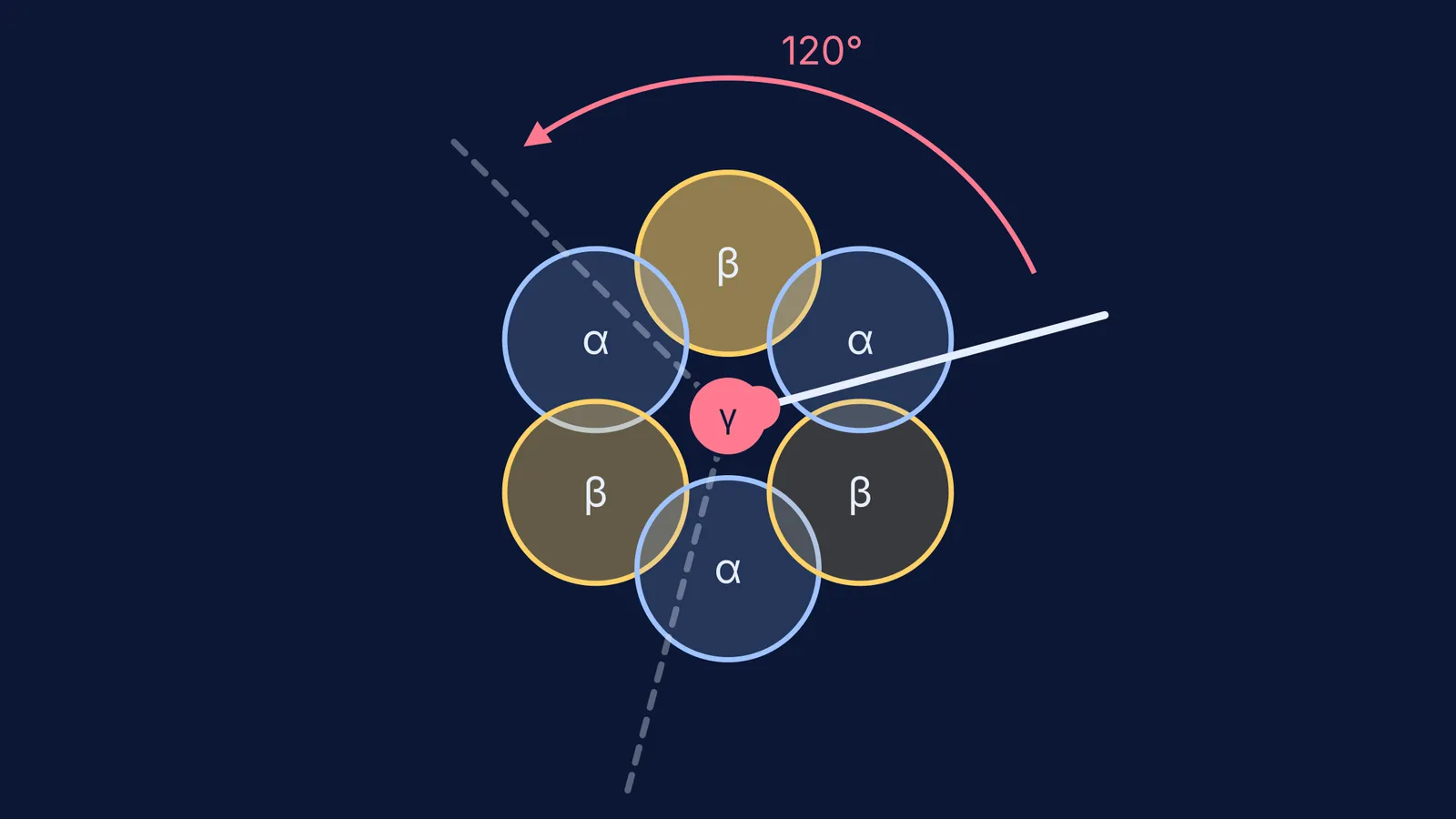
The structure showed that the three catalytic beta subunits differ in shape and in the nucleotide they hold, as Boyer's model predicted (PubMed abstract). The authors suggested that rotation of the alpha3beta3 ring relative to the gamma subunit may convert each site from one state to the next.
Then came direct observation. In 1997, Hiroyuki Noji, Ryohei Yasuda, Masasuke Yoshida and Kazuhiko Kinosita Jr. attached a fluorescent actin filament to the gamma subunit of the isolated F1 part and watched it under a microscope. Fed with ATP, so that the motor ran in its ATP-splitting direction, the filament rotated for more than 100 revolutions in an anticlockwise direction viewed from the membrane side (Noji et al., Nature 1997). A year later the same group showed that the shaft turns in discrete 120 degree steps, one third of a turn per step, driven by the three catalytic beta subunits (Yasuda et al., Cell 199881456-7)).
That same year, 1997, Boyer and Walker shared half of the Nobel Prize in Chemistry for the mechanism of ATP synthesis; the other half went to Jens Christian Skou for the sodium-potassium pump (Wikipedia biography). Boyer died on 2 June 2018, aged 99 (Chemistry World).
How does the ATP synthase motor work, step by step?
The parts are F0 in the membrane and F1 sticking out into the matrix or stroma; our post on the F0 and F1 parts of ATP synthase covers the labels. Here is the motion in order:
Protons flow down their gradient through F0 in the inner mitochondrial membrane.
That flow turns the F0 ring, which turns the attached gamma shaft.
The gamma shaft is lopsided, so as it turns inside the alpha3beta3 ring it pushes each beta subunit into a new shape.
Each beta subunit steps loose, then tight, then open: it binds ADP and phosphate, joins them into ATP, then lets the ATP go.
One full turn carries all three beta subunits through all three states, so each full turn should release three ATP. Run in reverse, the motor takes one 120 degree step for each ATP it splits (Yasuda et al., Cell 199881456-7)).
The same machine works in chloroplasts, driven by protons from the thylakoid lumen; see chemiosmosis in chloroplasts.
How can you explain it in an exam in 60 seconds?
Say this out loud until you can do it without notes:
Who: Paul Boyer proposed the binding change mechanism; John Walker solved the F1 structure in 1994; they shared the 1997 Nobel Prize.
Where the energy goes: proton flow turns the shaft; the shaft changes the binding of the beta subunits.
The cycle: loose, tight, open. Three beta subunits, three states at once.
The proof: different beta shapes in the crystal; a filament on the shaft seen spinning in 120 degree steps.
Self-check: draw the ring of three alpha and three beta subunits from above, shaft in the middle, and label each beta loose, tight or open. Rotate the shaft a third of a turn and relabel. If you can, you know the mechanism, not just the names.
Rotation is hard to picture from a flat figure. Fermi's AI tutor can draw the figure on a board and check your understanding as it goes. If chemiosmosis or the proton gradient itself is the gap, the Fermi Concept Library gives each concept its own lesson and its place in the map.
For where the story of ATP began, read about Karl Lohmann and the discovery of ATP in 1929.