

On this page
Every living cell runs on adenosine triphosphate (ATP). The universal enzyme that builds it is ATP synthase, a remarkable biological motor. Whether you are studying respiration in plants or animals, understanding how this enzyme uses a proton gradient is central to bioenergetics.
What is the role of F0 and F1 in ATP synthase?
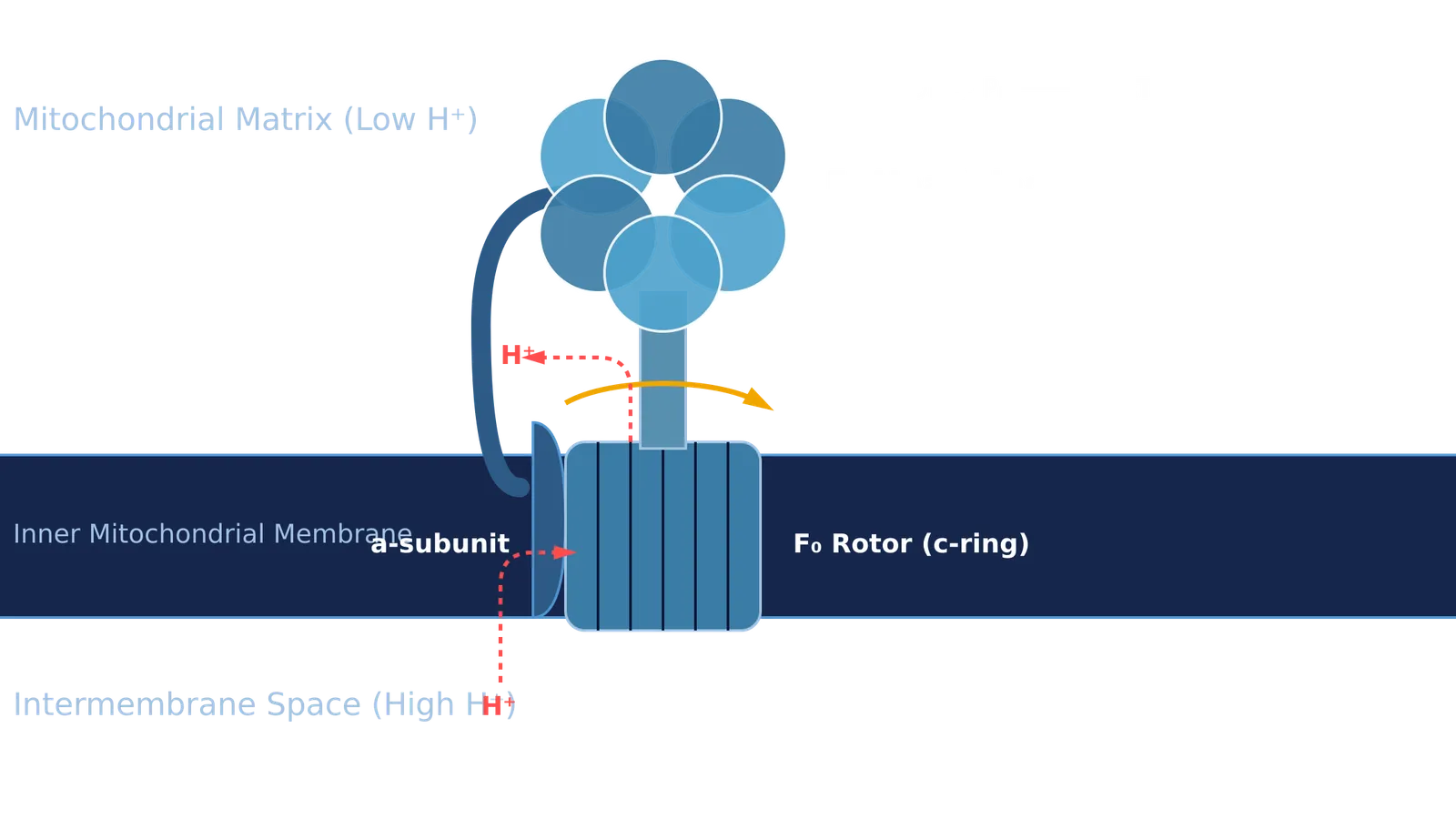
ATP synthase has two main domains: the F₀ proton channel and the F₁ catalytic headpiece.
The F₀ portion is embedded in the membrane. It contains a ring of "c" subunits (the rotor) and a stationary "a" subunit. As protons (H⁺) flow through this channel from an area of high concentration to an area of low concentration, they bind to specific amino acid residues on the c-ring. This binding neutralises a charge, allowing the ring to rotate into the hydrophobic lipid membrane, physically turning the entire rotor.
The F₁ portion is a water-soluble headpiece that protrudes from the membrane. It contains the active sites where adenosine diphosphate (ADP) and inorganic phosphate (Pᵢ) are pushed together to form ATP. The spinning F₀ rotor turns an asymmetric central stalk that extends into the centre of the F₁ head. As the stalk rotates, it forces the F₁ subunits through three different shapes: one that binds ADP and Pᵢ loosely, one that forces them together tightly to form ATP, and one that releases the newly synthesised ATP.
If you struggle to picture how an electrochemical gradient drives mechanical rotation, the Fermi Simulation Lab has interactive models showing the protons flowing through the channel and the c-ring turning in real time.
How does ATP synthase differ in mitochondria and chloroplasts?
Both mitochondria and chloroplasts rely on ATP synthase, but the enzyme is located and oriented differently in each organelle.
In mitochondria, the F₀ portion is embedded in the inner mitochondrial membrane. Protons flow from the intermembrane space back into the matrix. The F₁ headpiece protrudes into the mitochondrial matrix, where the newly made ATP is released to power the cell. (For a broader view of cellular metabolism, see Respiration as an amphibolic pathway: where fats and proteins enter).
In chloroplasts, the enzyme is often called CF₀-CF₁ ATP synthase. The CF₀ portion sits in the thylakoid membrane. Protons flow from the thylakoid lumen into the stroma, and the CF₁ headpiece releases ATP directly into the stroma to power the Calvin cycle. (This is related to Photorespiration: why RuBisCO wastes energy in C3 plants).
How many protons are needed to make one ATP?
The efficiency of ATP synthase depends entirely on how many c subunits are in its F₀ rotor. A full 360° rotation of the rotor always produces exactly 3 ATP molecules at the F₁ head. Therefore, the number of protons required per ATP is the number of c subunits divided by 3.
In mammalian mitochondria, the F₀ rotor has exactly 8 c subunits. This means a full rotation requires 8 protons, making the biological cost 2.7 protons per ATP molecule synthesised (often rounded to 3 in textbooks).
Why is there an efficiency difference?
Chloroplast ATP synthase is significantly less efficient than the mitochondrial version. Vascular plants, such as spinach, have 14 c subunits in their chloroplast rotor. As a result, they require 14 protons for a full rotation, which works out to about 4.7 protons per ATP.
This difference is an evolutionary adaptation to the membrane environment. The inner mitochondrial membrane maintains a very steep electrical gradient, driven by the electron transport chain, so fewer protons are needed to provide the energy for rotation. The thylakoid membrane in chloroplasts relies mainly on a chemical pH gradient driven by sunlight, so it uses a larger rotor with more subunits to generate the necessary torque.
If you need a quick way to review these metabolic pathways and structural differences before an exam, you can search for them in the Fermi Concept Library, which breaks down the essential stoichiometry across biology and chemistry.


