

On this page
Every time your heart beats, a muscle contracts or a neuron fires, your cells pay for the work using a specific molecule. It is the universal currency of biological energy, and without it, life as we know it would stop in seconds.
Who discovered ATP in 1929?
The German biochemist Karl Lohmann first isolated adenosine triphosphate (ATP) from muscle extracts in 1929, finding the molecule that powers cells 1. Working in Heidelberg, he originally named the substance "adenylpyrophosphate" because he determined it was made of an adenine nucleotide attached to a pyrophosphate group.
In the very same year, Cyrus Fiske and Yellapragada Subbarow independently reported discovering the same molecule at Harvard Medical School. Their paper, *Phosphorus Compounds of Muscle and Liver*, was published in the journal *Science* in October 1929 2. Though Fiske and Subbarow were the first to publish the isolation of the compound, it was Lohmann who correctly identified its chemical structure and went on to demonstrate that breaking its phosphate bonds provided the energy for muscle contraction.
If you want to read about the scientist who later explained exactly how these phosphate bonds store energy, see our post on Fritz Lipmann, phosphate bond energy and coenzyme A.
How does the ATP cycle work?
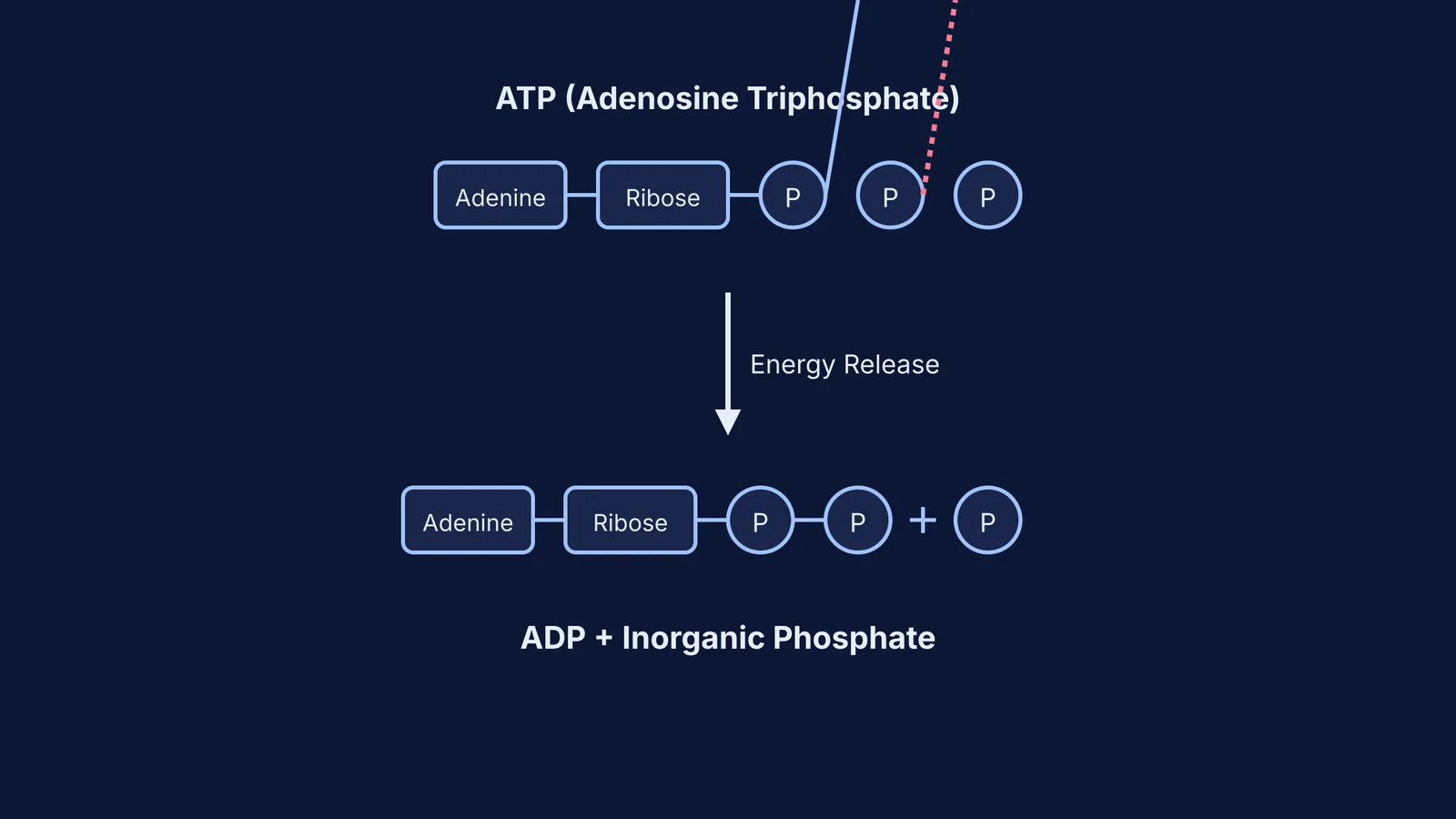
Lohmann's work solved a major puzzle in bioenergetics: how cells store and release energy on demand. ATP is built from three parts: an adenine base, a ribose sugar, and a chain of three phosphate groups.
The bonds between the second and third phosphate groups are often called "high-energy bonds". When a cell needs to do work, it breaks off the final phosphate group in a process called hydrolysis. This reaction converts ATP into adenosine diphosphate (ADP) and an inorganic phosphate (Pi), releasing the stored energy. The cell then uses energy from food—primarily glucose broken down during cellular respiration—to reattach a phosphate group to ADP, turning it back into ATP.
If you are working through the stoichiometry of cellular respiration and need to track where these phosphate bonds form, the Fermi Problem Library has worked problems with a step-by-step solver that explains the reasoning rather than printing an answer.
For more on how your body breaks down different fuels to drive this cycle, read our guide on Respiration as an amphibolic pathway: where fats and proteins enter.
How much ATP do we use every day?
Your body does not store large reserves of ATP; instead, it constantly recycles a very small amount. At any given moment, an adult human body contains only about 50 grams of ATP 1.
Because ATP is consumed almost immediately after it is made, the turnover rate is staggering. An average adult human recycles approximately 50 kilograms of ATP daily 1. This means that you synthesise and consume roughly your entire body weight in ATP over the course of a single day.
Worked example: calculating your daily ATP recycling
Understanding the scale of this chemical cycle helps put Lohmann's discovery in perspective. Here is how you can calculate the rapid recycling rate of ATP in an average human body 1:
Find the total daily consumption. A human typically uses their entire body weight worth of ATP over the course of a single day. This requires the hydrolysis of approximately 100 to 150 moles of ATP daily to power basal metabolism and physical activity.
Convert moles to mass. The molar mass of ATP is roughly 507 grams per mole. Multiplying 100 moles by 507 g/mol gives 50,700 grams, or just over 50 kilograms of ATP hydrolysed each day.
Calculate the recycling frequency. Since the body only stores about 50 grams of ATP at any given time, we divide the total daily mass by the stored mass (50,700 g / 50 g). The result is 1,014.
This means every single ATP molecule in your cells is broken down into ADP and recharged back into ATP over 1,000 times every 24 hours. When Lohmann isolated that first sample of muscle extract in 1929, he had discovered the tiny, rapidly spinning engine that keeps the entire biological world in motion.


