

On this page
In 1961, the British biochemist Peter Mitchell published a paper in *Nature* titled "Coupling of Phosphorylation to Electron and Hydrogen Transfer by a Chemi-Osmotic type of Mechanism" (https://doi.org/10.1038/191144a0). At the time, scientists knew that photosynthesis and respiration produced ATP, but they were searching for a direct chemical intermediate. Mitchell proposed something entirely different: cells use an electrochemical gradient across a membrane to drive ATP synthesis.
This idea, known as the chemiosmotic hypothesis, fundamentally changed bioenergetics. It was later confirmed by extensive experimental evidence, earning Mitchell the Nobel Prize in Chemistry in 1978 (https://en.wikipedia.org/wiki/Chemiosmosis). Today, this mechanism is a core part of the Class 11 biology syllabus, explaining how both mitochondria and chloroplasts generate cellular energy.
How does the proton gradient build up in the chloroplast?
For chemiosmosis to work, you need a membrane, a proton pump, a proton gradient, and an enzyme to use that gradient. In chloroplasts, this happens across the thylakoid membrane.
As the light-dependent reactions of photosynthesis proceed, protons (H⁺ ions) accumulate on the inside of the thylakoid, known as the lumen. Meanwhile, the concentration of protons in the outer fluid, or stroma, decreases. This builds a powerful proton gradient, driven by three distinct processes:
Splitting of water: When water molecules are split by Photosystem II, the reaction takes place on the inner side of the thylakoid membrane, releasing protons directly into the lumen.
Proton pumping by electron carriers: As electrons move through the electron transport chain from Photosystem II to Photosystem I, primary acceptors transfer them to hydrogen carriers like plastoquinone. These carriers pick up a proton from the stroma and release it into the lumen.
NADP reductase activity: On the stroma side of the membrane, the enzyme NADP reductase uses protons from the stroma to reduce NADP⁺ into NADPH + H⁺.
Because the lumen becomes packed with protons while the stroma is depleted, a strong electrochemical gradient forms across the thylakoid membrane. If you are comparing this to other metabolic pathways, you will see similar principles at play in how Robert Hill and oxygen released by isolated chloroplasts established the light-dependent nature of these reactions.
What are the roles of CF0 and CF1 in ATP synthesis?
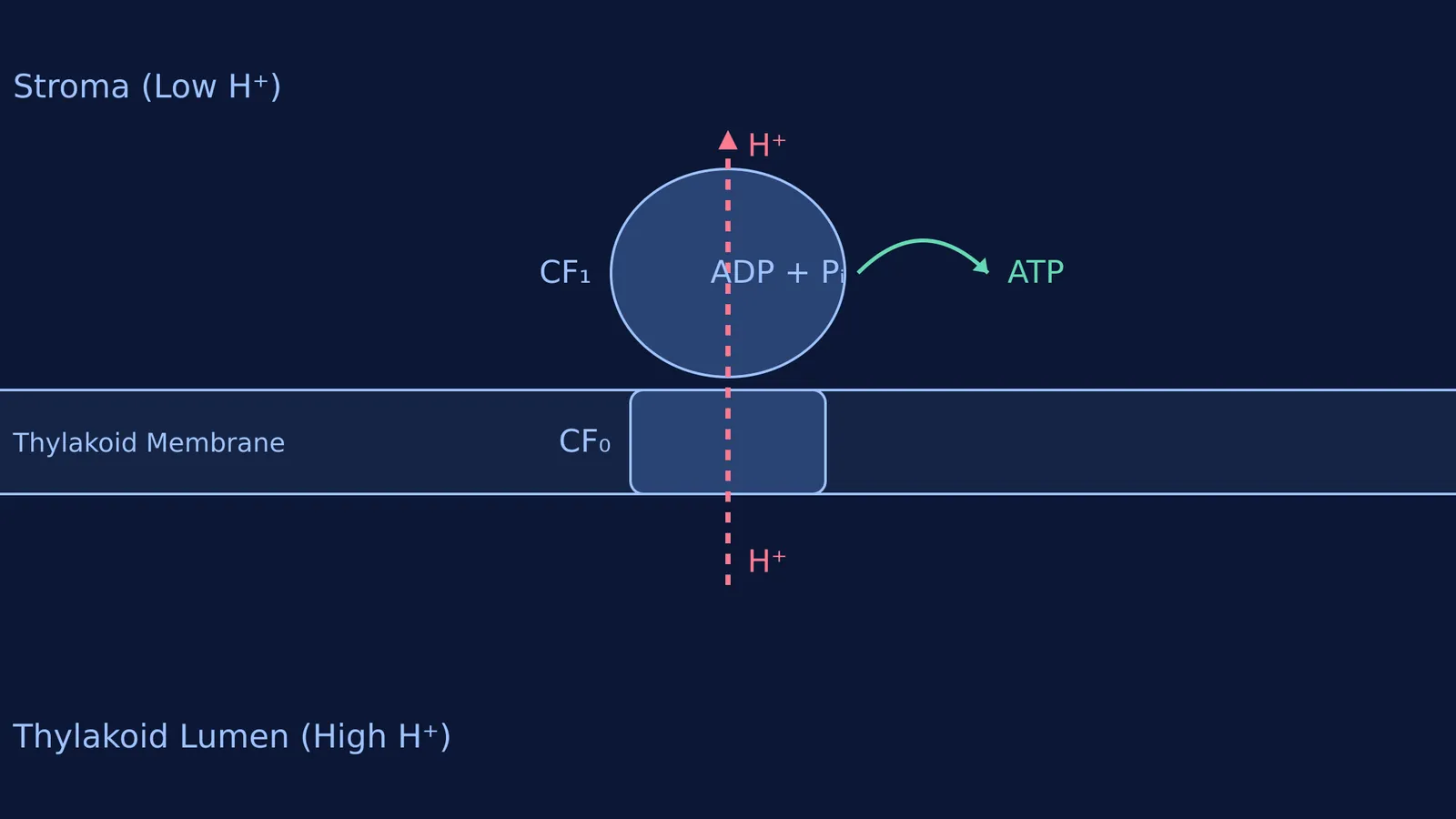
The thylakoid membrane is impermeable to protons, so they cannot simply diffuse back into the stroma. Instead, they must pass through a highly specialised enzyme called ATP synthase. This enzyme consists of two main parts, CF0 and CF1, which work together to harness the gradient's energy.
The CF0 part is embedded directly within the thylakoid membrane. It forms a transmembrane channel that allows the facilitated diffusion of protons to flow down their gradient, from the high-concentration lumen back out to the low-concentration stroma.
The CF1 part protrudes from the outer surface of the thylakoid membrane, facing the stroma. As protons rush through the CF0 channel, the movement forces the CF1 particle to undergo a conformational change. This physical shift provides the energy required to catalyse the bonding of ADP and an inorganic phosphate (Pi) to form ATP.
If you find it difficult to picture these moving parts in three dimensions, the Fermi Simulation Lab provides interactive simulations for the ideas that are easier to see than to read, letting you watch the gradient build and resolve in real time.
How is this energy used next?
The breakdown of the proton gradient directly drives the synthesis of ATP. Immediately after CF1 releases the newly formed ATP into the stroma, it is put to work.
Along with the NADPH generated earlier, this ATP is the main energy currency for the biosynthetic phase of photosynthesis, often called the Calvin Cycle. In the stroma, these molecules provide the energy to fix carbon dioxide into sugars. Understanding how these phases connect is crucial; any disruption in the ATP supply becomes one of the limiting factors in photosynthesis: Blackman's law and CO₂ dictate how efficiently the plant can produce food.
Keeping track of which reaction happens in the stroma versus the lumen is a common stumbling block. If you often lose marks on these spatial biology questions, the Fermi Problem Library has worked problems with a step-by-step solver that explains the reasoning rather than printing an answer, walking you through the logic of where every proton and electron moves. Connecting these spatial facts to broader plant metabolism, such as why photorespiration: why RuBisCO wastes energy in C3 plants occurs in the stroma, will make the whole system much easier to remember.


