On this page
The new Pamban bridge carries trains across the sea from Mandapam to Rameswaram island, and partway across, a 72.5 m section rises straight up, 17 m, to let ships through. The Press Information Bureau calls it India's first vertical-lift railway sea bridge, 2.07 km long. The Prime Minister was set to inaugurate it on 6 April 2025, and it opened to traffic that month. Beside it stood a 1914 bridge that opened a different way, and whose dismantling began in 2026. Both are lessons in balance, and in what salt water does to steel.
How did the old 1914 Pamban bridge open for ships?
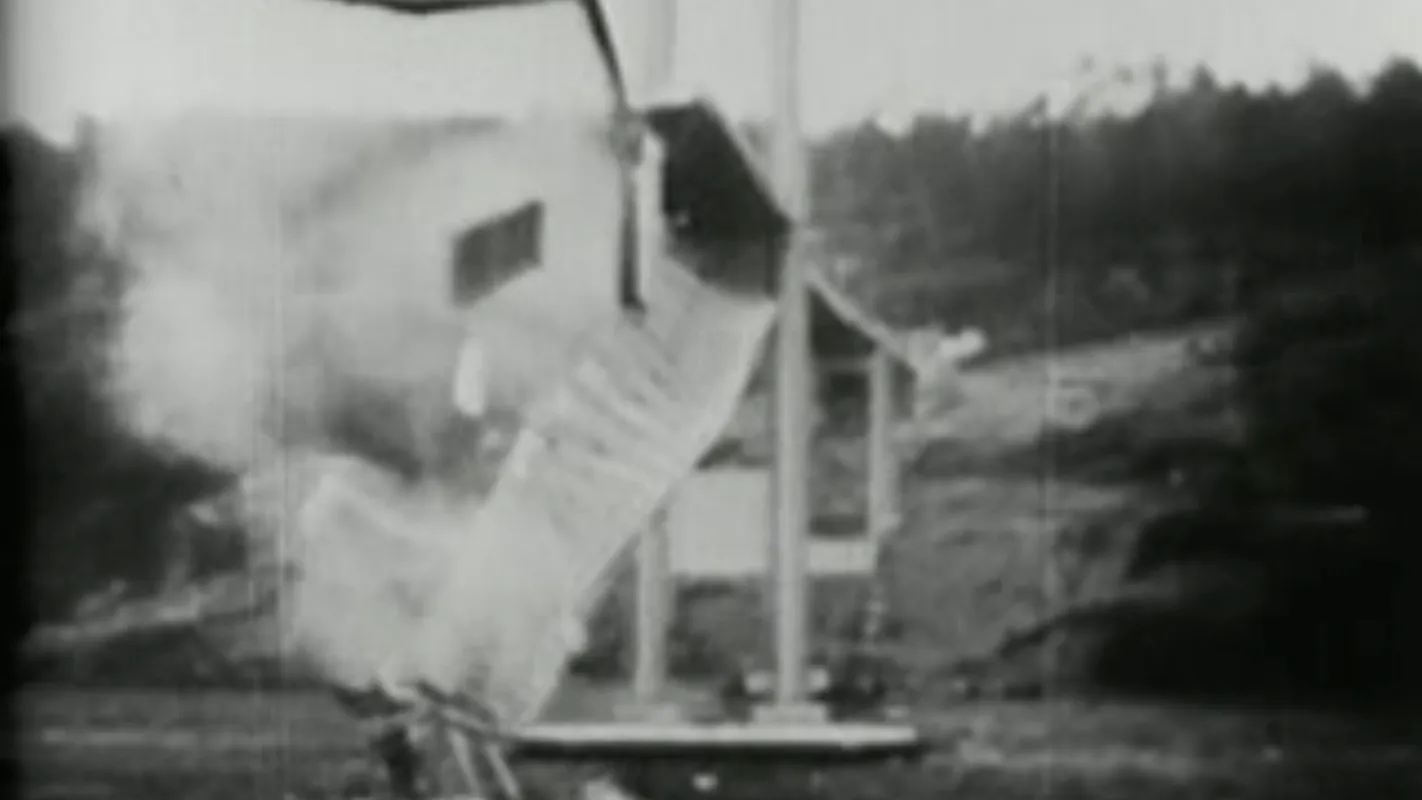
The old bridge had a Scherzer rolling lift span. This is a kind of bascule, a movable bridge whose counterweight continuously balances the span as it swings up. William Donald Scherzer patented this rolling design in 1893. Each leaf rolls back on a curved track, like the base of a rocking chair.
At Pamban, two leaves met in the middle. TYPSA, which designed the new lift span, describes each old leaf rolling on the circular lower edge of its double steel girder, worked by hand with cranks. Each half weighed 415 tonnes, and each took about 45 minutes to raise and lower. Turning that much steel by hand works only because a counterweight balances most of its weight.
How does the new Pamban bridge work?
The new span does not tilt. It goes up like a lift car. TYPSA's design note calls it a tower-drive vertical lift: sheaves (large pulley wheels), steel ropes and counterweights, with low-power electric motors at the top of the towers.
The ropes: four sets of six 46 mm galvanised steel ropes, one set at each corner of the deck.
The sheaves: 3 m across, which limits rope wear and bending fatigue.
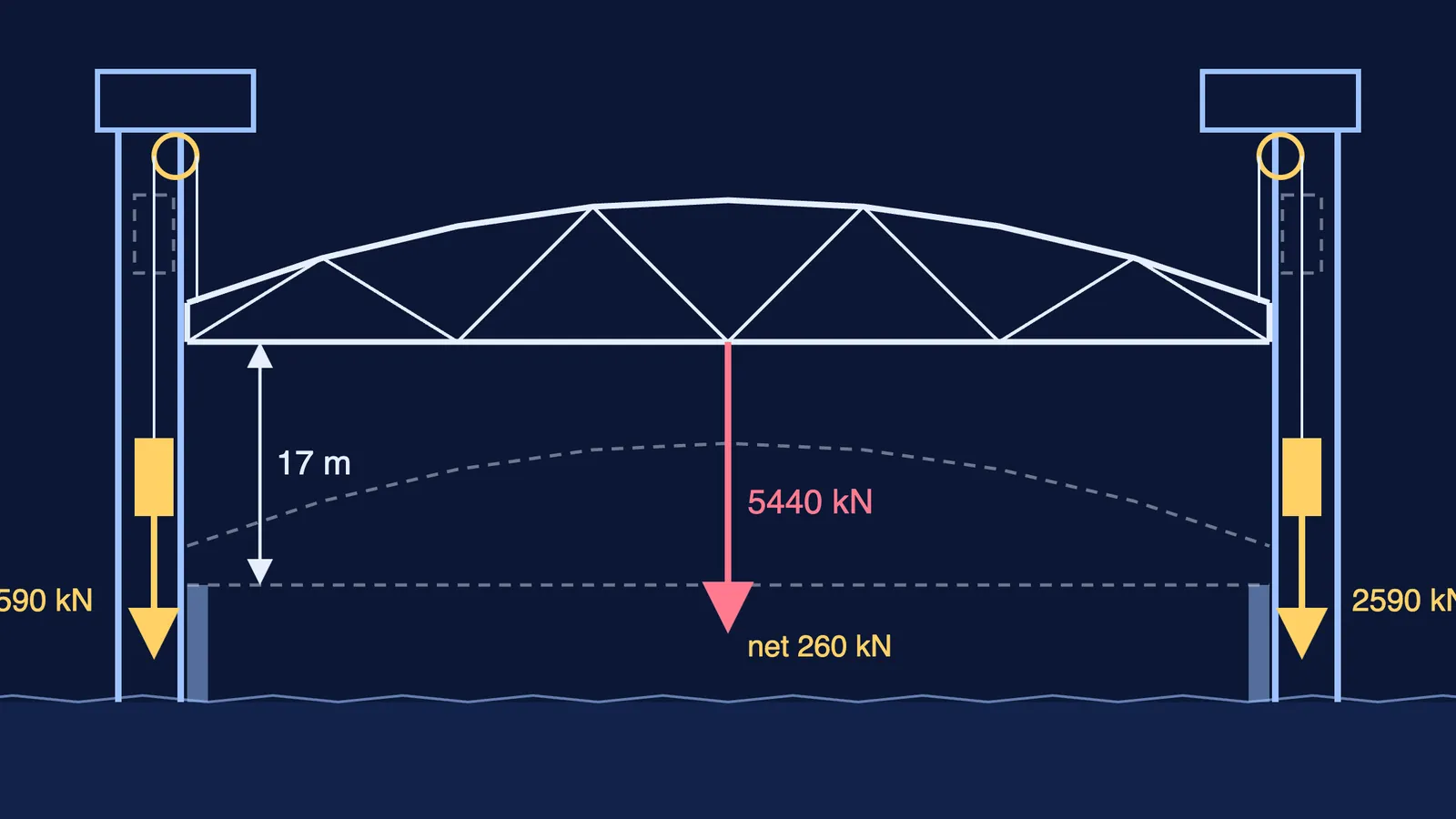
The deck: its steel weighs 4240 kN. With rails, sleepers, fixings and walkways the total load is 5440 kN.
The counterweights: one in each tower, 2590 kN each.
The lift: 17 m in under 5 minutes, at a top speed of 4.8 m/min.
Safety: emergency brakes can stop the span in under 10 seconds, and they clamp on automatically if the power fails.
The PIB note adds a wind check. An anemometer on pier 38 turns the signals red and stops trains if the wind passes 58 km/h.
Worked example: how much work do the counterweights save?
Use the designer's numbers from the list above.
Deck load W = 5440 kN. Counterweights: 2 × 2590 = 5180 kN.
Unbalanced load: 5440 − 5180 = 260 kN. That is under 5% of the deck.
Top speed: 4.8 m/min = 0.08 m/s.
Power with no counterweights: P = Fv = 5440 kN × 0.08 m/s ≈ 435 kW.
Power with counterweights: 260 kN × 0.08 m/s ≈ 21 kW, about one-twentieth.
Energy: raising the deck 17 m stores about 5440 × 17 ≈ 92 MJ. The falling counterweights supply about 5180 × 17 ≈ 88 MJ, and the motors only about 4.4 MJ.
Real motors must also overcome friction and get the mass moving, and the design gives each tower a 250 kW main motor plus a backup. A building's elevator uses the same trick, as our explainer on why lifts have a counterweight shows. If P = Fv and pulley problems still trip you up, the Fermi Problem Library has worked problems with a step-by-step solver that explains the reasoning.
Why did corrosion end the old bridge, and how is the new one protected?
In December 2022, rail traffic on the old bridge was stopped for good because corrosion had badly weakened the bascule section. TYPSA calls the site one of the harshest marine corrosion environments in the world. Its defences come in layers:
A base of zinc sprayed on hot (thermal metallising), then an epoxy sealer, then a polysiloxane top coat. The coating is planned to last 50 years with regular maintenance.
Smooth, continuous surfaces with no pockets where seawater can sit.
A deck raised higher than the old one, out of the splash zone where waves keep the steel wet.
Motors and machinery at the top of the towers, away from the most corrosive air.
The bridge is designed for a 100-year service life. PIB adds stainless steel reinforcement and fully welded joints. Why zinc first? Zinc is more reactive than iron, so it corrodes in place of the steel, even where the paint gets scratched. Our explainer on how a zinc coating protects iron works through the electrode potentials.
What can you check for yourself?
From photos of the bridge, try this:
Find the rope sets at the deck corners, each running over a sheave to a tower counterweight.
Notice that the counterweight drops exactly as far as the deck rises: 17 m.
Redo step 5 with a 10% heavier deck and see how fast the motor power climbs.
Turn 2590 kN into a mass in tonnes with g = 9.8 m/s².
For a very different steel bridge, read how the Chenab bridge's steel arch was built.