On this page
The Chenab bridge carries the railway from Udhampur to Srinagar across the gorge of the Chenab river in Reasi. Prime Minister Narendra Modi inaugurated it on Friday, 6 June 2025, as The Tribune reported. Here is how its arch was built and why the shape works.
How was the Chenab bridge built?
The official figures are in New India Samachar, a Government of India magazine. The bridge has a height of 359 metres, 35 metres higher than the Eiffel Tower, and is 1,315 metres long. Its main arch spans 467 metres and weighs 10,619 tonnes.
The same page says a 915-metre-long cable crane was installed across the river to help build the bridge.
The Railway Technology project profile describes "a two-ribbed arch with steel trusses made of concrete-filled sealed steel boxes". It says cable cranes and derricks were used, and that the structure is supported through cables by two 100-metre-high pylons, one on either end. It says the steel arch was completed in April 2021 and gives the main span as 469 metres.
Why would cables matter during construction? Until the two halves of an arch meet at the crown, each is an overhanging arm leaning over the gorge, and something has to hold it back.
How does an arch carry a train in compression?
A beam carries load by bending: its top is squeezed and its bottom stretched. A true arch has elements "operating under compressive forces", as the Wikipedia article on arches puts it.
Robert Hooke saw why in the 1670s: "As hangs the flexible line, so but inverted will stand the rigid arch" (Wikipedia, Arch). A hanging chain is in pure tension; flip its shape and you get pure compression. When the load is spread evenly along the horizontal, like a deck, the hanging shape is a parabola (Wikipedia, Catenary). So a parabolic arch under an even deck load is squeezed rather than bent.
There is a price. An arch pushes outward at its feet, and that sideways thrust is why masonry arches needed heavy abutments (Wikipedia, Arch). In a deep gorge, the rock on each side can take that push. A suspension bridge does the opposite and hangs in tension, like Thomas Telford's Menai Suspension Bridge and its iron chains.
Worked example: how hard does the arch push on the rock?
Use the figures from New India Samachar: a 467 m span and an arch weighing 10,619 tonnes. Spread that weight evenly along the span; leave out the deck and trains.
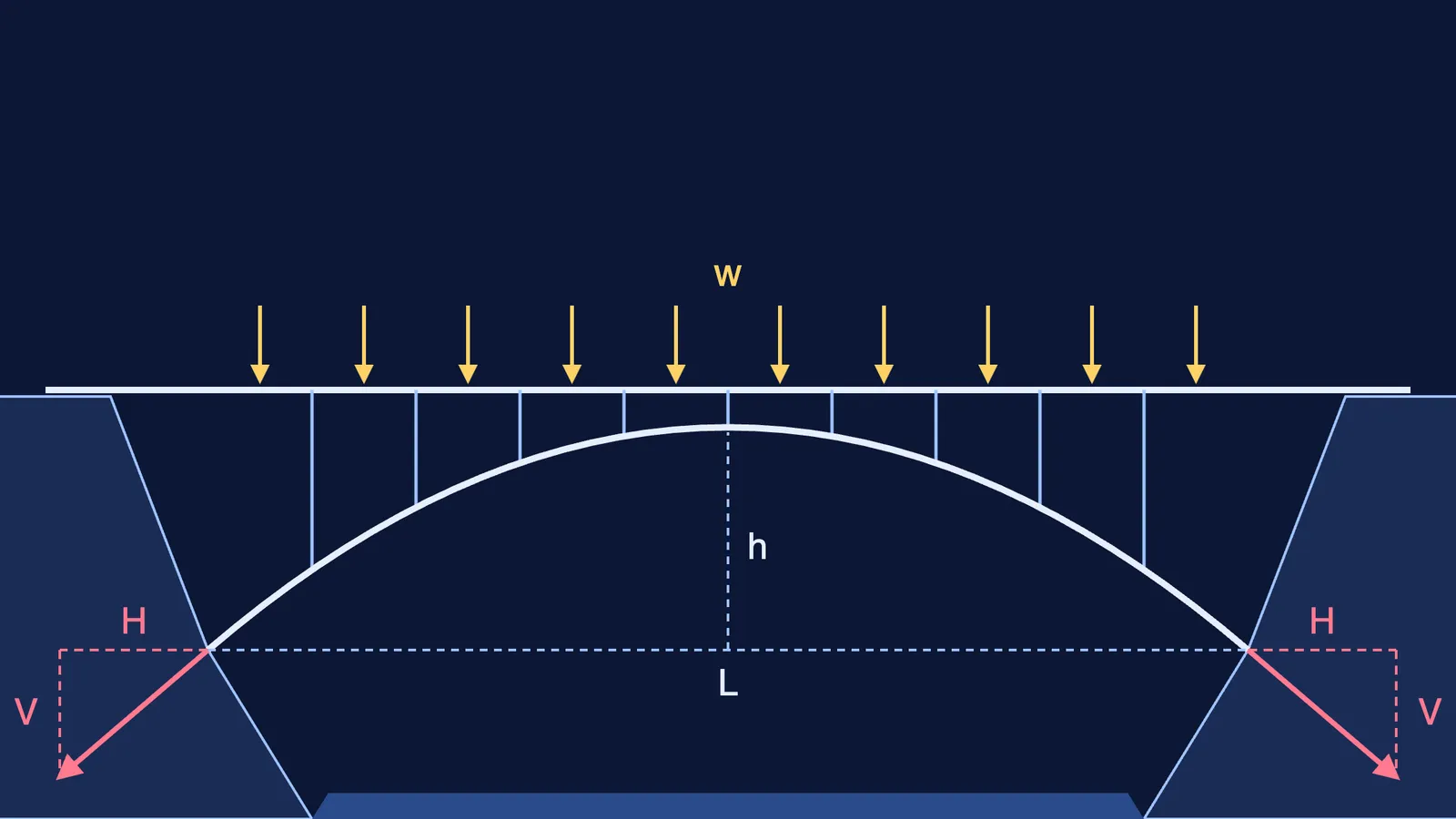
Load per metre: w = (10,619,000 kg × 9.8 m/s²) ÷ 467 m ≈ 223 kN per metre.
Vertical push at each foot: V = wL/2 = 223 × 233.5 ≈ 52,000 kN.
Cut at the crown: the left half is held there by a horizontal force H, a height h above the feet. Take moments about the left foot: H × h = (wL/2) × (L/4), so H = wL²/(8h).
Pick a rise. The sources give no rise, so assume h = 100 m: H = 223 × 467² ÷ 800 ≈ 61,000 kN, about 61 meganewtons.
Check the direction: V/H = 4h/L ≈ 0.86, which is the slope of the parabola at its foot. The push runs along the arch into the rock, about 41° below the horizontal.
How is the Chenab bridge designed for wind and earthquakes?
New India Samachar says the bridge is built to withstand wind speeds up to 266 km/h; Railway Technology gives 260 km/h. Wind pressure grows with the square of speed, so wind at 266 km/h pushes about seven times as hard as wind at 100 km/h (2.66² ≈ 7.1). Railway Technology reports wind tunnel tests by Norway-based Force Technology on static force coefficients and gust buffeting, and a planned online monitoring and warning system to protect trains. Pushes in step with a structure's natural rhythm can build up sway, as in why soldiers break step on a bridge.
For earthquakes, Reasi lies in seismic zone IV, but the bridge is designed to bear earthquake forces of the highest intensity, zone V, says the same government page. It was also designed for blast load with DRDO, a first for an Indian bridge, and for a 120-year life. For how other structures ride out shaking, see how earthquake-resistant buildings are made.
How can you practise arch problems yourself?
Arch thrust is a statics problem. A routine:
Draw half the arch as a free body: the load, H at the crown, H and V at the foot.
Take moments about the foot so the unknown foot forces drop out.
Check that the resultant at the foot runs along the arch.
Change the rise or the load and predict the new thrust before calculating.
If forces along a curve are hard to picture, the Fermi Simulation Lab has interactive simulations for ideas that are easier to see than to read. For moment and equilibrium numericals, the Fermi Problem Library has worked problems with a step-by-step solver that explains the reasoning rather than printing an answer.