

On this page
On 30 January 1826, a road opened across the Menai Strait between mainland Wales and the island of Anglesey, hanging from iron chains. The Menai Suspension Bridge was designed by Thomas Telford, and it was one of the first big bridges anywhere to carry traffic this way. Its chains were given a deeper sag to cut their pull.
Why did Telford build a suspension bridge over the Menai Strait?
Before 1826, people crossed the strait by ferry, and its strong currents made that dangerous. After Ireland joined the United Kingdom in 1800, the road from London to the port of Holyhead on Anglesey became an important route, as Menai Heritage explains.
The strait was also busy with tall sailing ships. The bridge had to leave 100 feet of clear space beneath its deck so they could pass. Piers or a stone arch in the middle of the channel would have blocked them. Hanging the deck from chains slung between two towers left the water open.
How long is the Menai Suspension Bridge?
The main span between the towers is 176 metres (577 feet), and the whole bridge is 417 metres long. Work began in 1819 and the bridge opened in 1826. Menai Heritage calls it the biggest suspension bridge in the world at the time.
The deck hung from sixteen chain cables. Each cable was made of five parallel bars of wrought iron links, giving 80 iron bars and 935 links per cable. The final middle section of each chain was floated out on a raft and lifted by 150 men pulling on a system of pulleys.
The iron came from William Hazledine's works. Telford arranged extensive tests of the strength of iron and built a 50-foot model bridge before committing to the design. Together with his road improvements, the bridge cut the London to Holyhead journey from 36 hours to 27.
Why did a deeper sag make the chains safer?
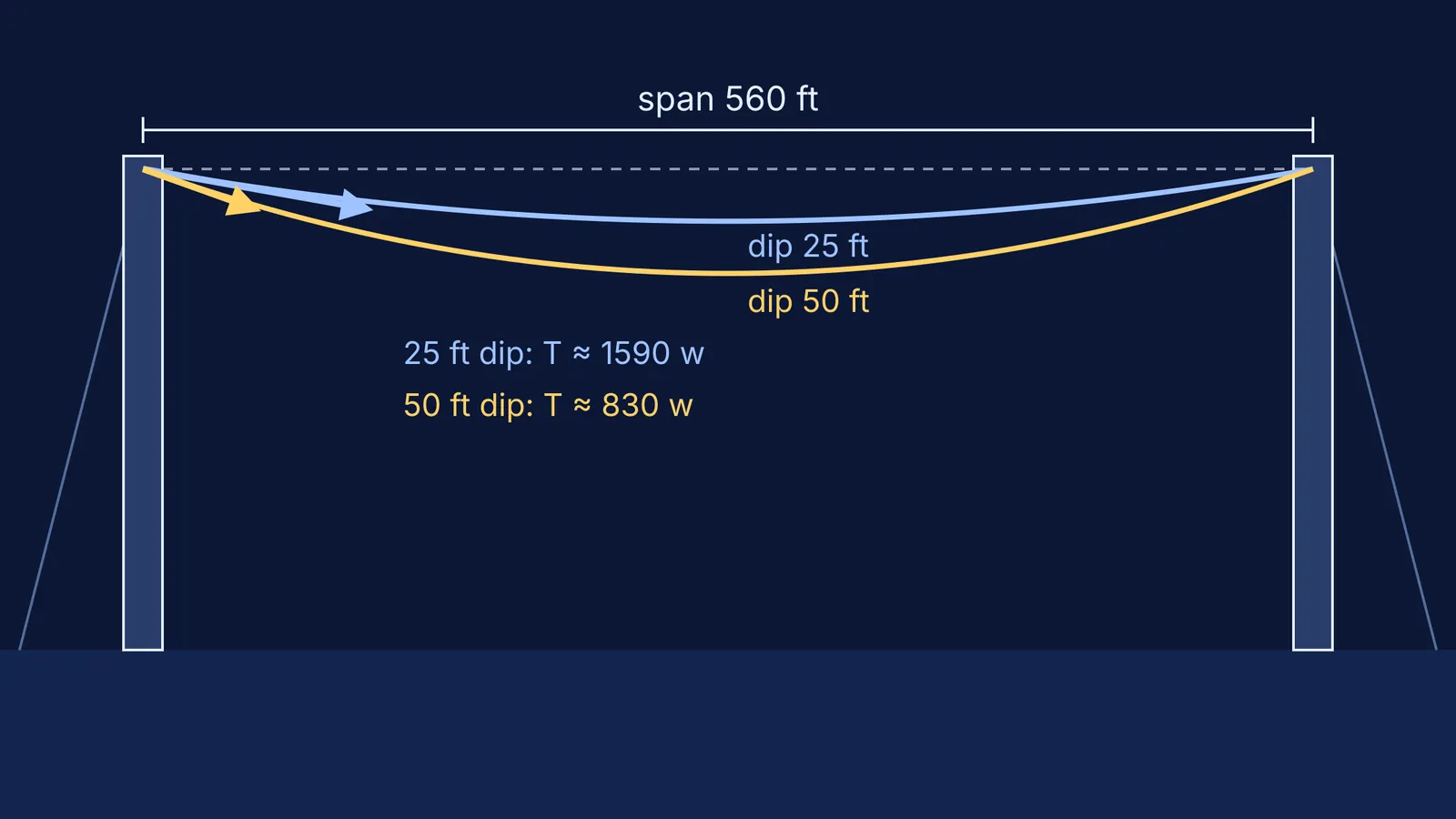
Telford had help from the mathematician Davies Gilbert. In a 2015 commentary, Cambridge engineer C. R. Calladine describes how Gilbert's work on the hanging chain, the catenary, influenced Telford's final design. Telford first planned a dip of 25 feet over a span of 560 feet; Gilbert showed that doubling the dip to 50 feet would halve the tension in the chains, and Telford accepted this.
You can check Gilbert's point yourself. If a chain carries a deck whose weight w is spread evenly along the span L, it hangs in a parabola. Its horizontal pull H, which stays the same all along the chain, is H = wL²/8d, where d is the dip.
Shallow dip: L = 560 ft, d = 25 ft. H = w × 560² ÷ (8 × 25) = 1568w.
Deep dip: d = 50 ft. H = w × 560² ÷ 400 = 784w. Exactly half.
At the tower, the chain also holds up half the deck, a vertical pull of wL/2 = 280w in both cases.
Total tension at the tower is √(H² + (280w)²): about 1590w for the shallow chain and about 830w for the deep one, roughly 52 per cent.
There is a cost. A deeper dip needs taller towers to keep the same clearance under the deck, and longer chains. A perfectly straight chain would need infinite tension, which is why a taut horizontal string can never be perfectly straight.
What went wrong, and are the 1826 chains still there?
The original roadway was only 24 feet wide with no stiffening trusses, and it moved in the wind. Strong winds damaged the timber deck a week after opening; a storm in 1836 caused large oscillations, and one in 1839 left the deck in ruins. The deck was strengthened in 1840 and replaced with steel in 1893.
From 1938 the wrought iron chains were replaced with steel ones without closing the bridge. So the iron Telford hung is gone, but his towers, span and shape still carry traffic. Later, wire cables replaced chains on longer spans, the story told in our post on John Roebling's wire rope and the Brooklyn Bridge.
Try it at home: feel the sag rule in five minutes
Tie a 1-metre string between your two hands and hang a small bag from the middle.
Let it sag deeply. Notice how little you need to pull.
Slowly spread your hands to straighten the string. Feel your pull grow.
Measure each dip. For one weight W at the middle, the pull is H = WL/4d, so doubling the dip should halve it.
Write one sentence explaining why a bridge cannot have a flat chain.
If the curve is hard to picture, the Fermi Simulation Lab has interactive simulations for ideas that are easier to see than to read. If you want the force ideas behind it from the start, the Fermi Concept Library gives each physics concept its own lesson.
For another way engineers handled huge spans, read how the Forth Bridge cantilever was explained with a human model.


