On this page
Before Oliver Evans, a flour mill ran on human backs. The miller carried grain up the stairs a sack at a time, and men shovelled flour across the loft floor to cool it. In the late 1780s Evans, an inventor from Delaware, handed nearly all of those jobs to machines driven by the waterwheel or by gravity.
Who was Oliver Evans and what did he build?
Oliver Evans lived from 1755 to 1819, according to the Mills Archive biography of Oliver Evans. Work on a mill on Red Clay Creek, Delaware, began in 1783, as Invention & Technology magazine describes. In the old method it describes, two men shovelled the flour into tubs, then spread it on the loft floor with shovel and rake to cool.
His brothers built it on family land at Newport, with Evans overseeing, says the Wikipedia article on Oliver Evans. It opened in 1785 as an ordinary mill; over the next five years he made it automatic.
On 18 December 1790 he received the third patent issued under the new US patent law, for his flour mill (Invention & Technology).
What were the five machines in Evans's mill?
Evans listed them himself in The Young Mill-wright and Miller's Guide, 1795 edition (quotes with the long s modernised):
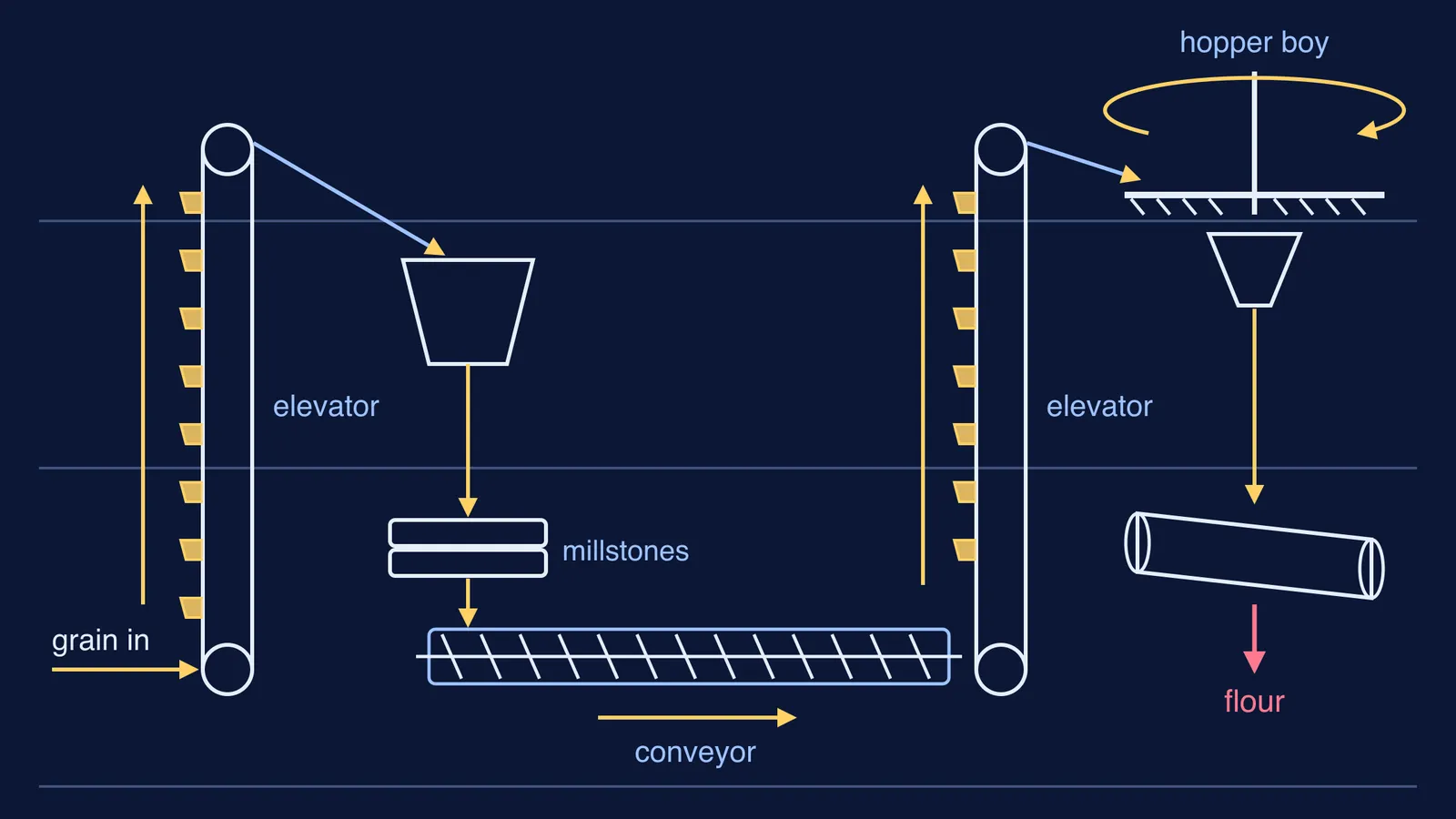
Elevator: "an endless strap, revolving over two pullies", with buckets that fill under the lower pulley and empty over the upper one.
Conveyor: "an endless screw of two continued spires" turning in a trough, pushing grain sideways. It works like an Archimedes screw, the ancient water-lifting device, laid on its side.
Hopper boy: a vertical shaft turning slowly, "not above 4 revolutions in a minute", its arm spreading warm meal to cool and gathering cool meal into the sifting hopper.
Drill: a nearly level strap with small rakes instead of buckets.
Descender: a sloping strap of thin leather, canvas or flannel, set moving by the weight of the falling meal, on the principle of an overshot waterwheel.
Evans wrote that the machines worked "by the force of the water, without the aid of manual labour, except to set the different machines in motion". He claimed this cut the labour and expense of attendance in a flour mill by "fully one half".
How did grain travel through the mill?
Here is Evans's walk-through of his plate VIII, shortened (1795 Guide). Trace it on the diagram above:
Wheat from a wagon is weighed, and an elevator lifts it up the mill.
A swivelling "crane spout" directs it into a bin. After stones rub off the dust, it falls through a rolling screen and a fan's air blast.
A conveyor keeps the hoppers over the millstones evenly full.
Meal falls from the stones into another conveyor, which carries it to the meal elevator.
The meal is lifted again and runs down a spout to the hopper boy, which cools it and feeds the sifting hoppers.
The superfine flour falls into a packing chest, ready for barrels.
How fast did the hopper boy's arm move?
Invention & Technology describes the hopper boy's rake as twelve feet long (source), and Evans gives a top speed of 4 revolutions per minute (1795 Guide). Treat it as an arm turning about its centre:
Radius: r = 6 ft, about 1.83 m.
Angular speed: ω = 4 × 2π ÷ 60, about 0.42 rad/s.
Tip speed: v = ωr = 0.42 × 1.83, about 0.77 m/s at most. That is a slow stroll.
Because v = ωr, meal halfway along the arm moves at half that speed. If angular and linear speed blur together for you, the Fermi Simulation Lab has interactive simulations for ideas that are easier to see than read.
Why does Evans's mill still matter?
The American Society of Mechanical Engineers lists Colvin Run Mill in Virginia as a landmark. The mill is closely modelled on Evans's principles, and the ASME says the only labour his system required was to "start, stop and adjust the machinery". Citing the Society for the Preservation of Old Mills, it adds that the mill may hold the only operating hopper boy in the United States.
Evans's book went through fifteen printed editions between 1795 and 1860, says the Mills Archive. George Washington's name topped its subscriber list, and he had his Mount Vernon gristmill converted to the Evans system. For the same idea a century later, see Henry Ford's 1913 moving assembly line.
How can you use Evans's method on a problem?
Evans's real trick was a question. Try it on any process, such as a canteen queue:
List every step where something is carried by hand.
Label each move as up, sideways or down.
Up gets a lift (elevator). Sideways gets a push (conveyor or drill). Down gets gravity (spout or descender).
Ask what still needs a person. For Evans's system, the ASME's answer is starting, stopping and adjusting.
For exam practice, try the force needed to keep a conveyor belt moving as sand falls. If your answer goes wrong, the Fermi Problem Library has worked problems with a step-by-step solver that explains the reasoning rather than printing an answer.