

On this page
What was the Henry Ford moving assembly line of 1913?
Before 1913, building an automobile was a stationary and slow craft. A team of mechanics would gather around a single chassis on the factory floor. They would fetch parts from bins, figure out how they fit, and slowly piece the vehicle together until it was ready to drive. This method was inefficient, and as global demand for the affordable Model T grew, the Ford Motor Company needed a way to build cars much faster.
On December 1, 1913, Henry Ford and his engineers launched the first permanent moving assembly line at the Highland Park plant in Michigan (History.com). Instead of the workers moving around the car, the car moved past the workers. Initially using a simple rope and winch system, the chassis was pulled steadily along a line across the factory floor. Each worker stayed anchored in one specific place, waiting for the car to come to them so they could perform their single, designated task.
How did Ford reduce the time to build a Model T?
The secret to the speed of the moving assembly line was the strict division of labour. Rather than having mechanics build an entire system, the process of assembling a Model T chassis was broken down into 84 distinct steps (History.com). By standardising every single motion, workers did not have to stop to think about what to do next or waste time walking across the floor to look for a missing spanner.
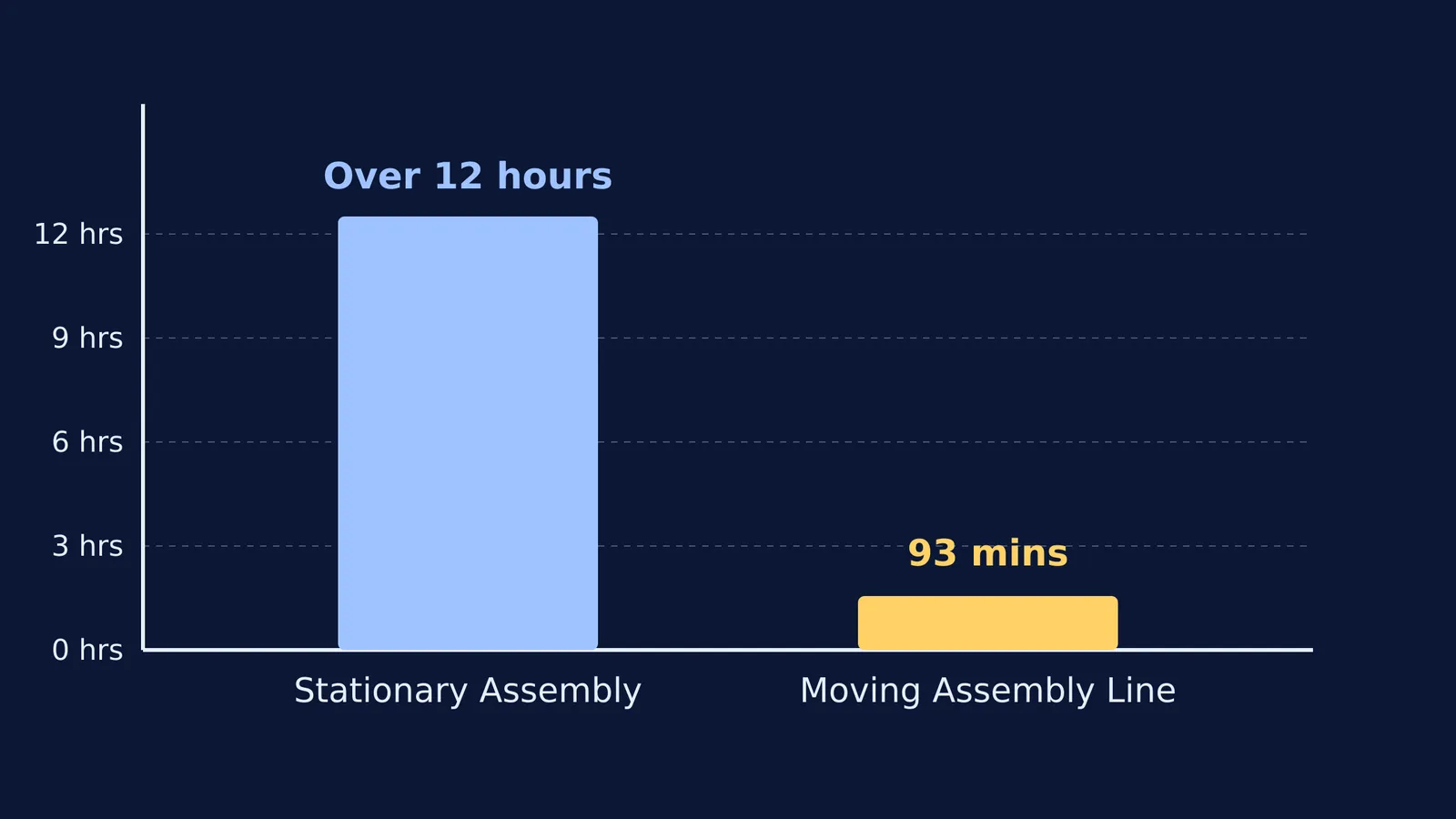
This specialization meant a worker only had to master one repetitive action—like tightening a specific bolt on the axle, attaching a single wheel, or securing a particular bracket. The results of this system were immediate and clear. By breaking the heavy work into 84 discrete steps, Ford reduced the time it took to build a chassis from more than 12 hours to just one hour and 33 minutes, or 93 minutes (History.com).
This jump in productivity changed industrial manufacturing permanently. It allowed Ford to drop the price of the Model T so low that everyday workers could afford one, changing the landscape of modern transport. He achieved in mass production what engineers like George Stephenson and the friction that made railways work achieved for transport: making complex mechanics accessible and highly efficient for the public.
Can the assembly line method help you study?
When you sit down to study a massive syllabus for an exam like JEE or NEET, it can easily feel like building a car from scratch in the 1910s. You might waste 20 minutes deciding what chapter to read, another 10 minutes finding your printed notes, and then constantly switch contexts between reading a textbook, attempting a problem, and checking the answer key. This is the "stationary mechanic" problem, and it drains your mental energy before you even begin the real work.
To study efficiently, you can apply the moving assembly line principles to your own desk and learning habits:
Break it down into steps: Do not just sit down to "study physics". Break the session into highly discrete steps: five minutes to gather formulas, 20 minutes to read theory, and 30 minutes to apply them to practice problems. Much like the gap method: arranging so that no two are together, you should separate different cognitive tasks so they do not clash. Do one thing at a time and focus on it entirely.
Standardise your workspace: A Ford worker never had to look for a tool. Keep your rough book, your pen, and your calculator in the exact same spot every day. Eliminate the friction of searching for things so you can start working the second you sit down.
Let the work flow to you: In a modern factory, the worker does not have to fetch the car. When you are learning, a tool like Fermi's AI tutor can work out what you already know and build a plan for the session, so you sit down to a clear next step instead of a blank page.
When you remove the friction of deciding what to do next, you can solve relative motion problems or memorise biological pathways much faster. If you hit a roadblock during your focused work, the Fermi Problem Library has worked problems with a step-by-step solver that explains the reasoning rather than printing an answer. By dividing your study sessions into highly focused, single-task steps, you can drastically cut the time it takes to master any subject, just as Ford revolutionised the factory floor.


