On this page
Most people know Omar Khayyam as a poet. In his own time he was also a working astronomer. In 1079 he was one of eight scholars asked to reform the calendar for Sultan Malik Shah. The result was the Jalali calendar. Here is how close they got, and how to check it yourself.
What did Omar Khayyam do for the Jalali calendar?
The MacTutor History of Mathematics archive says Khayyam (born 1048, died 1131) was invited by Malik Shah to set up an observatory in Esfahan, where he led the scientists for 18 years and compiled astronomical tables, until political events in 1092 ended that period. In 1079 he was among eight learned men who reformed the calendar for Malik Shah. The new system was called the Jalali era, after Jalal-ud-din, one of the king's names.
The key idea was simple. According to an entry by Behnaz Hashemipour in the Biographical Encyclopedia of Astronomers, the calendar's most remarkable feature was that its new year, Nowruz, matched the vernal equinox, the beginning of Aries. Its year was the mean interval between two vernal equinoxes. Today we call this the tropical year.
A calendar whose year is slightly too long or too short slowly slides away from the seasons, the problem we explain in why we have leap years at all.
How long did Khayyam say a year is?
MacTutor reports that Khayyam measured the year as 365.24219858156 days. The same page gives 365.242196 days for the end of the 19th century and 365.242190 days for today.
The gap between Khayyam's figure and today's value is about 0.0000086 days, which is under one second. Treat the long string of decimals with care: MacTutor itself notes the "incredible confidence" of quoting so many places, since the length of the year changes in the sixth decimal place over a person's lifetime. But the core value, a year about 11 minutes shorter than 365¼ days, was right. MacTutor also quotes Gibbon, who wrote that the Jalali system "surpasses the Julian, and approaches the accuracy of the Gregorian style." For the mathematician side of his story, read how Omar Khayyam solved cubic equations with geometry.
How accurate is the Jalali calendar compared with the Gregorian?
The US Naval Observatory gives the tropical year as approximately 365.2422 days, the Julian average as 365.25 days and the Gregorian average as 365.2425 days. The Gregorian rule adds a leap day every 4 years but skips century years not divisible by 400, which is 97 leap days in 400 years.
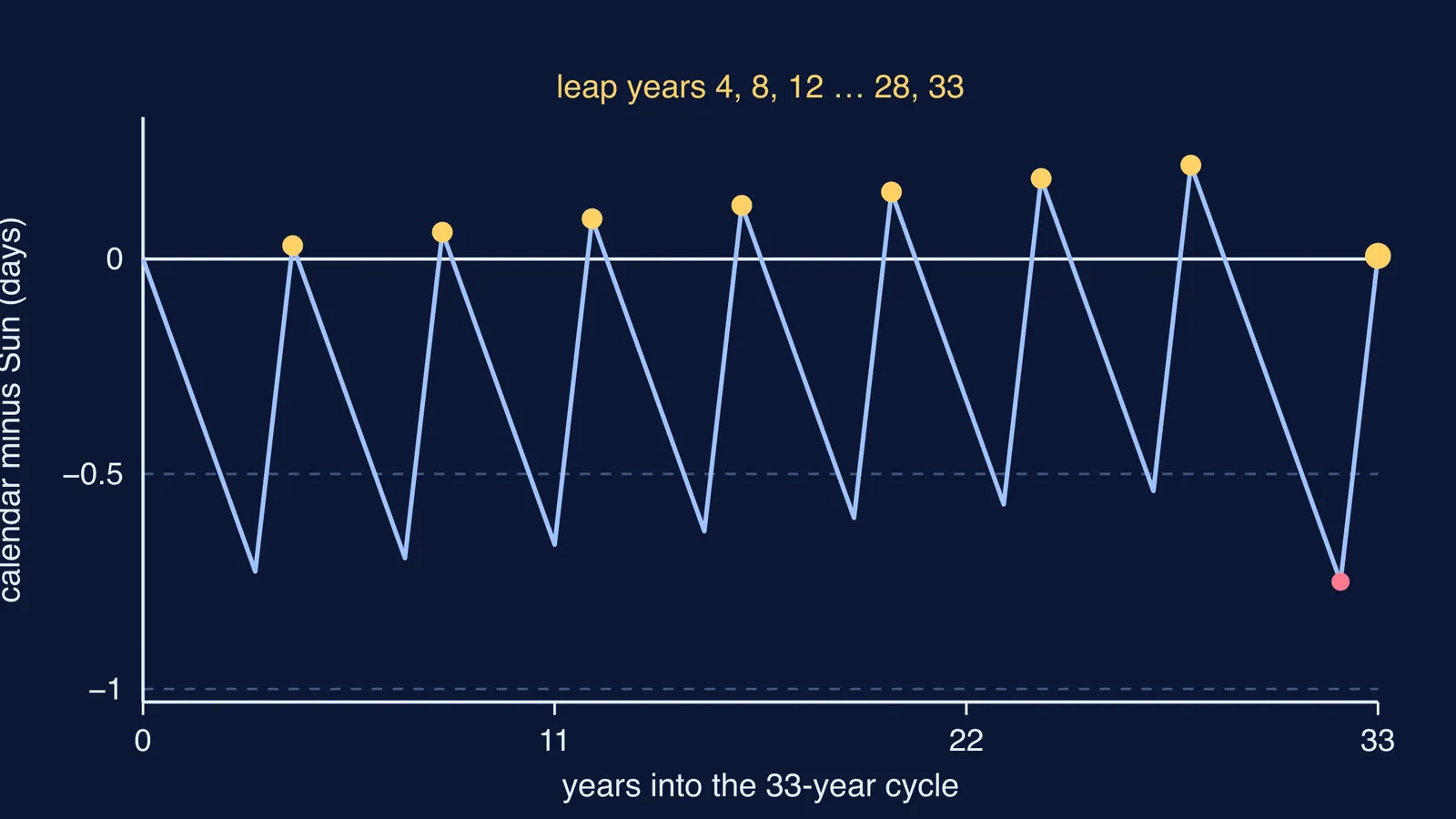
The 33-year cycle often linked to the Jalali calendar adds 8 leap days in 33 years: years 4, 8, 12, 16, 20, 24, 28 and 33. Here is the worked example:
Average year = 365 + (leap days ÷ cycle length).
Julian: 365 + 1/4 = 365.25. Error = 0.0078 days a year, so one day off in about 128 years.
Gregorian: 365 + 97/400 = 365.2425. Error = 0.0003 days a year, so one day off in about 3,300 years.
33-year cycle: 365 + 8/33 = 365.24242... Error = about 0.00022 days a year, so one day off in about 4,460 years.
On these averages, the 33-year cycle beats the Gregorian rule, though "divisible by 4, except centuries" is easier to remember.
Did the Jalali calendar really use a 33-year cycle?
This is where you need to be careful with popular accounts. The Biographical Encyclopedia of Astronomers entry describes a rule of mostly 4-year leap periods with an occasional 5-year one, which produces 33-, 29- and 37-year patterns. It also says there is a wide variety of opinions on the exact pattern, leaving the calendar's actual accuracy an open question.
So: the calendar was anchored to the equinox, its year length was excellent, and the neat 8-in-33 rule is a common reconstruction, not a settled fact. Chinese astronomers wrestled with the same problem, as you can read in the story of Guo Shoujing's Shoushi calendar.
How can you check any leap-year rule yourself?
Use this four-step test on any calendar, real or invented.
Write the rule as a fraction: leap days ÷ years in the cycle.
Add it to 365 to get the average year.
Subtract the US Naval Observatory tropical year of 365.2422 days and ignore the sign. That is the drift per year.
Divide 1 by the drift to get the years before the calendar is a whole day out.
Try it on 7 leap days in 29 years, or 31 in 128. Which beats the Gregorian rule? If the link between Earth's orbit, the equinox and the seasons still feels abstract, the Fermi Simulation Lab has interactive simulations for ideas that are easier to see than to read.
If terms like tropical year, equinox or orbital period are the sticking point, look them up in the Fermi Concept Library, where each concept has its own lesson.