On this page
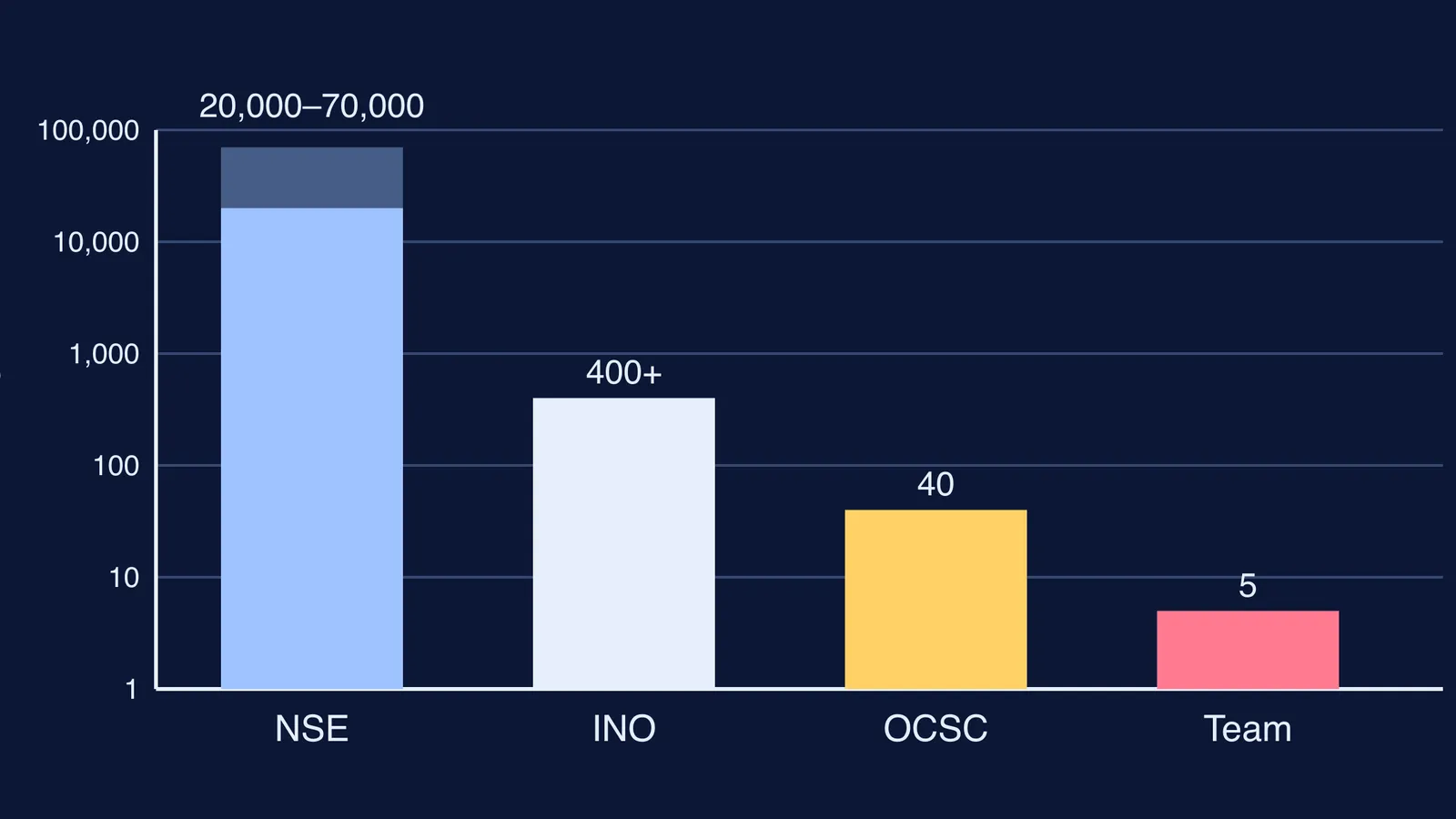
If you do well enough in the Indian National Olympiad (INO) in physics, chemistry, biology or astronomy, you are invited to Mumbai. According to the HBCSE science olympiad brochure for 2026-27, the Orientation-cum-Selection Camp is the third of five stages in the national programme run by the Homi Bhabha Centre for Science Education (HBCSE).
Who gets invited to the OCSC?
Your INO rank, within your class group, decides whether you are invited. The brochure says biology, chemistry and physics each aim to invite 20 students from Group A (Class 12) and 20 from Group B (Class 11 or 10), so 40 per camp. Astronomy aims for 15 from Group A and 35 from Group B, a total of 50.
The groups matter only for entry: the international team is chosen "purely on the basis of a combined merit list of all students attending the OCSC", the brochure says.
These are targets: the 2026 OCSC list invited 35 students in physics and 40 in chemistry, with no waitlist.
You can attend only one camp a year, including the maths camp (IMOTC). If you qualify in more than one subject, you go to the one ranked highest in the preference list you gave when you registered for the INO. You also get a Certificate of Merit in every subject where you scored at least as much as the last student selected.
What happens during the camp?
The 2026 dates on HBCSE's science olympiad page were listed as tentative: 13 to 24 April for chemistry, 21 April to 4 May for physics, 27 April to 13 May for astronomy and 11 to 22 May for biology, so about two weeks each.
The brochure describes two things happening side by side:
Orientation: olympiad-level theory and lab sessions, with an emphasis on "conceptual foundations and problem-solving skills". The experiments focus on conceptual and procedural understanding. Astronomy students also do data analysis and observe the night sky.
Selection: "several theoretical and experimental/observational tests" spread through the camp, whose results decide the team.
The students selected get merit awards of books and cash, and each subject has special prizes for theory and experiment.
For leave letters and catching up on classes, see our guide to missing school for olympiad camps.
How is the Indian team selected?
According to the brochure, 5 students are chosen for the IPhO, 4 for the IChO, 4 for the IBO and 5 for the IOAA.
Selection also depends on the age limit, pre-university status, medical fitness and parental consent. By the time the camp starts, you must hold an Indian passport valid for at least six months after the international olympiad, so apply as soon as INO results are out if you don't have one.
After the camp, the team trains again at HBCSE before leaving. For 2027, the brochure lists this pre-departure camp in July, with the IPhO in Saudi Arabia the same month. The maths equivalent, the IMO training camp, picks six students from about 65.
How should you prepare for the OCSC?
The brochure tentatively schedules the 2027 INOs for 30 and 31 January, which leaves ten weeks or more before the camps.
Paperwork first. Check your passport, write to your school about leave, and choose Mumbai as your centre for any entrance exam during the camp.
Lab work every week. Camp experiments test conceptual and procedural understanding, so practise planning a measurement and estimating its uncertainty. Our guide to preparing for the experimental physics olympiad covers the skills.
Timed theory papers. Work through past INO papers from HBCSE's archive under exam conditions, using the method in our INPhO theory paper guide.
A mistake log. After each paper, note the topic, the error and the fix.
How can you practise camp-style experiments at home?
Time 20 swings of a pendulum at lengths 0.40, 0.60, 0.80 and 1.00 m. Expect periods of about 1.27, 1.55, 1.80 and 2.01 s. Squaring them gives 1.61, 2.42, 3.22 and 4.03 s². Plot T² against L to get a straight line with a slope of about 4.03 s²/m, so g = 4π²/slope ≈ 9.8 m/s². Then work out how much a 0.2 s timing error over 20 swings changes g. Turning data into a straight line and checking its error is a core skill in olympiad experiments.
If you can't explain why T² against L is a straight line, look it up in the Fermi Concept Library, which has a lesson for every concept in physics, chemistry, biology and maths. If a past INO problem defeats you, the Fermi Problem Library has worked problems with a step-by-step solver that explains the reasoning rather than printing an answer.
HBCSE will announce the 2027 OCSC dates by 15 January 2027. Block them in your calendar, and start the pendulum practice this week.