

On this page
The first hurdle in the national physics olympiad selection process is psychological. The National Standard Examination in Physics (NSEP), conducted by the Indian Association of Physics Teachers, tests rapid pattern recognition and multiple-choice calculation across 2 hours. According to the Homi Bhabha Centre for Science Education, approximately 400 students qualify from NSEP to sit for INPhO, from which roughly 35 to 40 are selected for the Orientation-cum-Selection Camp (OCSC). As documented in the HBCSE past papers archive, INPhO is a 3-hour subjective theory paper carrying 75 to 80 marks distributed across 5 to 6 comprehensive problems.
Multiple-choice habits often sabotage capable students. In JEE Main or NSEP, you can substitute dimensional extremes, test boundary values like θ = 0, or eliminate options without solving the full problem. INPhO removes all scaffolding. There are no options to eliminate, and each problem presents an unfamiliar setup spanning multiple sequential sub-questions. A mistake in defining coordinates in sub-part (a) propagates through the entire solution unless your notation is disciplined.
Cognitive science explains why this transition feels difficult. In a foundational study in *Cognitive Science*, Chi, Feltovich, and Glaser (1981) found that novices classify physics problems by superficial surface features, such as blocks or inclined planes, whereas experts classify them by deep physical laws, such as conservation of energy or momentum. Succeeding in INPhO requires breaking the habit of searching for a memorised formula and learning to construct physical models from first principles. When you need to see how core laws govern unfamiliar physical setups, the Fermi Concept Library covers every concept in physics, chemistry, biology, mathematics and computing, each with its own lesson and its place in the map.
How should you tackle complex multi-part mechanics?
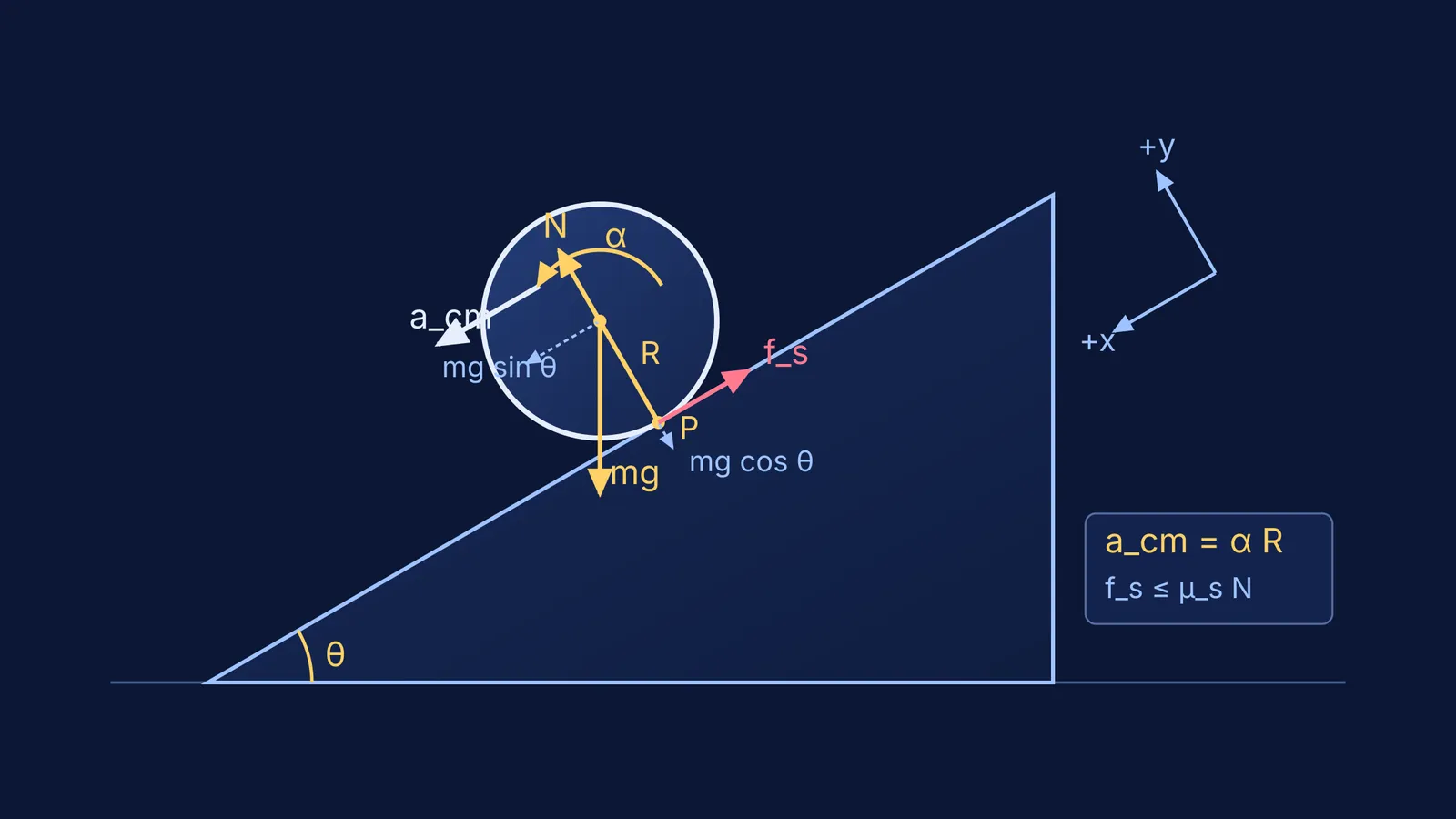
Mechanics forms the conceptual core of the INPhO paper, often accounting for more than a third of the total marks according to the HBCSE past papers archive. Unlike conventional school questions, olympiad mechanics combines multiple constraints simultaneously: non-inertial reference frames, rolling without slipping on moving curved surfaces, and variable-mass dynamics.
Research in *Science* by Larkin, McDermott, Simon, and Simon (1980) revealed that novices work backward from the unknown variable, hunting for equations that contain the target symbol. Experts, by contrast, work forward: they build a clear spatial representation, identify all active forces, choose an optimal coordinate frame, and write down the governing dynamical equations.
To master INPhO mechanics, apply a four-step forward protocol:
Define the reference frame and coordinate axes explicitly, marking positive directions for linear displacement x and rotational angle θ.
Formulate geometric constraint equations before writing equations of motion, just as you would when setting up constraint equations in mechanics.
Apply conservation laws, such as energy, linear momentum, or angular momentum about an instantaneous axis, to eliminate intermediate internal forces.
Check limiting cases: verify physical dimensions and evaluate expressions when mass ratios approach zero or infinity.
Visualising dynamic constraints can be challenging when working solely on paper. The Fermi Simulation Lab provides interactive simulations for ideas that are easier to see than to read, allowing you to test rolling constraints and moving frames dynamically.
How do examiners award marks in the answer booklet?
The examination procedure detailed in the HBCSE past papers archive divides your answer booklet into two distinct sections: the Summary Answer Sheet and the Detailed Answer Sheets. The Summary Answer Sheet, placed at the front of the booklet, requires you to enter your final symbolic or numerical expression into designated boxes and indicate the exact page numbers where your detailed working appears.
Marks are awarded primarily for method and reasoning, not just the final number. Evaluators inspect your free-body diagrams, coordinate declarations, differential equations, and algebraic steps. If you enter the correct formula in the summary box but provide no derivation in your detailed sheets, marks can be withheld under official HBCSE exam instructions. Conversely, if you execute a rigorous derivation but commit an arithmetic slip in the final step, you retain most method marks.
This evaluation style parallels the standards required when writing full mathematical proofs for olympiads. Neat presentation is logical communication: write in dark blue or black ink, reserve pencil for diagrams, state physical principles before writing equations, and strike out rough work cleanly.
What is an effective daily preparation routine?
Preparing for INPhO requires quality over volume. According to guidelines from the Indian Association of Physics Teachers, working through multi-stage problems to their conclusion builds deeper intuition than skimming multiple problem collections.
Build your routine around three deliberate habits:
Solve past INPhO and IPhO theoretical papers under timed 3-hour conditions from the HBCSE past papers archive, forcing yourself to complete both the detailed derivations and the summary boxes without looking at solutions.
Carry algebraic variables until the final step. Substituting numbers too early hides cancellations and prevents dimensional analysis.
Review official model solutions published on the HBCSE past papers portal to study how national examiners structure multi-page arguments and allocate step marks.
When you encounter complex multi-step problems where reasoning breaks down, the Fermi Problem Library offers worked problems with a step-by-step solver that explains the reasoning rather than printing an answer. In addition, Fermi's AI tutor holds a line of reasoning across a session, noticing where you get stuck and deciding whether to explain, ask, or show so you build durable problem-solving habits.


