On this page
Combinatorics is the olympiad topic that feels least like school maths. There are few formulas, and many problems look impossible until you spot one idea. The good news is that a few ideas carry a beginner a long way. Here are three, a worked example for each, and a four-week plan.
What combinatorics is on the Indian olympiad syllabus?
The HBCSE olympiad syllabus page lists combinatorics as "basic enumeration, pigeonhole principle and its applications, recursion, elementary graph theory". The same page says the major areas are algebra, combinatorics, geometry and number theory, and that you should be familiar with everything in the NCERT Mathematics books of Class VIII, IX and X. It also warns that the list is not exhaustive.
According to HBCSE's olympiad FAQ, IOQM, the first stage conducted by the Mathematics Teachers' Association (India), asks for integer answers, while RMO and INMO ask you to write detailed proofs. So from the start, practise writing why an answer is right, not just the number. For dates and eligibility, see our guide to the maths olympiad and IOQM and the official pages.
What are the first three ideas to learn?
1. Counting principles
If a task happens in stages, multiply the number of choices at each stage (the product rule). If it splits into separate cases, add them (the sum rule). When counting what you want is messy, count everything and subtract what you don't want.
Worked example: how many four-digit numbers have all different digits? The first digit cannot be 0, so it has 9 choices. The second can be any of the remaining 9 digits (0 is now allowed), the third has 8, the fourth has 7. Answer: 9 × 9 × 8 × 7 = 4536. Always handle the restricted stage first.
2. The pigeonhole principle
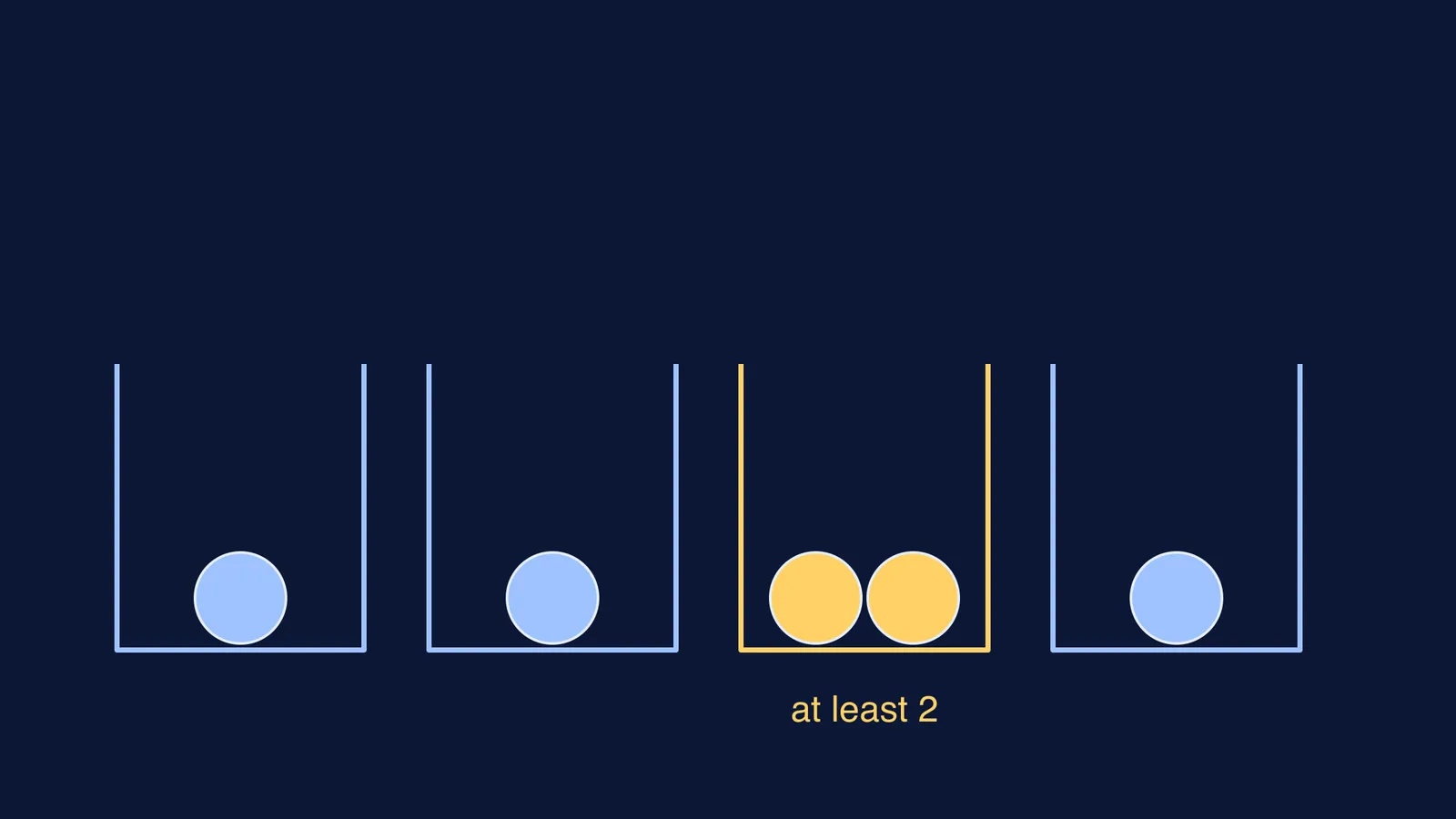
The pigeonhole principle says that if you put more objects than boxes into boxes, at least one box holds two or more objects. The skill is choosing the boxes.
Worked example: pick any 6 numbers from 1 to 10. Show that two of them add up to 11. Make five boxes from the pairs {1, 10}, {2, 9}, {3, 8}, {4, 7}, {5, 6}. Six numbers go into five boxes, so one box gets both its numbers, and each pair sums to 11. For more practice, work through our pigeonhole principle problems.
3. Invariants
An invariant is a quantity that does not change when you apply the allowed moves. If the start and the target differ in that quantity, the target is unreachable.
Worked example: the numbers 1 to 10 are written on a board. A move erases two numbers a and b and writes |a − b|. After nine moves one number is left. Can it be 0? Look at parity: a + b and |a − b| are always both even or both odd, so the parity of the total never changes. The total starts at 55, which is odd, so the last number is odd and cannot be 0. Our explainer on the invariants method for puzzles has more of these.
How should you practise combinatorics problems?
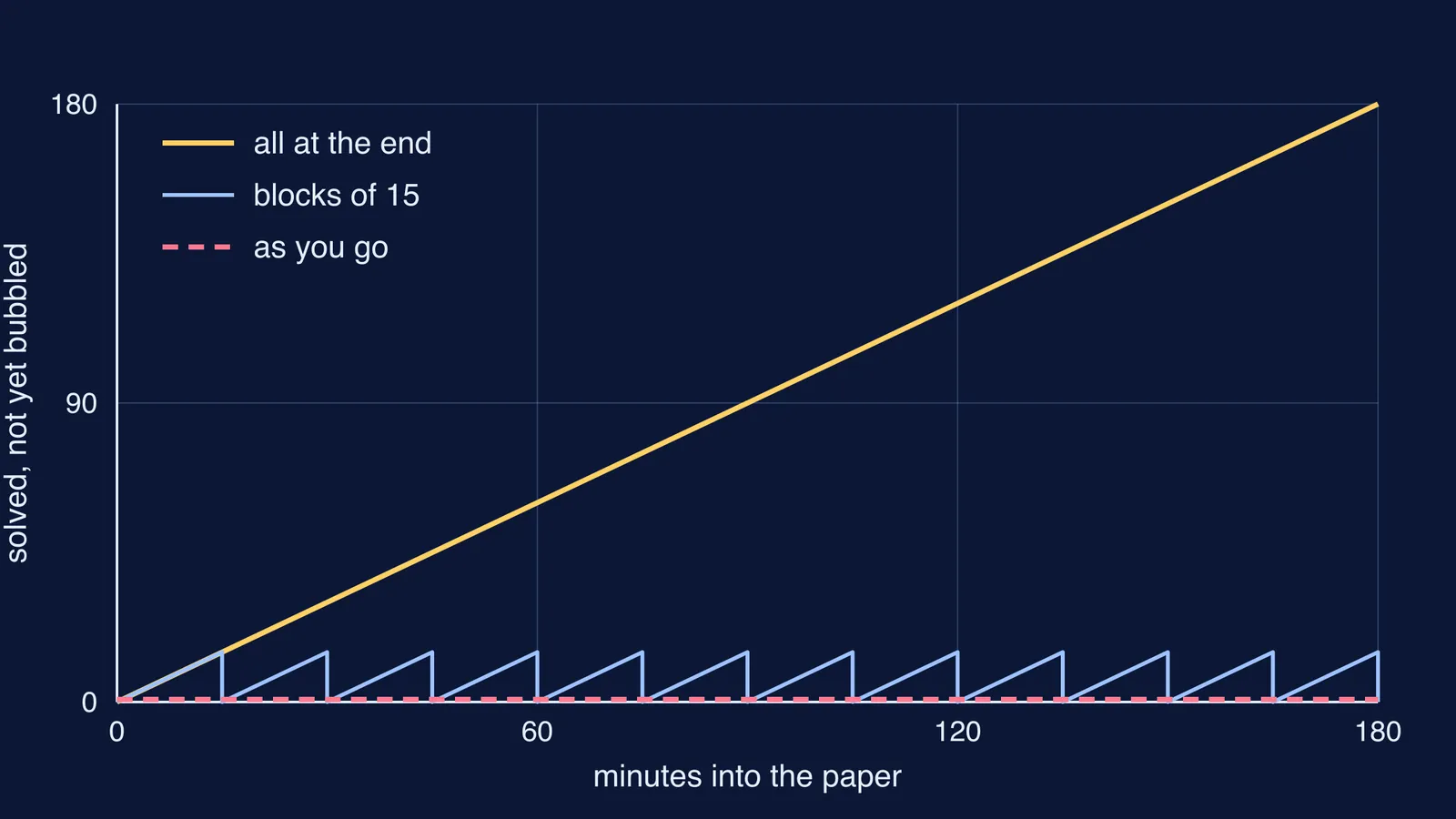
Mix your problems once you know a few methods. In a study published in the Journal of Educational Psychology, Doug Rohrer and colleagues gave 126 seventh-grade students the same maths problems over three months, either grouped by topic (blocked) or shuffled (interleaved). Interleaved practice produced higher scores on a test one day later (Cohen's d = 0.42) and a bigger advantage 30 days later (d = 0.79), according to the ERIC record. Shuffled sets make you choose the strategy from the problem itself, as an exam does.
In combinatorics the hard part is usually recognising which idea fits. If a solution confuses you, compare it step by step with your attempt; the Fermi Problem Library has worked problems with a step-by-step solver that explains the reasoning rather than printing an answer.
What does a four-week starter plan look like?
Aim for about 45 minutes, five days a week. Keep a notebook where every problem gets a full written solution.
Week 1, counting: product and sum rules, permutations and combinations, counting the complement. Then rewrite two solutions neatly, as if for RMO.
Week 2, pigeonhole: start with "some box has two" problems, then the stronger form (n boxes, more than kn objects, some box has more than k). For every problem, write down what your boxes are.
Week 3, invariants: parity, sums, and colouring arguments on grids. Before solving, write the invariant you suspect in one line.
Week 4, mixed: shuffle problems from all three weeks with no topic labels. Try each properly before any hint, and note which idea you should have spotted.
For books, HBCSE's syllabus page suggests titles including Richard Brualdi's Introductory Combinatorics, S. S. Sane's Combinatorial Techniques, and A. Engel's Problem Solving Strategies. If permutations and combinations themselves feel shaky, revise them first in the Fermi Concept Library, which has a lesson on every concept in mathematics.
Next, move on to recursion and simple graph problems, keeping one mixed set every week.