On this page
Early wireless had a problem you would notice at once: a receiver could pick up any spark transmitter nearby. Oliver Lodge, a physicist working in Liverpool, tackled it with an idea that mirrors one from sound. Strike one tuning fork and a second fork of the same pitch starts to hum; a fork of a different pitch stays silent. Lodge built the electrical version and called it syntony.
What did Oliver Lodge invent in 1897?
Lodge filed British patent GB189711575, "Improvements in Syntonised Telegraphy without Line Wires", on 10 May 1897, and it was published on 10 August 1898, according to the patent record on Google Patents. The patent describes transmitting apparatus with adjustable inductance and capacity, using Leyden jars and spark gaps.
The idea was older than the patent. The Science Museum holds two Leyden jars that were possibly the ones Lodge used in March 1889 at the Royal Institution to show resonance between neighbouring circuits at the same frequency, and it calls his 1897 patent "the fundamental patent for tuning" (Science Museum Group collection). When one jar discharged, sparks jumped a small gap on the second jar only while the two circuits matched; moving the slider on the second jar stopped the effect.
In 1894 Lodge also improved the coherer, a radio-wave detector, and the Marconi Company acquired his syntonic patent in 1912 (IEEE Engineering and Technology History Wiki). For the rest of that story, read how Guglielmo Marconi built practical radio.
How does syntonic tuning work?
A coil (inductance L) joined to a capacitor (capacitance C) is an oscillator. Charge sloshes back and forth between them at one natural frequency, f = 1/(2π√LC), because at resonance the inductive and capacitive reactances cancel and the circuit looks like its resistance alone (HyperPhysics, series RLC resonance). Our explainer on LC oscillations walks through the energy swapping between coil and capacitor.
Lodge's US patent 609,154 states the principle plainly: a station responds when it has a circuit "capable of electric oscillations of that same particular frequency", and it explains that the frequency can be adjusted by changing the capacity of the condenser or jar, or the coils in the discharge circuit (US609154, Google Patents). The same patent says messages can reach individual stations "without disturbing the receiving appliances at other stations which are tuned" to a different frequency. Its first claim adds a self-inductance coil "for the purpose of prolonging any electrical oscillations", so that the system has a "definite frequency or pitch".
Worked example: tune a receiver to a station
Say your receiver coil has L = 250 μH and you want to pick up a station at 1000 kHz.
Rearrange f = 1/(2π√LC) to get C = 1/(4π²f²L).
Put in numbers: 4π² × (10⁶)² × (250 × 10⁻⁶) ≈ 9.87 × 10⁹.
So C ≈ 1.01 × 10⁻¹⁰ F, about 101 pF.
Now retune to 1200 kHz. Since C is proportional to 1/f², the new C = 101 pF ÷ 1.2² ≈ 70 pF.
Check: with 70.4 pF and 250 μH, 1/(2π√LC) comes out at about 1.20 MHz. This is exactly what the variable capacitor in an old radio does when you turn the knob.
Why does a sharper resonance pick one station?
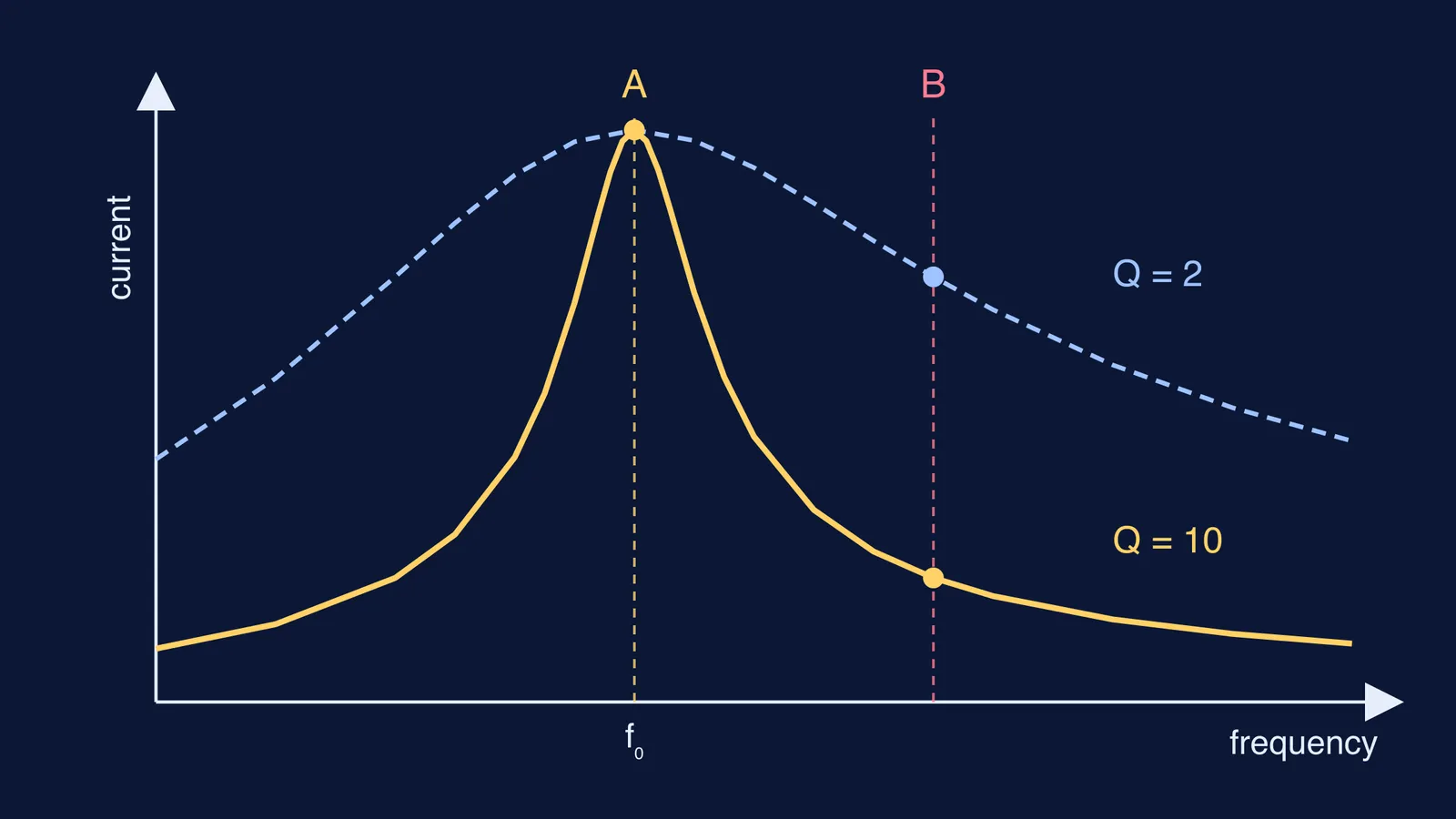
The quality factor Q = ω₀L/R measures how sharp the peak is: the smaller the resistance, the higher the Q for given L and C (HyperPhysics). For a series circuit, the current at frequency f compared with the peak is 1/√(1 + Q²(x − 1/x)²), where x = f/f₀.
Try it with a receiver tuned to station A and a second station B at 1.25 times that frequency. With Q = 10, B drives only about 22% of the peak current. With Q = 2, B still drives about 74%, so the two stations blur together. That is why Lodge wanted oscillations that lasted. More practice: LCR resonance and radio tuning.
If the curve still feels abstract, the Fermi Simulation Lab has interactive simulations for ideas that are easier to see than to read.
How do you answer a tuning question in four steps?
Write f = 1/(2π√LC) first, and decide whether the question wants f or ω = 2πf.
Convert units before substituting: μH is 10⁻⁶ H, pF is 10⁻¹² F, kHz is 10³ Hz.
Use ratios for "retune" questions: f is proportional to 1/√C, so quadrupling C halves f.
For "which station is rejected more" questions, compare Q, not just f₀.
If you get the right formula but the wrong answer, the Fermi Problem Library has worked problems with a step-by-step solver that explains the reasoning rather than printing an answer, so you can see which step went wrong.