On this page
In 1769, a French army officer named Nicolas-Joseph Cugnot built a cart that moved without a horse. It was slow, had to stop often to refuel, and was hard to steer. Wikipedia's biography of Nicolas-Joseph Cugnot describes his fardier à vapeur as the world's first full-size and working self-propelled mechanical land vehicle.
Who was Nicolas-Joseph Cugnot and what did he build?
Cugnot was a French army officer and engineer, born on 26 February 1725, according to the Linda Hall Library's profile of Cugnot. The army asked him for a steam-powered vehicle for hauling cannon. He built a scaled-down working model in 1769 and a full-size machine in 1770.
A *fardier* was a heavy horse-drawn army cart; Cugnot replaced the horse with a third wheel. According to EBSCO's history of Cugnot's road carriage, his first working prototype was shown to General Gribeauval and other senior officers in Paris on 23 October 1769.
The full-size fardier was meant to carry 4 tons, and it weighed about 2.5 tonnes empty, according to Grace's Guide. It was supposed to cover 2 lieues (7.8 km) in an hour, but it never managed that in practice.
How fast was Cugnot's steam carriage, really?
The Wikipedia article on the fardier à vapeur cites one account that puts its speed at about 3.6 km/h, and the Linda Hall Library says it could reputedly manage "a little over 2 miles per hour". ETHW's history of the fardier says a prototype could carry its load at least as fast as marching troops. The Linda Hall Library adds that it had to come to a complete stop to take on wood about every 15 minutes.
Here is a worked example that uses only those numbers:
Distance between stops: 3.6 km/h × 0.25 h = 0.9 km, less than a kilometre per load of wood.
Target versus reality: 7.8 km ÷ 3.6 km/h ≈ 2.2 h of moving, more than twice the planned hour.
Stops on that trip: 2.2 h ÷ 0.25 h ≈ 8.7, so about 8 stops to refuel and raise steam.
Why was Cugnot's steam carriage so hard to steer?
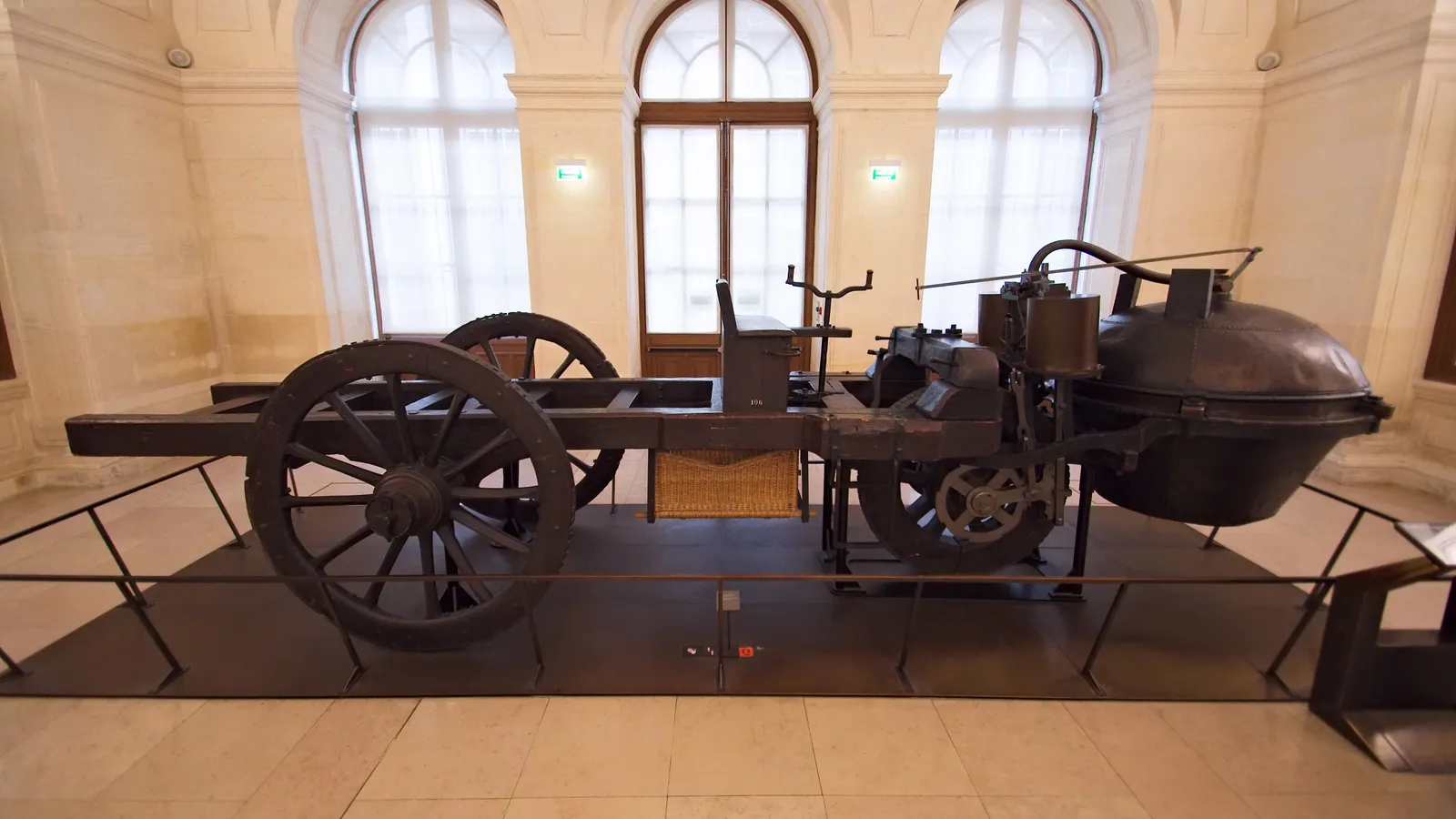
Wikipedia's biography of Cugnot explains the layout: the front wheel carried the steam boiler and the driving mechanism, and the driver steered from there with a double handle. Grace's Guide calls the front wheel the single driving wheel. So one wheel had three jobs: carrying the heaviest part of the machine, pushing it forward and steering it. The Linda Hall Library notes that the cart was difficult to manoeuvre, "which you can understand when you look at the placement of the boiler."
In the photo at the top, the boiler hangs out ahead of the front wheel. The physics:
Turning inertia. Steering means swinging the boiler around the pivot. Moment of inertia is I = Σmr², so a heavy mass far from the pivot is hard to start turning, and hard to stop.
Friction at the tyre. A wheel carrying lots of weight presses hard on the road, so there is more friction to overcome when you twist it.
A tipping triangle. A three-wheeler stands on a triangle of contact points, narrowest at the single front wheel. With the weight high and far forward, a turn can push the centre of mass outside that triangle. The Wikipedia fardier article reports that poor weight distribution was a serious disadvantage, and Grace's Guide says the machine was reported to be very unstable.
That third point is the same physics behind why three-wheelers topple on sharp turns, which you can watch on any busy Indian road.
Did Cugnot's carriage cause the first car crash?
Possibly. According to Grace's Guide, the second vehicle is said to have gone out of control in 1771 and knocked down part of the Arsenal wall. The engineering history site ETHW notes that there is some question as to whether this really happened. Either way, the machine survived. Grace's Guide says it moved to the Conservatoire National des Arts et Métiers in 1800, and it is still on show in Paris.
How can you use Cugnot's carriage to study physics?
Try this four-question check on the fardier, then on a bicycle, an auto-rickshaw or a loaded scooter:
Power: What pushes it forward, and from where? (Steam cylinders, through the front wheel.)
Endurance: How far can it go on one load of fuel? (Speed × time, as above.)
Control: Where is the heaviest mass compared with the steering pivot? (Far in front of it.)
Stability: Draw the support polygon from above and mark the centre of mass. How close is it to an edge?
If moment of inertia or centre of mass still feels abstract, the Fermi Concept Library has a lesson on each concept, and the Fermi Simulation Lab has interactive simulations for ideas that are easier to see than to read.
For the engines that came before and after Cugnot's cart, read about Thomas Newcomen's 1712 atmospheric engine and Karl Benz's 1886 Motorwagen.